Falk C T, Schwartz R C, Ramirez F, Tsipouras P
Am J Hum Genet. 1986 Mar;38(3):269-79.
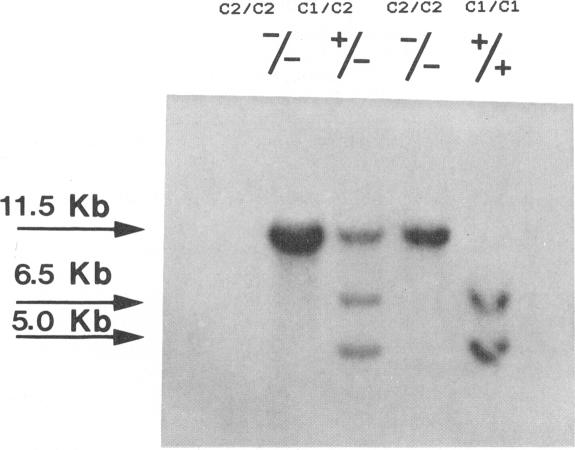
Autosomal dominant osteogenesis imperfecta (OI) is a heterogeneous group of disorders. Molecular haplotypes associated with the pro alpha 2(I) gene of human type I procollagen were used for genetic linkage studies in a group of 10 families with OI. The clinical phenotypes of the families studied were those of OI type I and OI type IV. Evidence for linkage was highly suggestive in the four families with OI type IV (Z = 3.91 for theta = 0). In contrast, little or no indication for linkage was found in the six families with OI type I (Z = .055 for theta = .415). Heterogeneity between the two groups of families was highly significant (chi 2 = 11.14, P = .0008), suggesting that at least two separate gene defects may be the cause of the autosomal dominant forms of OI.
常染色体显性遗传性成骨不全(OI)是一组异质性疾病。在一组10个患有OI的家庭中,将与人类I型前胶原的原α2(I)基因相关的分子单倍型用于遗传连锁研究。所研究家庭的临床表型为I型OI和IV型OI。在四个患有IV型OI的家庭中,连锁证据极具提示性(θ = 0时,Z = 3.91)。相比之下,在六个患有I型OI的家庭中,几乎没有或没有发现连锁迹象(θ = 0.415时,Z = 0.055)。两组家庭之间的异质性非常显著(χ2 = 11.14,P = 0.0008),这表明至少两个独立的基因缺陷可能是常染色体显性形式OI的病因。