Department of Epidemiology, Rollins School of Public Health, Emory University, Atlanta, Georgia, USA.
Department of Clinical Epidemiology, Aarhus University Hospital, Aarhus, Denmark.
BMJ Open. 2018 Aug 1;8(7):e021805. doi: 10.1136/bmjopen-2018-021805.
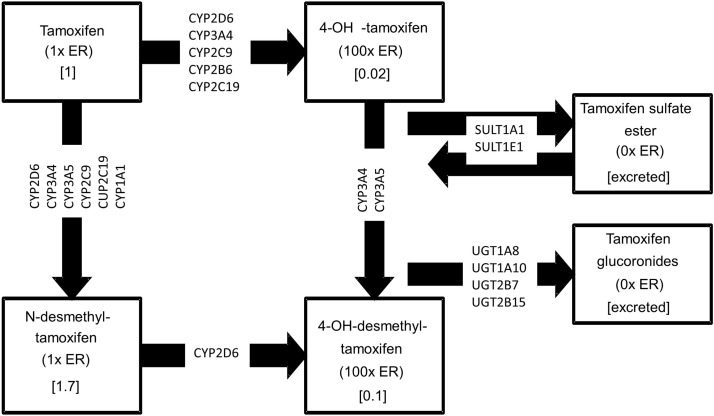
The Predictors of Breast Cancer Recurrence (ProBe CaRe) study was established to evaluate modification of tamoxifen (TAM) effectiveness in premenopausal women through reduced activity of TAM-metabolising enzymes. It comprehensively evaluates the effects of pharmacogenetic variants, use of concomitant medications and biomarkers involved in oestrogen metabolism on breast cancer recurrence risk.
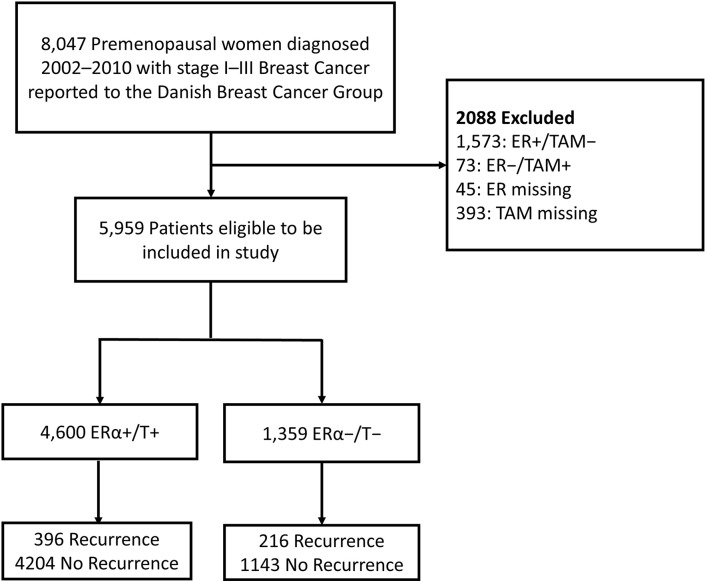
The ProBe CaRe study was established using resources from the Danish Breast Cancer Group (DBCG), including 5959 premenopausal women diagnosed with stage I-III primary breast cancer between 2002 and 2010 in Denmark. Eligible participants were divided into two groups based on oestrogen receptor alpha (ERα) expression and receipt of TAM therapy, 4600 are classified as ERα+/TAM+ and 1359 are classified as ERα-/TAM-. The ProBe CaRe study is a population-based cohort study nested in a nearly complete source population, clinical, tumour and demographic data were abstracted from DBCG registry data. Linkage to Danish registries allows for abstraction of information regarding comorbid conditions, comedication use and mortality. Formalin-fixed paraffin-embedded tissue samples have been prepared for DNA extraction and immunohistochemical assay.
To mitigate incorrect classification of patients into specific categories, we conducted a validation substudy. We compared data acquired from registry and from medical record review to calculate positive predictive values (PPVs) and negative predictive values. We observed PPVs near 100% for tumour size, lymph node involvement, receptor status, surgery type, receipt of radiotherapy, receipt of chemotherapy and TAM treatment. We found that the PPVs were 96% (95% CI 83% to 100%) for change in endocrine therapy and 61% (95% CI 42% to 77%) for menopausal transition.
The ProBeCaRe cohort study is well positioned to comprehensively examine pharmacogenetic variants. We will use a Bayesian pathway analysis to evaluate the complete TAM metabolic path to allow for gene-gene interactions, incorporating information of other important patient characteristics.
开展乳腺癌复发预测(ProBe CaRe)研究,旨在通过降低 TAM 代谢酶的活性来评估绝经前妇女使用他莫昔芬(TAM)的疗效。该研究全面评估了药物代谢相关基因多态性、伴随药物使用情况以及与雌激素代谢相关的生物标志物对乳腺癌复发风险的影响。
ProBe CaRe 研究利用丹麦乳腺癌协作组(DBCG)的资源建立,共纳入 5959 例 2002 年至 2010 年在丹麦诊断为 I-III 期原发性乳腺癌的绝经前女性。根据雌激素受体α(ERα)表达和 TAM 治疗情况将合格参与者分为两组,4600 例被归类为 ERα+/TAM+,1359 例被归类为 ERα-/TAM-。ProBe CaRe 研究是一项基于人群的队列研究,嵌套在一个近乎完整的人群中,从 DBCG 登记处数据中提取临床、肿瘤和人口统计学数据。与丹麦登记处的链接允许提取合并症、伴随用药和死亡率信息。福尔马林固定石蜡包埋组织样本已准备好提取 DNA 并进行免疫组织化学检测。
为了减轻患者分类错误的问题,我们进行了一项验证性子研究。我们比较了从登记处和病历回顾中获得的数据,以计算阳性预测值(PPV)和阴性预测值。我们发现,肿瘤大小、淋巴结受累、受体状态、手术类型、放疗、化疗和 TAM 治疗的 PPV 接近 100%。我们发现,内分泌治疗改变的 PPV 为 96%(95%CI83%100%),绝经过渡期的 PPV 为 61%(95%CI42%77%)。
ProBeCaRe 队列研究非常适合全面检查药物代谢相关基因多态性。我们将使用贝叶斯途径分析来评估完整的 TAM 代谢途径,以允许基因-基因相互作用,并纳入其他重要患者特征的信息。