
美国与自我报告中风相关的睡眠时间和身体活动状况:贝叶斯信念网络建模技术的应用。
Sleep Duration and Physical Activity Profiles Associated With Self-Reported Stroke in the United States: Application of Bayesian Belief Network Modeling Techniques.
作者信息
Seixas Azizi A, Henclewood Dwayne A, Williams Stephen K, Jagannathan Ram, Ramos Alberto, Zizi Ferdinand, Jean-Louis Girardin
机构信息
Department of Population Health, Department of Psychiatry, NYU Langone Health, New York, NY, United States.
Booz Allen Hamilton, Boston, MA, United States.
出版信息
Front Neurol. 2018 Jul 19;9:534. doi: 10.3389/fneur.2018.00534. eCollection 2018.
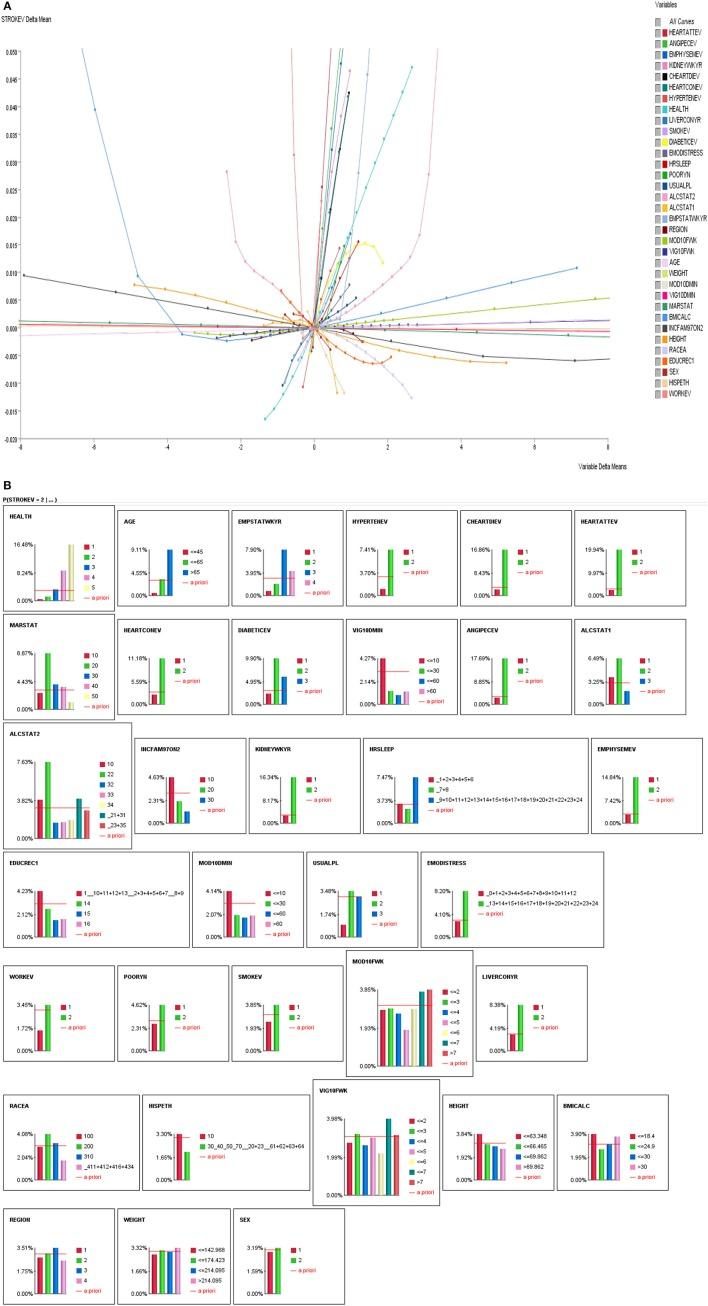
Physical activity (PA) and sleep are associated with cerebrovascular disease and events like stroke. Though the interrelationships between PA, sleep, and other stroke risk factors have been studied, we are unclear about the associations of different types, frequency and duration of PA, sleep behavioral patterns (short, average and long sleep durations), within the context of stroke-related clinical, behavioral, and socio-demographic risk factors. The current study utilized Bayesian Belief Network analysis (BBN), a type of machine learning analysis, to develop profiles of physical activity (duration, intensity, and frequency) and sleep duration associated with or no history of stroke, given the influence of multiple stroke predictors and correlates. Such a model allowed us to develop a predictive classification model of stroke which can be used in post-stroke risk stratification and developing targeted stroke rehabilitation care based on an individual's profile. Analysis was based on the 2004-2013 National Health Interview Survey ( = 288,888). Bayesian BBN was used to model the omnidirectional relationships of sleep duration and physical activity to history of stroke. Demographic, behavioral, health/medical, and psychosocial factors were considered as well as sleep duration [defined as short < 7 h. and long ≥ 9 h, referenced to healthy sleep (7-8 h)], and intensity (moderate and vigorous) and frequency (times/week) of physical activity. Of the sample, 48.1% were ≤ 45 years; 55.7% female; 77.4% were White; 15.9%, Black/African American; and 45.3% reported an annual income < $35 K. Overall, the model had a precision index of 95.84%. We found that adults who reported 31-60 min of vigorous physical activity six times for the week and average sleep duration (7-8 h) had the lowest stroke prevalence. Of the 36 sleep (short, average, and long sleep) and physical activity profiles we tested, 30 profiles had a self-reported stroke prevalence lower than the US national average of approximately 3.07%. Women, compared to men with the same sleep and physical activity profile, appeared to have higher self-reported stroke prevalence. We also report age differences across three groups 18-45, 46-65, and 66+. Our findings indicate that several profiles of sleep duration and physical activity are associated with low prevalence of self-reported stroke and that there may be sex differences. Overall, our findings indicate that more than 10 min of moderate or vigorous physical activity, about 5-6 times per week and 7-8 h of sleep is associated with lower self-reported stroke prevalence. Results from the current study could lead to more tailored and personalized behavioral secondary stroke prevention strategies.
身体活动(PA)和睡眠与脑血管疾病及中风等事件相关。尽管已经对PA、睡眠和其他中风风险因素之间的相互关系进行了研究,但在与中风相关的临床、行为和社会人口统计学风险因素的背景下,我们尚不清楚不同类型、频率和持续时间的PA、睡眠行为模式(短、平均和长睡眠时间)之间的关联。本研究利用贝叶斯信念网络分析(BBN)这一机器学习分析类型,在多种中风预测因素和相关因素的影响下,建立与有或无中风病史相关的身体活动(持续时间、强度和频率)和睡眠时间的概况。这样一个模型使我们能够开发一种中风预测分类模型,可用于中风后风险分层,并根据个体概况制定有针对性的中风康复护理方案。分析基于2004 - 2013年国家健康访谈调查(n = 288,888)。贝叶斯BBN用于模拟睡眠时间和身体活动与中风病史之间的全方位关系。考虑了人口统计学、行为、健康/医学和心理社会因素,以及睡眠时间[定义为短睡眠<7小时,长睡眠≥9小时,以健康睡眠(7 - 8小时)为参照],以及身体活动的强度(中等和剧烈)和频率(每周次数)。在样本中,48.1%的人年龄≤45岁;55.7%为女性;77.4%为白人;15.9%为黑人/非裔美国人;45.3%的人报告年收入<$35K。总体而言,该模型的精确指数为95.84%。我们发现,每周进行6次、每次31 - 60分钟剧烈身体活动且睡眠时间平均(7 - 8小时)的成年人中风患病率最低。在我们测试的36种睡眠(短、平均和长睡眠)和身体活动概况中,30种概况的自我报告中风患病率低于美国约3.07%的全国平均水平。与具有相同睡眠和身体活动概况的男性相比,女性的自我报告中风患病率似乎更高。我们还报告了18 - 45岁、46 - 65岁和66岁以上三组之间的年龄差异。我们的研究结果表明,几种睡眠时间和身体活动概况与自我报告中风的低患病率相关,且可能存在性别差异。总体而言,我们的研究结果表明,每周进行约5 - 6次、每次超过10分钟的中等或剧烈身体活动以及7 - 8小时的睡眠与较低的自我报告中风患病率相关。本研究结果可能会带来更具针对性和个性化的中风二级行为预防策略。



 Zotero 插件