SISSA, International School for Advanced Studies, via Bonomea 265, I-34136, Trieste, Italy.
Dipartimento di Fisica e Astronomia "Galileo Galilei", sezione INFN, Università degli Studi di Padova, via Marzolo 8, I-35131, Padova, Italy.
Nat Commun. 2018 Aug 3;9(1):3051. doi: 10.1038/s41467-018-05413-z.
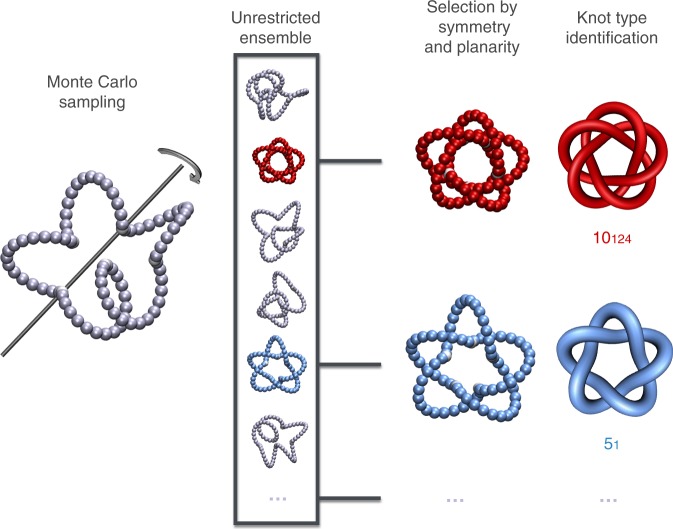
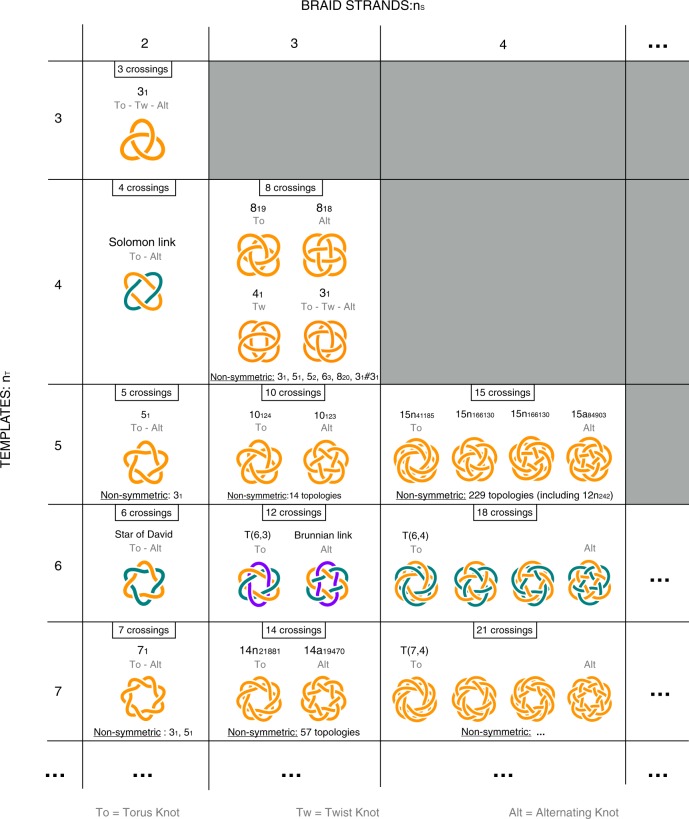
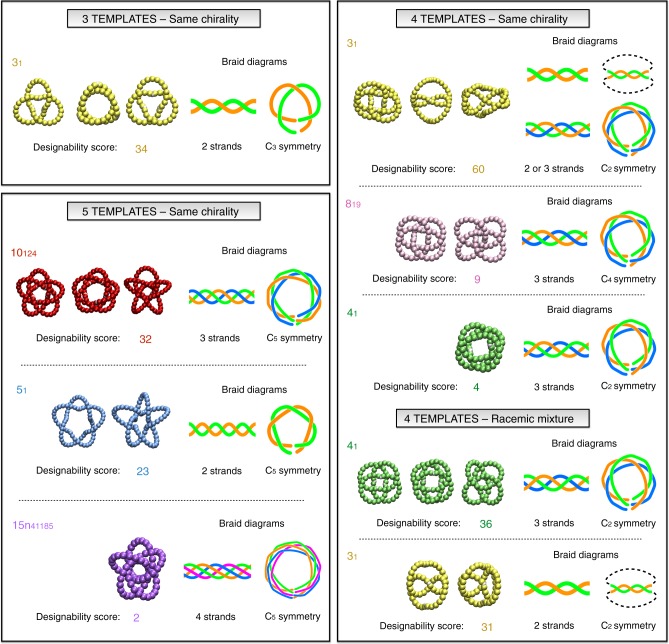
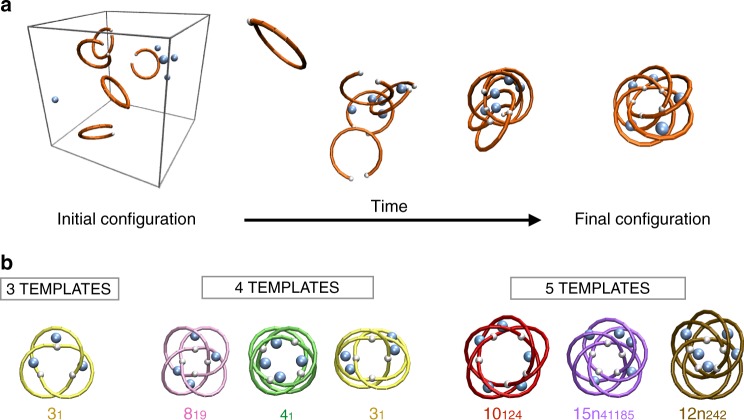
Despite the several available strategies to build complex supramolecular constructs, only a handful of different molecular knots have been synthesised so far. Here, in response to the quest for further designable topologies, we use Monte Carlo sampling and molecular dynamics simulations, informed by general principles of supramolecular assembly, as a discovery tool for thermodynamically and kinetically accessible knot types made of helical templates. By combining this approach with the exhaustive enumeration of molecular braiding patterns applicable to more general template geometries, we find that only few selected shapes have the closed, symmetric and quasi-planar character typical of synthetic knots. The corresponding collection of admissible topologies is extremely restricted. It covers all known molecular knots but it especially includes a limited set of novel complex ones that have not yet been obtained experimentally, such as 10 and 15n, making them privileged targets for future self-assembling experiments.
尽管有几种可用的策略来构建复杂的超分子结构,但到目前为止,只合成了少数几种不同的分子结。在这里,为了满足对进一步可设计拓扑结构的需求,我们使用蒙特卡罗采样和分子动力学模拟,根据超分子组装的一般原理,作为由螺旋模板构成的热力学和动力学上可接近的结型的发现工具。通过将这种方法与适用于更一般模板几何形状的分子编织模式的穷举枚举相结合,我们发现只有少数选定的形状具有合成结的封闭、对称和准平面特征。相应的可接受拓扑结构集合受到极大限制。它涵盖了所有已知的分子结,但它特别包括一组有限的新的复杂结,这些结尚未通过实验获得,例如 10 和 15n,这使得它们成为未来自组装实验的优先目标。