Laboratory for Translational Immunology, University Medical Centre Utrecht, Utrecht, The Netherlands.
Department of Paediatric Immunology and Rheumatology, University Medical Centre Utrecht, Utrecht, The Netherlands.
Ann Rheum Dis. 2018 Nov;77(11):1599-1605. doi: 10.1136/annrheumdis-2018-213725. Epub 2018 Aug 4.
Autoinflammatory diseases can cause irreversible tissue damage due to systemic inflammation. Recently, the Autoinflammatory Disease Damage Index (ADDI) was developed. The ADDI is the first instrument to quantify damage in familial Mediterranean fever, cryopyrin-associated periodic syndromes, mevalonate kinase deficiency and tumour necrosis factor receptor-associated periodic syndrome. The aim of this study was to validate this tool for its intended use in a clinical/research setting.
The ADDI was scored on paper clinical cases by at least three physicians per case, independently of each other. Face and content validity were assessed by requesting comments on the ADDI. Reliability was tested by calculating the intraclass correlation coefficient (ICC) using an 'observer-nested-within-subject' design. Construct validity was determined by correlating the ADDI score to the Physician Global Assessment (PGA) of damage and disease activity. Redundancy of individual items was determined with Cronbach's alpha.
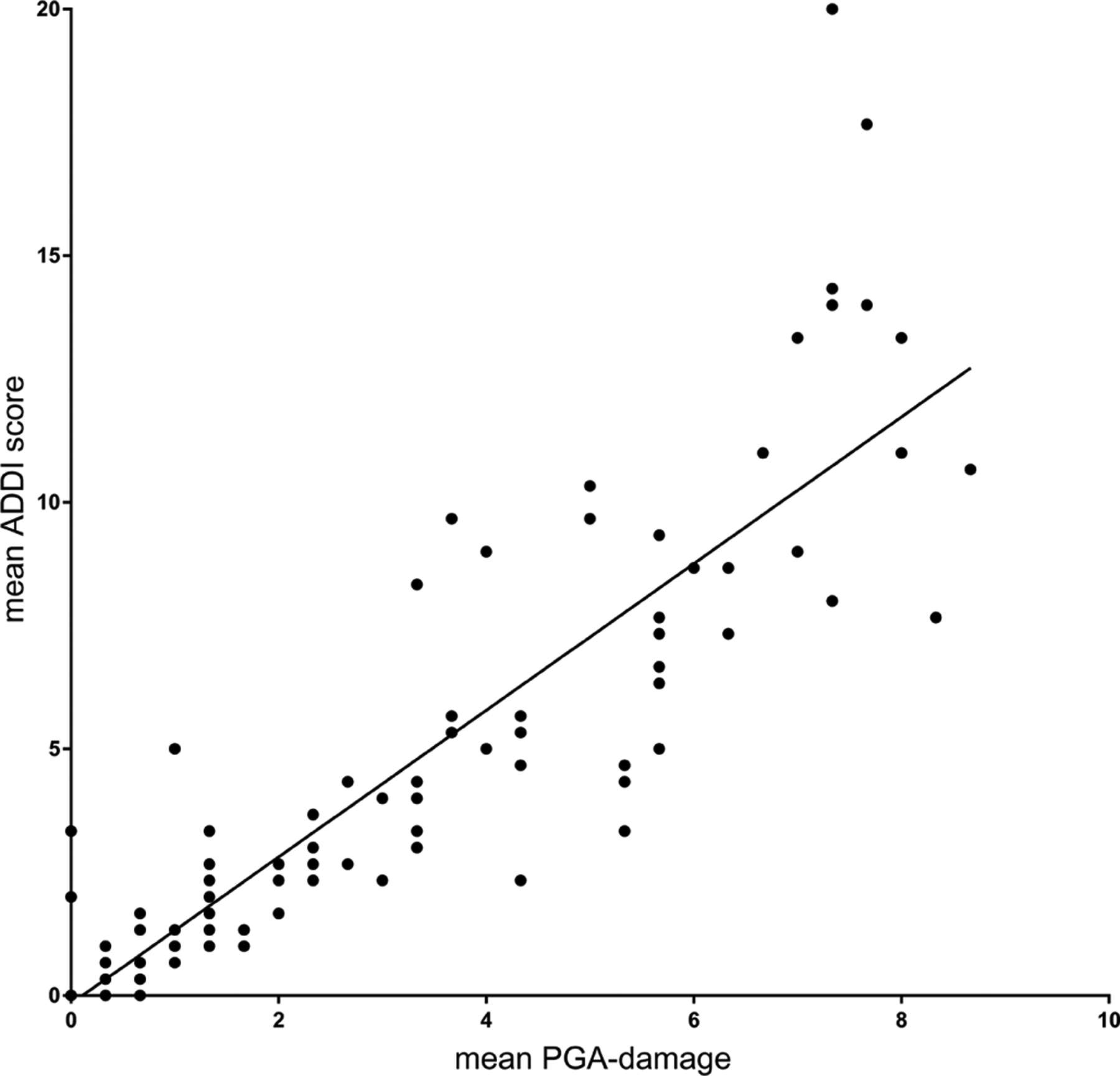
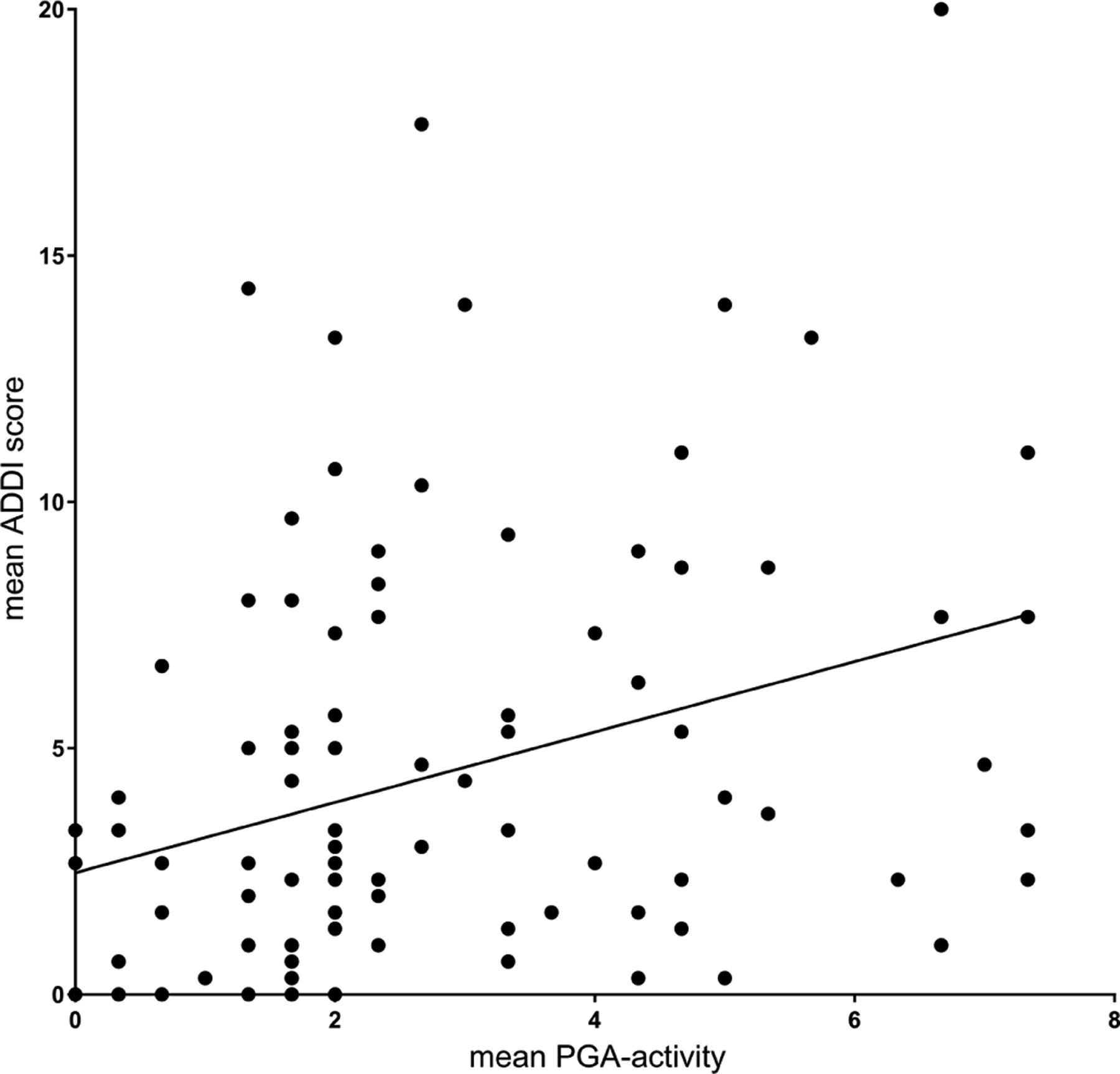
The ADDI was validated on a total of 110 paper clinical cases by 37 experts in autoinflammatory diseases. This yielded an ICC of 0.84 (95% CI 0.78 to 0.89). The ADDI score correlated strongly with PGA-damage (r=0.92, 95% CI 0.88 to 0.95) and was not strongly influenced by disease activity (r=0.395, 95% CI 0.21 to 0.55). After comments from disease experts, some item definitions were refined. The interitem correlation in all different categories was lower than 0.7, indicating that there was no redundancy between individual damage items.
The ADDI is a reliable and valid instrument to quantify damage in individual patients and can be used to compare disease outcomes in clinical studies.
自身炎症性疾病可因全身炎症而导致不可逆转的组织损伤。最近,开发了自身炎症性疾病损伤指数(ADDI)。ADDI 是第一个用于量化家族性地中海热、冷吡啉相关周期性综合征、甲羟戊酸激酶缺乏症和肿瘤坏死因子受体相关周期性综合征中损伤的工具。本研究旨在验证该工具在临床/研究环境中的预期用途。
至少三位医生独立地在纸质临床病例上对 ADDI 进行评分。通过要求对 ADDI 发表评论来评估表面效度和内容效度。使用“观察者嵌套在受试者内”设计计算组内相关系数(ICC)来测试可靠性。通过将 ADDI 评分与医生整体损伤和疾病活动评估(PGA)进行相关性来确定结构效度。使用 Cronbach's alpha 确定各个项目的冗余度。
共有 37 名自身炎症性疾病专家对 110 份纸质临床病例进行了 ADDI 验证,得出 ICC 为 0.84(95%CI 0.78 至 0.89)。ADDI 评分与 PGA 损伤强烈相关(r=0.92,95%CI 0.88 至 0.95),且不受疾病活动的强烈影响(r=0.395,95%CI 0.21 至 0.55)。在收到疾病专家的意见后,对一些项目定义进行了修订。在所有不同类别中,项目间的相关性均低于 0.7,表明单个损伤项目之间没有冗余。
ADDI 是一种可靠且有效的工具,可用于量化个体患者的损伤,可用于比较临床研究中的疾病结局。