Pediatric Unit, Department of Women's and Children's Health, Karolinska Institutet and Karolinska University Hospital, SE-171 76, Stockholm, Sweden.
Present address: Faculty of Medicine, University of Iceland, Reykjavik, Iceland.
J Neuroinflammation. 2018 Aug 8;15(1):223. doi: 10.1186/s12974-018-1253-y.
Cerebral ischemia generates neuroinflammation that can induce neural cell death. This cohort study assessed whether Fas-ligand (FasL) and interleukin (IL)-6 levels in the cerebrospinal fluid (CSF) after hypoxic-ischemic encephalopathy (HIE) can serve as biomarkers of hypoxic brain injury in neonates.
Term infants (> 37-week gestational age) who were admitted to the neonatal intensive care unit of Karolinska University Hospital in years 2002 to 2004 with perinatal asphyxia were enrolled prospectively. Control infants without brain pathology underwent lumbar puncture for suspected infection. FasL and IL-6 levels were measured in the CSF, by enzyme-linked immunosorbent assays. All patients underwent neurological assessment at 18 months. HIE was classified as mild, moderate, or severe (HIE I-III). Adverse neurological outcome at 18 months was defined as a mental developmental index < 85, deafness, blindness, cerebral palsy, or seizure disorder.
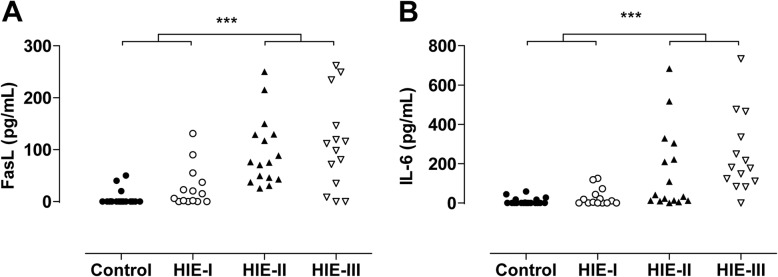
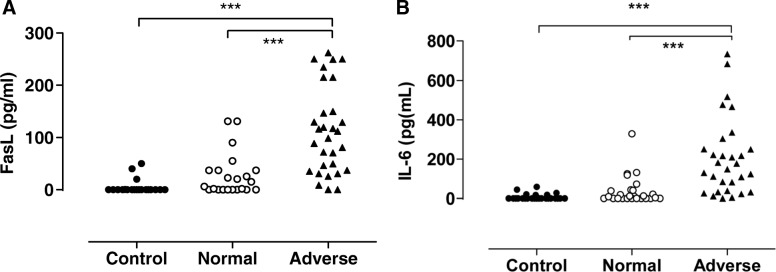
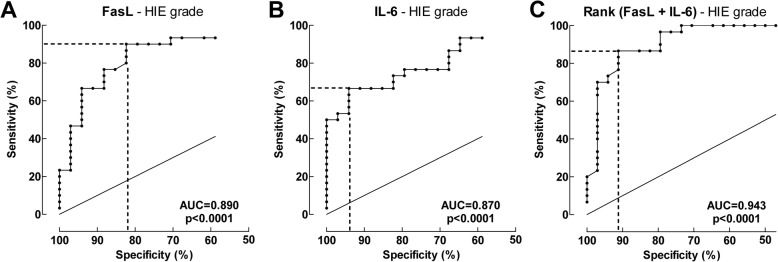
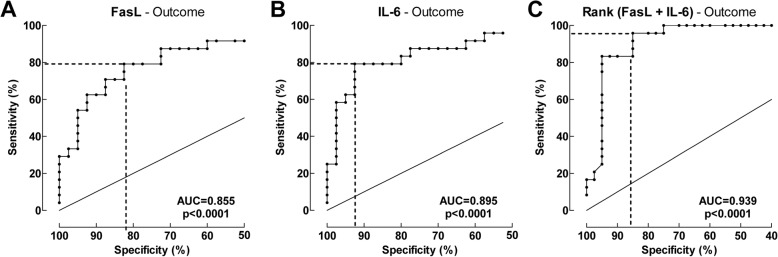
Of the 44 HIE patients, 14, 16, and 14 had HIE-I, HIE-II, and HIE-III, respectively. HIE-II and HIE-III patients had higher FasL and IL-6 levels than HIE-I patients and the 20 controls (all p < 0.0001). Patients with adverse outcomes had higher FasL and IL-6 levels than patients with normal outcomes and controls (both p < 0.0001). On receiver-operator curve analyses, FasL and IL-6 (alone and together) were highly predictive of HIE grade and outcome (areas under the curve range 0.86-0.94) and showed high sensitivity (66.7-100%). These biomarkers performed better than cord blood pH (areas under the curve: HIE grade = 0.80, adverse outcomes = 0.86).
CSF biomarkers FasL and IL-6 predicted severity of encephalopathy and long-term outcomes in post-asphyxiated infants better than a standard biomarker.
脑缺血会引发神经炎症,从而导致神经细胞死亡。本队列研究评估了缺氧缺血性脑病(HIE)后脑脊液(CSF)中 Fas 配体(FasL)和白细胞介素(IL)-6 水平是否可作为新生儿缺氧性脑损伤的生物标志物。
2002 年至 2004 年,在 Karolinska 大学医院新生儿重症监护病房收治的胎龄大于 37 周的围产期窒息的足月婴儿,前瞻性纳入本研究。无脑病理的对照组婴儿因疑似感染行腰椎穿刺。通过酶联免疫吸附试验(ELISA)检测 CSF 中的 FasL 和 IL-6 水平。所有患者在 18 个月时进行神经评估。HIE 分为轻度、中度和重度(HIE I-III)。18 个月时的不良神经结局定义为精神发育指数<85、耳聋、失明、脑瘫或癫痫。
44 例 HIE 患儿中,HIE-I、HIE-II 和 HIE-III 分别为 14、16 和 14 例。HIE-II 和 HIE-III 患儿的 FasL 和 IL-6 水平高于 HIE-I 患儿和 20 例对照组(均 p<0.0001)。不良结局患儿的 FasL 和 IL-6 水平高于正常结局患儿和对照组(均 p<0.0001)。在受试者工作特征曲线分析中,FasL 和 IL-6(单独或联合)对 HIE 分级和结局有高度预测性(曲线下面积范围 0.86-0.94),且具有较高的敏感性(66.7-100%)。这些生物标志物的性能优于脐血 pH(曲线下面积:HIE 分级=0.80,不良结局=0.86)。
CSF 生物标志物 FasL 和 IL-6 比标准生物标志物更能预测窒息后婴儿脑病的严重程度和长期结局。