College of Science and Engineering, James Cook University, Townsville, QLD, 4811, Australia.
Australian Research Council Centre of Excellence for Coral Reef Studies, James Cook University, Townsville, QLD, 4811, Australia.
Sci Rep. 2018 Aug 8;8(1):11885. doi: 10.1038/s41598-018-29608-y.
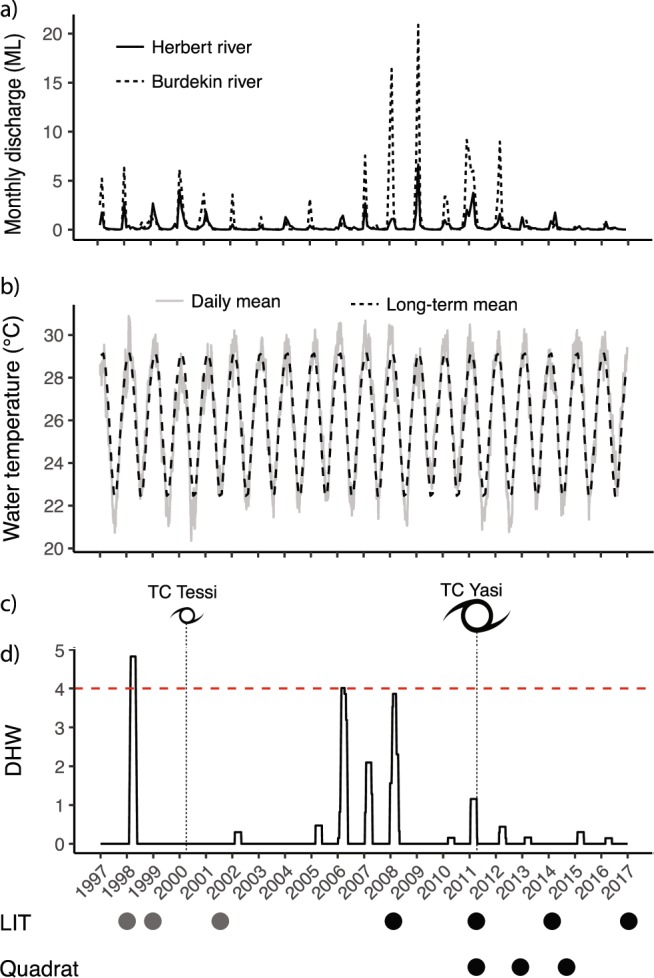
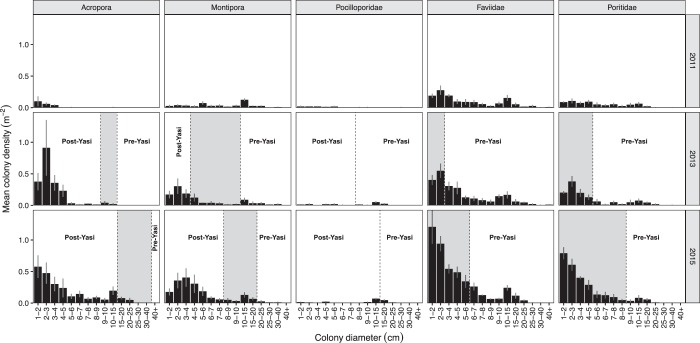
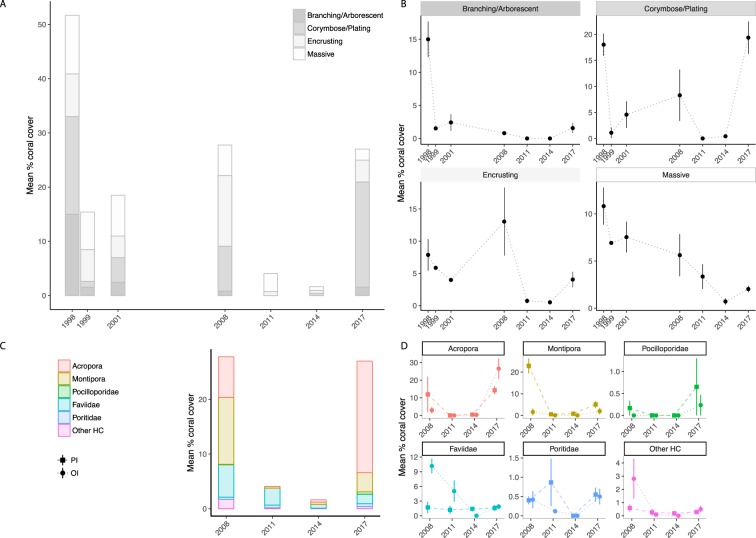
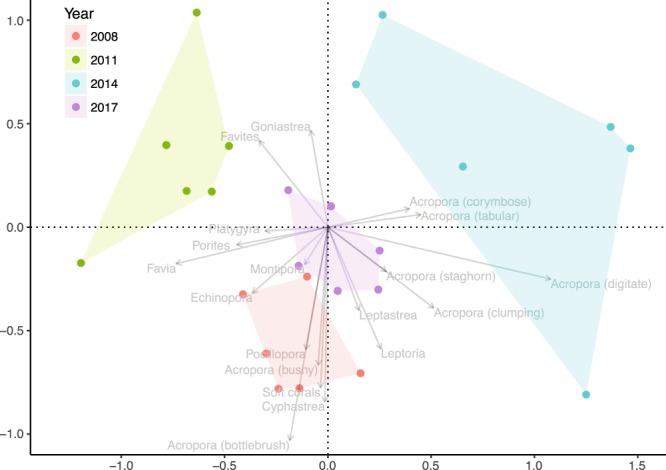
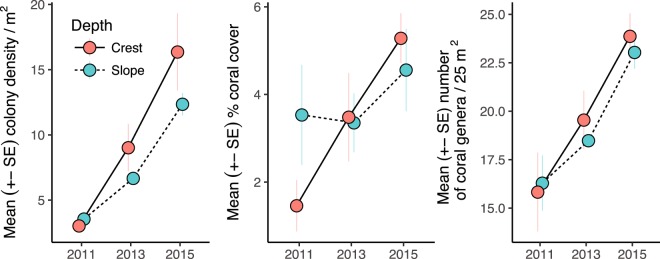
Increases in the frequency of perturbations that drive coral community structure, such as severe thermal anomalies and high intensity storms, highlight the need to understand how coral communities recover following multiple disturbances. We describe the dynamics of cover and assemblage composition of corals on exposed inshore reefs in the Palm Islands, central Great Barrier Reef, over 19 years encapsulating major disturbance events such as the severe bleaching event in 1998 and Cyclone Yasi in 2011, along with other minor storm and heat stress events. Over this time, 47.8% of hard coral cover was lost, with a concomitant shift in coral assemblage composition due to taxon-specific rates of mortality during the disturbances, and asymmetric recovery in the aftermath thereof. High recruitment rates of some broadcast-spawning corals, particularly corymbose Acropora spp., even in the absence of adult colonies, indicate that a strong external larval supply replenished the stocks. Conversely, the time required for recovery of slow-growing coral morphologies and life histories was longer than the recurrence times of major disturbances. With interludes between bleaching and cyclones predicted to decrease, the probability of another severe disturbance event before coral cover and assemblage composition approximates historical levels suggests that reefs will continue to erode.
驱动珊瑚群落结构变化的干扰频率增加,如严重的热异常和高强度风暴,这凸显了需要了解珊瑚群落在多次干扰后如何恢复。我们描述了在大堡礁中部棕榈岛近海暴露的珊瑚覆盖和群落组成的动态变化,时间跨度为 19 年,涵盖了严重白化事件(1998 年)和雅西飓风(2011 年)等重大干扰事件,以及其他较小的风暴和热应激事件。在此期间,硬珊瑚覆盖率损失了 47.8%,由于干扰期间特定分类群的死亡率,珊瑚群落组成发生了相应的变化,随后的恢复也不对称。一些散布产卵珊瑚,特别是丛生状的鹿角珊瑚属珊瑚,即使没有成年群体,也能以较高的繁殖率生长,这表明强大的外部幼虫供应补充了珊瑚礁的种群。相反,生长缓慢的珊瑚形态和生活史的恢复时间比重大干扰事件的复发时间更长。预计白化和飓风之间的间歇时间会减少,在珊瑚覆盖率和群落组成接近历史水平之前,发生另一次严重干扰事件的可能性表明,珊瑚礁将继续受到侵蚀。