Yu Bin, Niu Jianfeng, Feng Jianhua, Xu Meiling, Xie Xiujun, Gu Wenhui, Gao Shan, Wang Guangce
Key Laboratory of Experimental Marine Biology, Institute of Oceanology, Chinese Academy of Sciences, Qingdao, China.
College of Life Sciences, University of Chinese Academy of Sciences, Beijing, China.
Front Plant Sci. 2018 Jul 25;9:1092. doi: 10.3389/fpls.2018.01092. eCollection 2018.
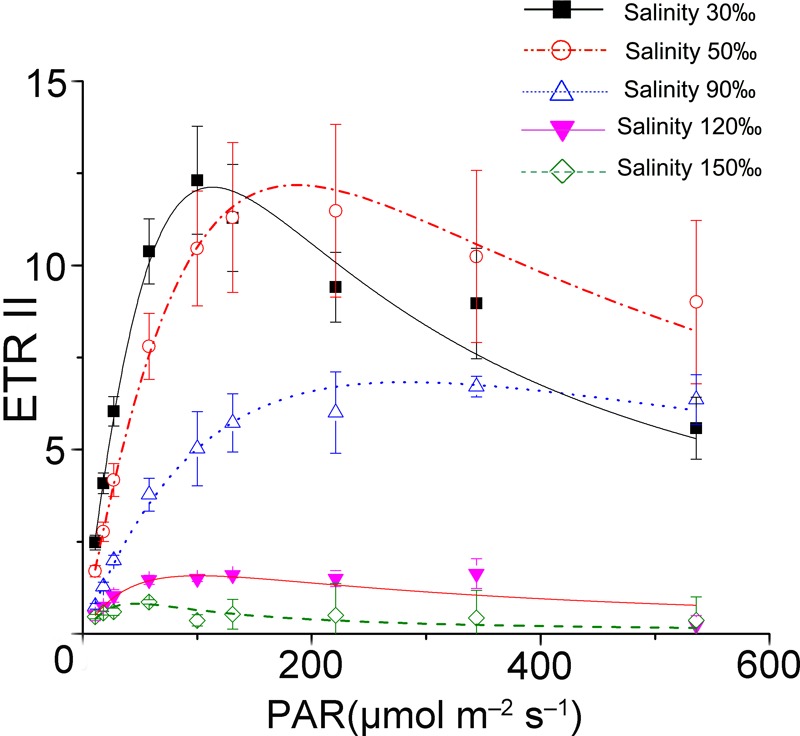
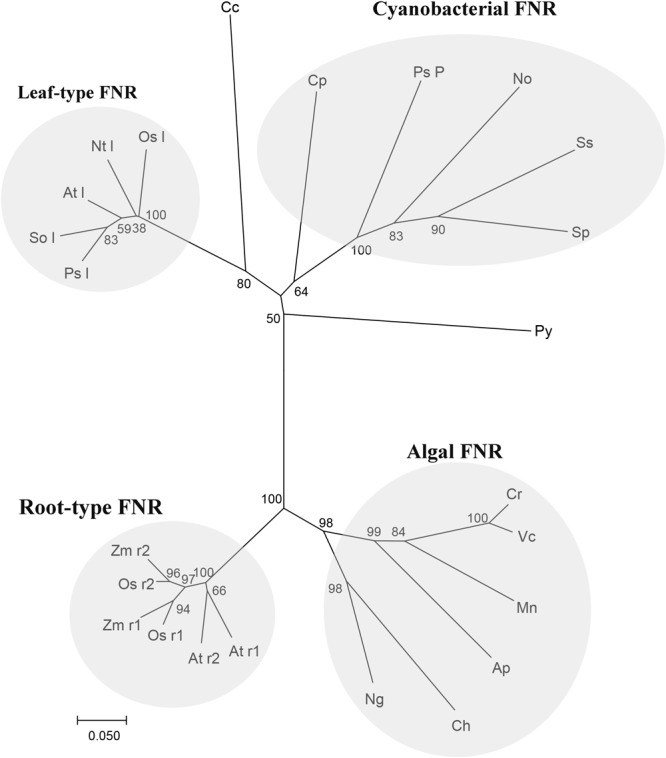
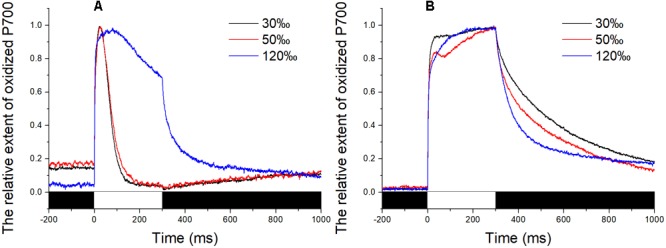
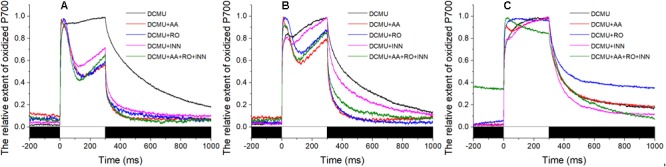
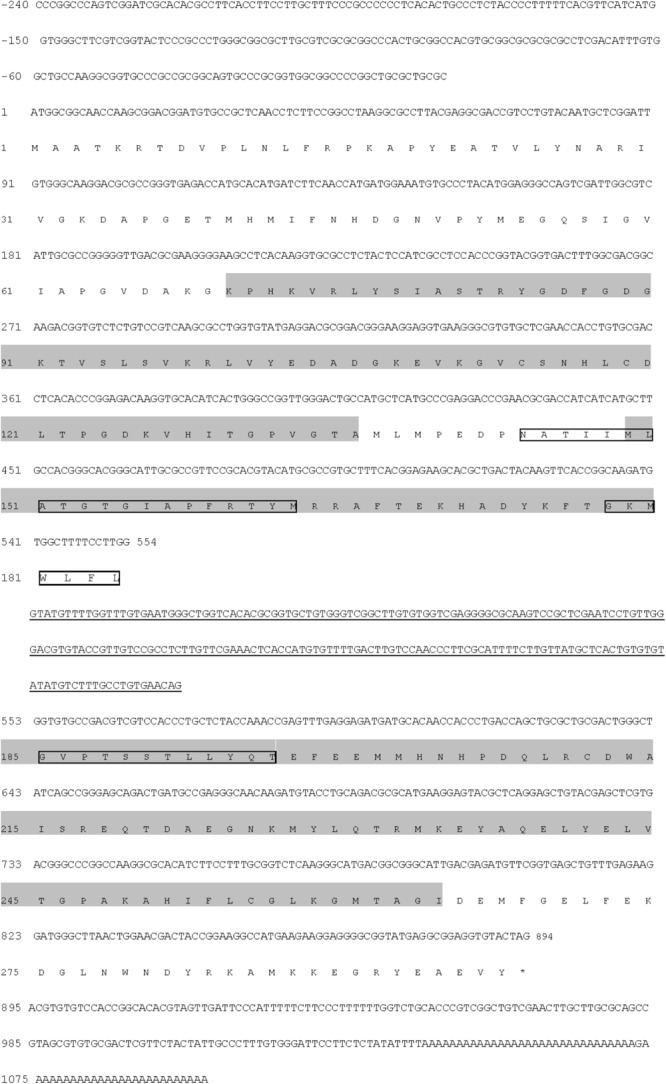
can survive the severe water loss that occurs during low tide, making it an ideal species to investigate the acclimation mechanism of intertidal seaweed to special extreme environments. In this study, we determined the effects of high salinity on photosynthesis using increasing salinity around algal tissues. Both electron transport rates, ETR (I) and ETR (II), showed continuous decreases as the salinity increased. However, the difference between these factors remained relatively stable, similar to the control. Inhibitor experiments illustrated that there were at least three different cyclic electron transport pathways. Under conditions of severe salinity, NAD(P)H could be exploited as an endogenous electron donor to reduce the plastoquinone pool in . Based on these findings, we next examined how these different cyclic electron transport (CETs) pathways were coordinated by cloning the gene () for ferredoxin-NADP oxidoreductase (FNR). A phylogenetic tree was constructed, and the evolutionary relationships among different FNRs were evaluated. The results indicated that the FNR showed a closer relationship with cyanobacterial FNR. The results of both real-time polymerase chain reaction and western blotting showed that the enzyme was upregulated under 90-120‰ salinity. Due to the structure-function correlations in organism, FNR was proposed to be involved in NAD(P)H-dependent Fd reduction under severe salinity conditions. Thus, through the connection between different donors bridged by FNR, electrons were channeled toward distinct routes according to the different metabolic demands. This was expected to make the electron transfer in the chloroplasts become more flexible and to contribute greatly to acclimation of to the extreme variable environments in the intertidal zone.
能够在退潮期间发生的严重水分流失中存活下来,这使其成为研究潮间带海藻对特殊极端环境适应机制的理想物种。在本研究中,我们通过增加藻类组织周围的盐度来确定高盐度对光合作用的影响。随着盐度增加,电子传递速率ETR(I)和ETR(II)均持续下降。然而,这些因素之间的差异保持相对稳定,与对照相似。抑制剂实验表明至少存在三种不同的循环电子传递途径。在高盐度条件下,NAD(P)H可作为内源性电子供体来还原质体醌库。基于这些发现,我们接下来通过克隆铁氧化还原蛋白-NADP氧化还原酶(FNR)的基因()来研究这些不同的循环电子传递(CETs)途径是如何协调的。构建了系统发育树,并评估了不同FNR之间的进化关系。结果表明,FNR与蓝细菌FNR的关系更密切。实时聚合酶链反应和蛋白质免疫印迹结果均表明,该酶在90-120‰盐度下上调。由于生物体中的结构-功能相关性,推测FNR在高盐度条件下参与依赖NAD(P)H的Fd还原。因此,通过FNR桥接的不同供体之间的连接,电子根据不同的代谢需求被引导至不同的途径。这有望使叶绿体中的电子传递变得更加灵活,并极大地有助于适应潮间带极端多变的环境。