Department of Ophthalmology and Visual Sciences, Vanderbilt University Medical Center, Nashville, TN, United States of America.
Department of Biostatistics, Vanderbilt University, Nashville, TN, United States of America.
PLoS One. 2018 Aug 9;13(8):e0201719. doi: 10.1371/journal.pone.0201719. eCollection 2018.
Angiotensin II type 1 receptor blockers (ARBs) have been investigated for their neuroprotective and intraocular pressure (IOP) lowering effects in treating glaucoma, but the reports have been inconsistent possibly because different compounds and models have been used. Here we selected three ARBs for head-to-head comparisons of their effects on IOP and transforming growth factor β (TGFβ) signaling, which is believed to play an important role in glaucoma pathogenesis.
Three ARBs (losartan, irbesartan or telmisartan) or vehicle controls were administered via chow to C57BL/6J mice for up to 7 days. Drug concentrations in the eye, brain, and plasma were evaluated by liquid chromatography mass spectrometry. Cohorts of mice were randomly assigned to different treatments. IOP and blood pressure were measured before and after ARB treatment. Effects of ARBs on TGFβ signaling in the retina were evaluated by phosphorylated Smad2 (pSmad2) immunohistochemistry.
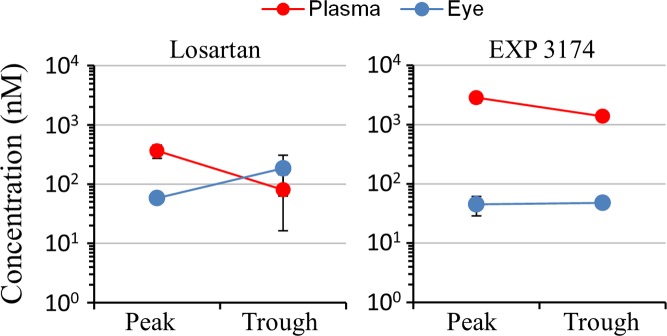
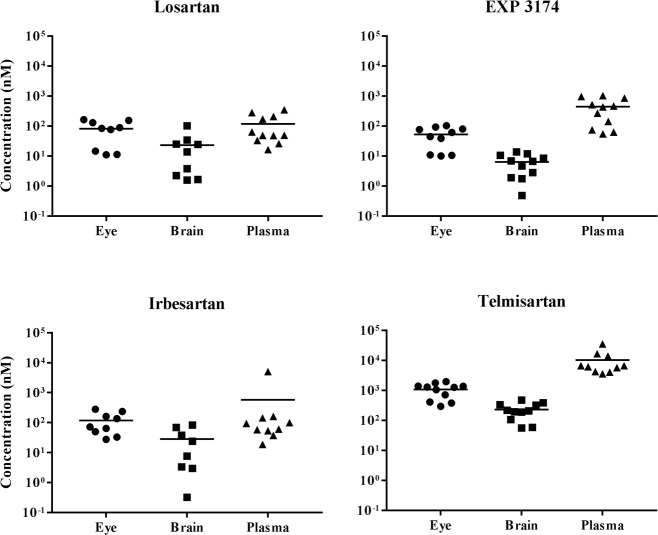
Physiologically relevant concentrations of losartan, irbesartan and telmisartan were detected in eye, brain and plasma after drug administration (n = 11 mice/treatment). Blood pressure was significantly reduced by all ARBs compared to vehicle-fed controls (all p-values < 0.001, n = 8-15 mice/treatment). Compared to vehicle control, IOP was significantly reduced by irbesartan (p = 0.030) and telmisartan (p = 0.019), but not by losartan (n = 14-17 mice/treatment). Constitutive pSmad2 fluorescence observed in retinal ganglion cells was significantly reduced by telmisartan (p = 0.034), but not by losartan or irbesartan (n = 3-4 mice/treatment).
Administration via chow is an effective delivery method for ARBs, as evidenced by lowered blood pressure. ARBs vary in their abilities to lower IOP or reduce TGFβ signaling. Considering the significant roles of IOP and TGFβ in glaucoma pathogenesis, specific ARBs with dual effects, such as telmisartan, may be more effective than other ARBs for treating glaucoma.
血管紧张素 II 型 1 型受体阻滞剂(ARBs)已被研究用于治疗青光眼的神经保护和降低眼内压(IOP)作用,但报告结果不一致,可能是因为使用了不同的化合物和模型。在这里,我们选择了三种 ARBs 进行头对头比较,以研究它们对 IOP 和转化生长因子β(TGFβ)信号的影响,TGFβ信号被认为在青光眼发病机制中起重要作用。
通过饮食向 C57BL/6J 小鼠给予三种 ARBs(氯沙坦、厄贝沙坦或替米沙坦)或载体对照物,持续长达 7 天。通过液相色谱-质谱法评估药物在眼睛、大脑和血浆中的浓度。将小鼠随机分配到不同的治疗组。在 ARB 治疗前后测量 IOP 和血压。通过磷酸化 Smad2(pSmad2)免疫组化评估 ARB 对视网膜中 TGFβ信号的影响。
在给药后(n = 11 只/治疗组),在眼睛、大脑和血浆中检测到与生理相关的氯沙坦、厄贝沙坦和替米沙坦浓度。与载体喂养对照相比,所有 ARB 均显著降低血压(所有 p 值均<0.001,n = 8-15 只/治疗组)。与载体对照相比,厄贝沙坦(p = 0.030)和替米沙坦(p = 0.019)可显著降低 IOP,但氯沙坦则不能(n = 14-17 只/治疗组)。视网膜神经节细胞中观察到的组成性 pSmad2 荧光明显被替米沙坦(p = 0.034)降低,但氯沙坦或厄贝沙坦则没有(n = 3-4 只/治疗组)。
通过饮食给予 ARB 是一种有效的给药方法,这一点从降低血压得到了证明。ARBs 在降低 IOP 或降低 TGFβ信号方面存在差异。考虑到 IOP 和 TGFβ 在青光眼发病机制中的重要作用,具有双重作用的特定 ARB,如替米沙坦,可能比其他 ARB 更有效地治疗青光眼。