1 Key Laboratory for Regenerative Medicine of the Ministry of Education of China, School of Biomedical Sciences, Faculty of Medicine, The Chinese University of Hong Kong, Hong Kong SAR, China.
2 Sichuan University, The Chinese University of Hong Kong Joint Laboratory for Reproductive Medicine, West China Second University Hospital, Sichuan University, Chengdu, Sichuan, China.
Cell Transplant. 2018 Sep;27(9):1352-1367. doi: 10.1177/0963689718780304. Epub 2018 Aug 10.
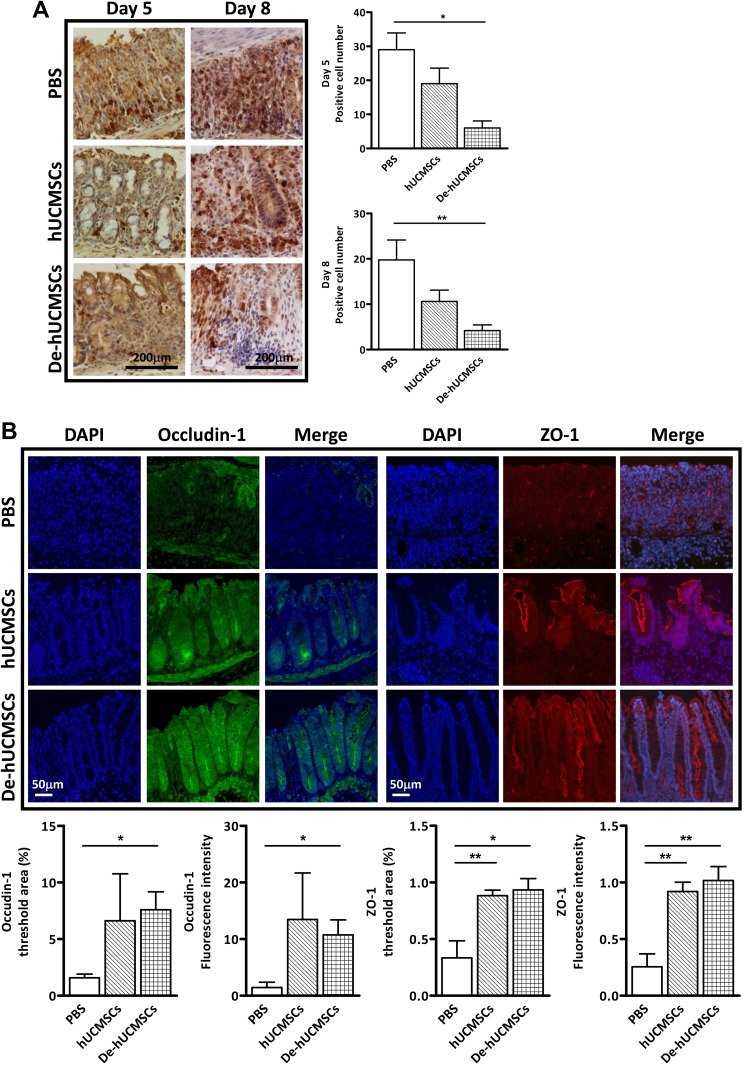
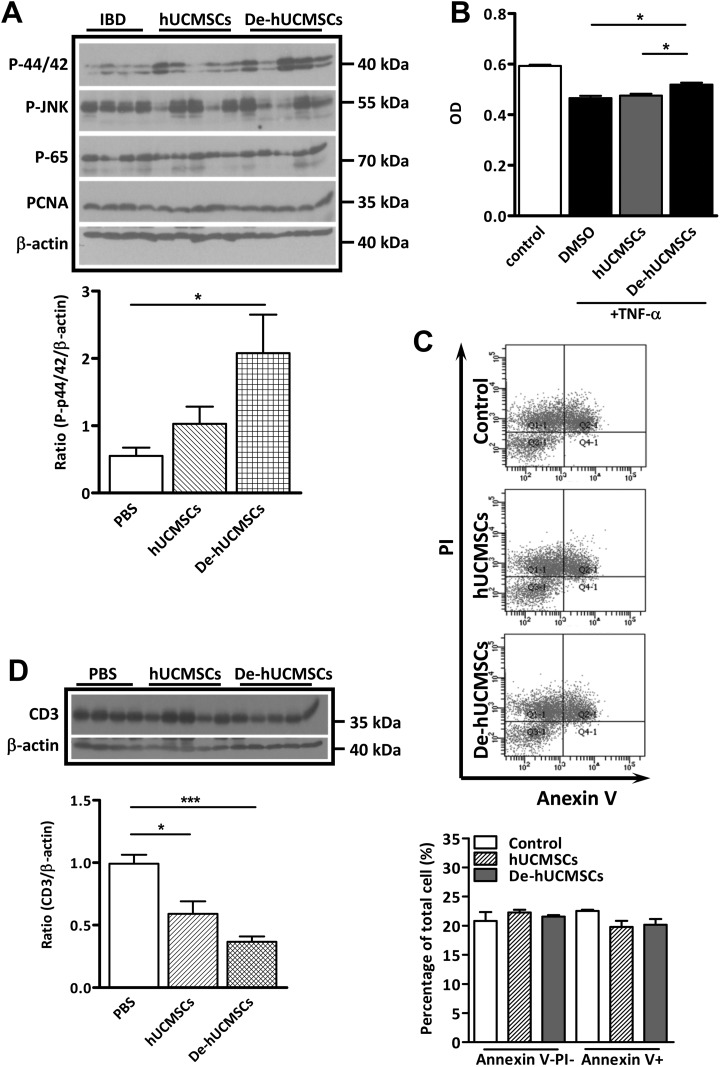
Mesenchymal stem cell (MSC)-based cell therapy has been demonstrated as a promising strategy in the treatment of inflammatory bowel disease (IBD), which is considered an immune disease. While the exact mechanisms underlying the therapeutic effect of MSCs are still unclear, MSCs display anti-inflammatory and immunomodulatory effects by interacting with various immunoregulatory cells. Our previous studies have shown that MSCs can be preconditioned and deconditioned with enhanced cell survival, differentiation and migration. In this study, we evaluated the effect of preconditioning on the immunoregulatory function of human umbilical cord-derived MSCs (hUCMSCs) and their therapeutic effect on treating IBD. Our results show that intraperitoneal administration of deconditioned hUCMSCs (De-hUCMSCs) reduces the disease activity index (DAI), histological colitis score and destruction of the epithelial barrier, and increases the body weight recovery more intensively than that of un-manipulated hUCMSCs. In addition, De-hUCMSCs but not hUCMSCs elicit anti-apoptotic effects via induction of the ERK pathway during the early stage of IBD development. In vitro co-culture studies indicate that De-hUCMSCs suppress T-cell proliferation and activation more markedly than hUCMSCs. Moreover, De-hUCMSCs block the induction of inflammatory cytokines such as tumor necrosis factor (TNF)α and interleukin (IL)-2, while promoting the secretion of the anti-inflammatory cytokine IL-10 in T-cells. Mechanically, we find that prostaglandin E2 (PGE2) secretion is significantly increased in De-hUCMSCs, the suppression of which dramatically abrogates the inhibitory effect of De-hUCMSCs on T-cell activation, implying that the crosstalk between De-hUCMSCs and T-cells is mediated by PGE2. Together, we have demonstrated that preconditioning enhances the immunosuppressive and therapeutic effects of hUCMSCs on treating IBD via increased secretion of PGE2.
间充质干细胞(MSC)为基础的细胞治疗已被证明是一种有前途的策略,在治疗炎症性肠病(IBD),这被认为是一种免疫性疾病。虽然确切的机制,背后的治疗效果的 MSC 仍不清楚,MSC 显示抗炎和免疫调节作用通过与各种免疫调节细胞。我们以前的研究表明,MSC 可以预处理和去条件与增强细胞的生存能力,分化和迁移。在这项研究中,我们评估预处理对免疫调节功能的人脐带间充质干细胞(hUCMSCs)和他们的治疗效果治疗 IBD。我们的结果表明,腹腔内给予去条件 hUCMSCs (De-hUCMSCs)降低疾病活动指数(DAI),组织学结肠炎评分和破坏上皮屏障,并增加体重恢复更强烈比未经处理的 hUCMSCs。此外,De-hUCMSCs 但不是 hUCMSCs 诱发抗凋亡作用通过诱导 ERK 通路在早期的 IBD 发展。体外共培养研究表明,De-hUCMSCs 抑制 T 细胞增殖和激活更为明显比 hUCMSCs。此外,De-hUCMSCs 阻断诱导炎症细胞因子如肿瘤坏死因子(TNF)α和白细胞介素(IL)-2,同时促进抗炎细胞因子白细胞介素 10(IL-10)的分泌 T 细胞。机械地,我们发现前列腺素 E2(PGE2)的分泌显著增加,De-hUCMSCs,抑制这一急剧废除抑制作用 De-hUCMSCs T 细胞激活,这意味着 PGE2 之间的串扰 De-hUCMSCs 和 T 细胞。总的来说,我们已经证明预处理增强免疫抑制和治疗效果的 hUCMSCs 治疗 IBD 通过增加 PGE2 的分泌。