International Center for Tropical Agriculture, Av. La Molina 1895, La Molina, Lima, Peru.
Centre for Interdisciplinary Science and Society Studies, Universidad de Ciencias y Humanidades, Av. Universitaria 5175, Los Olivos, Lima, Peru.
J Ethnobiol Ethnomed. 2018 Aug 10;14(1):54. doi: 10.1186/s13002-018-0247-2.
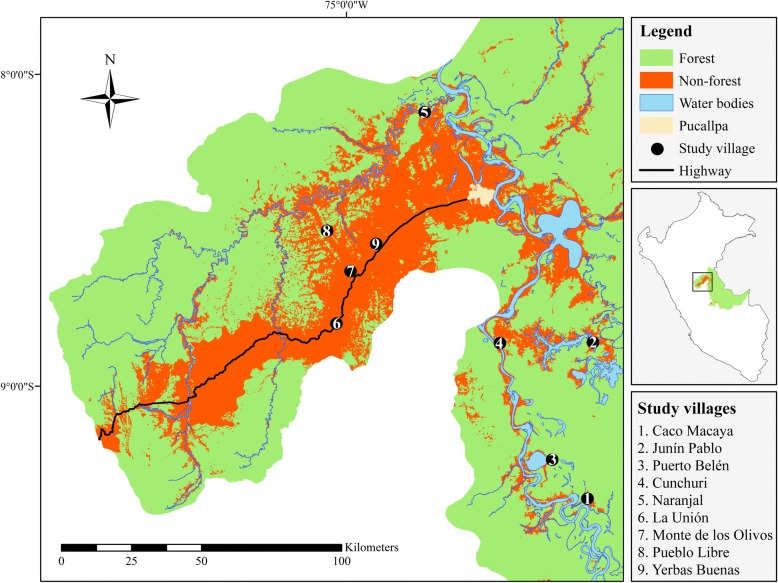
Wildlife has been traditionally used by forest communities as a source of protein, and the Peruvian Amazon is no exception. The articulation of colonist and indigenous communities to urban centers and markets results in changes in livelihood strategies and impacts on wildlife populations. To address the threat of overhunting and forest conversion, we provide a generalized characterization of colonist and indigenous communities and their hunting activities near Pucallpa, Ucayali, Peru.
A semi-structured household survey was conducted to characterize hunters and describe their prey collections. The data were analyzed by conducting a Kruskal-Wallis test, a multiple regression analysis, and by estimating the harvest rate (H).
Less wealthy households were more actively engaged in hunting for food security and as a livelihood strategy. Additionally, older hunters were associated with higher hunting rates. Although the percentage of hunters was relatively low, estimated hunting rates suggest overharvesting of wildlife. Lowland pacas (Cuniculus paca) were the most frequently hunted prey, followed by red brocket deer (Mazama americana) and primates. While hunting intensity was not significantly different between indigenous and colonist communities, hunting rate disparities suggest there are different types of hunters (specialized vs. opportunistic) and that prey composition differs between communities.
Close monitoring of wildlife populations and hunting activities is ideal for more accurately determining the impact of hunting on wildlife population and in turn on forest health. In lack of this type of information, this study provides insight of hunting as a shifting livelihood strategy in a rapidly changing environment at the forest/agriculture frontier.
野生动物一直是森林社区的蛋白质来源,秘鲁亚马逊地区也不例外。殖民者和土著社区与城市中心和市场的联系导致生计策略的变化,并对野生动物种群产生影响。为了解决过度捕猎和森林转换的威胁,我们对秘鲁乌卡亚利省普卡尔帕附近的殖民者和土著社区及其狩猎活动进行了概括性描述。
采用半结构的家庭调查来描述猎人并描述他们的猎物收集情况。通过进行 Kruskal-Wallis 检验、多元回归分析和估计收获率(H)来分析数据。
较贫穷的家庭更积极地从事狩猎以保障粮食安全和维持生计。此外,年长的猎人与更高的狩猎率相关。尽管猎人的比例相对较低,但估计的狩猎率表明野生动物过度捕猎。低地豚鼠(Cuniculus paca)是最常被猎捕的猎物,其次是红麂(Mazama americana)和灵长类动物。虽然土著和殖民者社区之间的狩猎强度没有显著差异,但狩猎率的差异表明存在不同类型的猎人(专门型和机会型),并且社区之间的猎物组成也不同。
密切监测野生动物种群和狩猎活动对于更准确地确定狩猎对野生动物种群的影响以及对森林健康的影响是理想的。在缺乏此类信息的情况下,本研究提供了有关在森林/农业前沿快速变化的环境中,狩猎作为一种不断变化的生计策略的见解。