Schaafsma Fokje L, Cherel Yves, Flores Hauke, van Franeker Jan Andries, Lea Mary-Anne, Raymond Ben, van de Putte Anton P
Wageningen Marine Research, Ankerpark 27, 1781 AG Den Helder, The Netherlands.
2Centre d'Etudes Biologiques de Chizé, UMR 7372 du CNRS et de l'Université de La Rochelle, 79360 Villiers-en-Bois, France.
Mar Biol. 2018;165(8):129. doi: 10.1007/s00227-018-3386-z. Epub 2018 Jul 18.
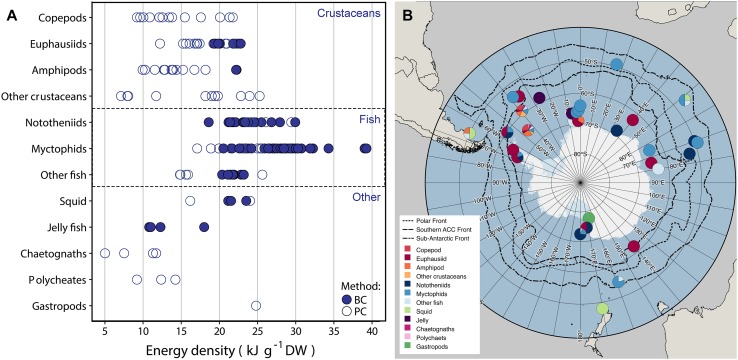
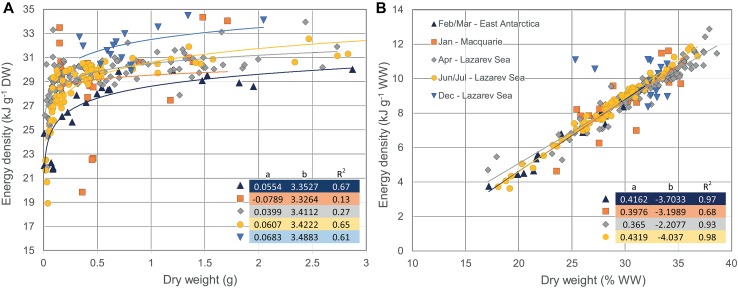
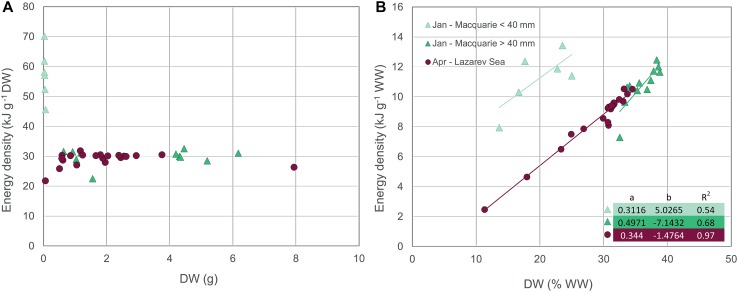
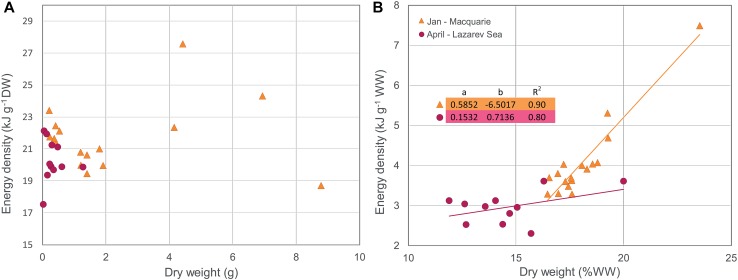
Understanding the energy flux through food webs is important for estimating the capacity of marine ecosystems to support stocks of living resources. The energy density of species involved in trophic energy transfer has been measured in a large number of small studies, scattered over a 40-year publication record. Here, we reviewed energy density records of Southern Ocean zooplankton, nekton and several benthic taxa, including previously unpublished data. Comparing measured taxa, energy densities were highest in myctophid fishes (ranging from 17.1 to 39.3 kJ g DW), intermediate in crustaceans (7.1 to 25.3 kJ g DW), squid (16.2 to 24.0 kJ g DW) and other fish families (14.8 to 29.9 kJ g DW), and lowest in jelly fish (10.8 to 18.0 kJ g DW), polychaetes (9.2 to 14.2 kJ g DW) and chaetognaths (5.0-11.7 kJ g DW). Data reveals differences in energy density within and between species related to size, age and other life cycle parameters. Important taxa in Antarctic food webs, such as copepods, squid and small euphausiids, remain under-sampled. The variability in energy density of was likely regional rather than seasonal, although for many species with limited data it remains difficult to disentangle regional and seasonal variability. Models are provided to estimate energy density more quickly using a species' physical parameters. It will become increasingly important to close knowledge gaps to improve the ability of bioenergetic and food web models to predict changes in the capacity of Antarctic ecosystems to support marine life.
了解食物网中的能量流动对于评估海洋生态系统支持生物资源存量的能力至关重要。在长达40年的发表记录中,众多小型研究对参与营养能量传递的物种的能量密度进行了测量。在此,我们回顾了南大洋浮游动物、游泳生物和几种底栖类群的能量密度记录,包括之前未发表的数据。比较所测量的类群,灯笼鱼科鱼类的能量密度最高(范围为17.1至39.3千焦/克干重),甲壳类动物(7.1至25.3千焦/克干重)、鱿鱼(16.2至24.0千焦/克干重)和其他鱼类科(14.8至29.9千焦/克干重)居中,而水母(10.8至18.0千焦/克干重)、多毛类动物(9.2至14.2千焦/克干重)和毛颚类动物(5.0 - 11.7千焦/克干重)的能量密度最低。数据揭示了物种内部和物种之间与大小、年龄及其他生命周期参数相关的能量密度差异。南极食物网中的重要类群,如桡足类动物、鱿鱼和小型磷虾,采样仍然不足。能量密度的变化可能是区域性的而非季节性的,尽管对于许多数据有限的物种,仍然难以区分区域和季节变化。提供了利用物种物理参数更快估算能量密度的模型。缩小知识差距对于提高生物能量学和食物网模型预测南极生态系统支持海洋生物能力变化的能力将变得越来越重要。