Hubot Nathan, Giering Sarah L C, Lucas Cathy H
National Oceanography Centre, Waterfront Campus, Southampton SO14 3ZH, UK.
Ocean and Earth Science, University of Southampton, National Oceanography Centre, Waterfront Campus, Southampton SO14 3ZH, UK.
J Plankton Res. 2022 Jan 21;44(2):337-344. doi: 10.1093/plankt/fbab091. eCollection 2022 Mar-Apr.
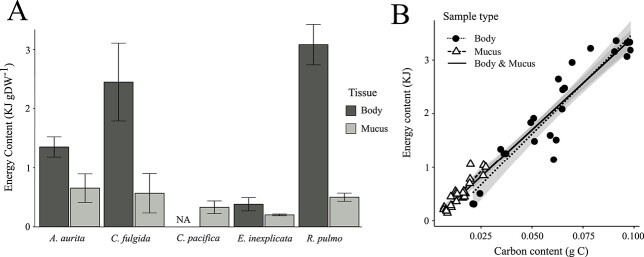
Recognition of the importance of jellyfish in marine ecosystems is growing. Yet, the biochemical composition of the mucus that jellyfish constantly excrete is poorly characterized. Here we analyzed the macromolecular (proteins, lipids and carbohydrates) and elemental (carbon and nitrogen) composition of the body and mucus of five scyphozoan jellyfish species (, , , and ). We found that the relative contribution of the different macromolecules and elements in the jellyfish body and mucus was similar across all species, with protein being the major component in all samples (81 ± 4% of macromolecules; 3.6 ± 3.1% of dry weight, DW) followed by lipids (13 ± 4% of macromolecules; 0.5 ± 0.4%DW) and carbohydrates (6 ± 3% of macromolecules; 0.3 ± 0.4%DW). The energy content of the jellyfish matter ranged from 0.2 to 3.1 KJ g DW. Carbon and nitrogen content was 3.7 ± 3.0 and 1.0 ± 0.8%DW, respectively. The average ratios of protein:lipid:carbohydrate and carbon:nitrogen for all samples were 14.6:2.3:1 and 3.8:1, respectively. Our study highlights the biochemical similarity between the jellyfish body and mucus and provides convenient and valuable ratios to support the integration of jellyfish into trophic and biogeochemical models.
人们越来越认识到水母在海洋生态系统中的重要性。然而,水母不断分泌的黏液的生化组成却鲜为人知。在这里,我们分析了五种钵水母纲水母物种( 、 、 、 和 )的身体和黏液的大分子(蛋白质、脂质和碳水化合物)以及元素(碳和氮)组成。我们发现,所有物种的水母身体和黏液中不同大分子和元素的相对贡献相似,蛋白质是所有样本中的主要成分(占大分子的81±4%;占干重的3.6±3.1%),其次是脂质(占大分子的13±4%;占干重的0.5±0.4%)和碳水化合物(占大分子的6±3%;占干重的0.3±0.4%)。水母物质的能量含量在0.2至3.1千焦/克干重之间。碳和氮含量分别为3.7±3.0%和1.0±0.8%干重。所有样本中蛋白质:脂质:碳水化合物和碳:氮的平均比例分别为14.6:2.3:1和3.8:1。我们的研究突出了水母身体和黏液之间的生化相似性,并提供了方便且有价值的比例,以支持将水母纳入营养和生物地球化学模型。