Department of Internal Medicine I, University of Tübingen, Tübingen, Germany.
Dr. Margarete Fischer-Bosch Institute for Clinical Pharmacology, Stuttgart and University of Tuebingen, Tuebingen, Germany.
Front Immunol. 2018 Jul 27;9:1735. doi: 10.3389/fimmu.2018.01735. eCollection 2018.
BACKGROUND & AIMS: Knowledge about innate antimicrobial defense of the liver is limited. We investigated hepatic expression and regulation of antimicrobial peptides with focus on the human beta defensin-1 (hBD-1).
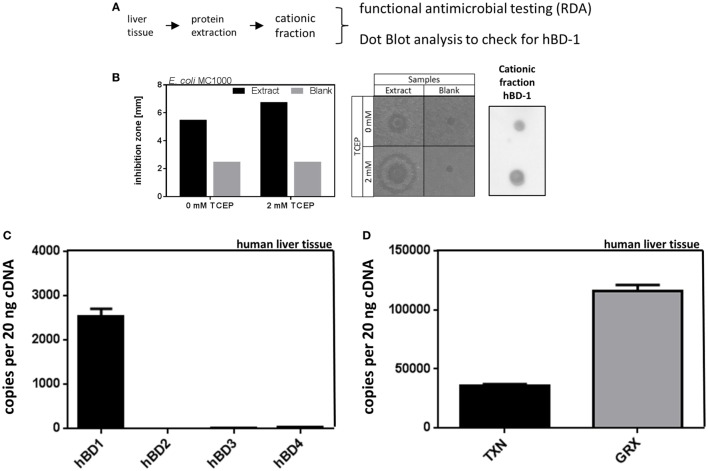
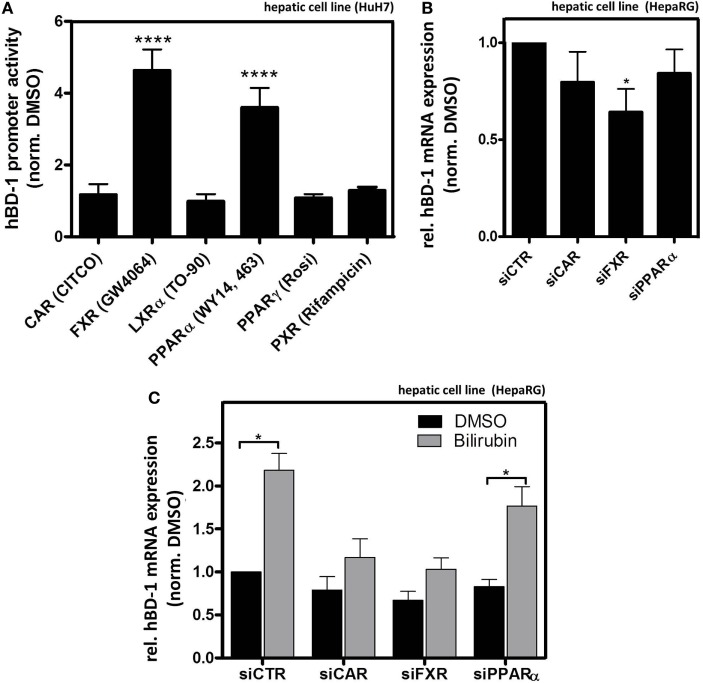
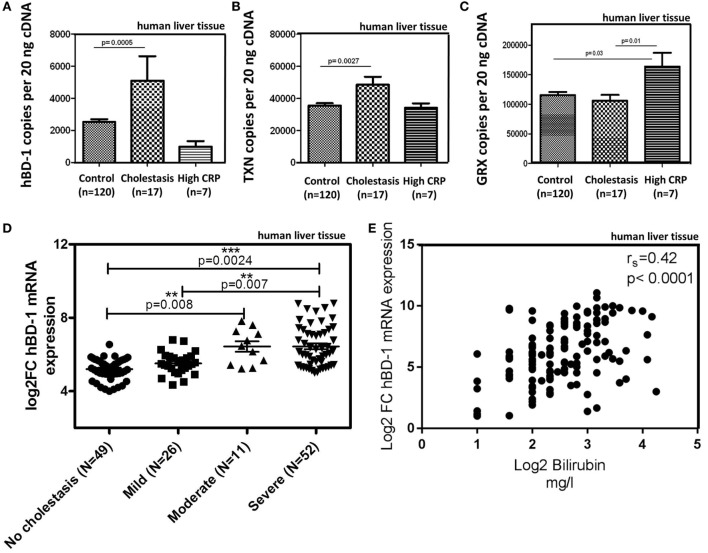
Radial diffusion assay was used to analyze antimicrobial activity of liver tissue. Different defensins including hBD-1 and its activator thioredoxin-1 (TXN) were analyzed in healthy and cholestatic liver samples by qPCR and immunostaining. Regulation of hBD-1 expression was studied and using bile duct-ligated mice. Regulation of hBD-1 bilirubin and bile acids (BAs) was studied using siRNA.
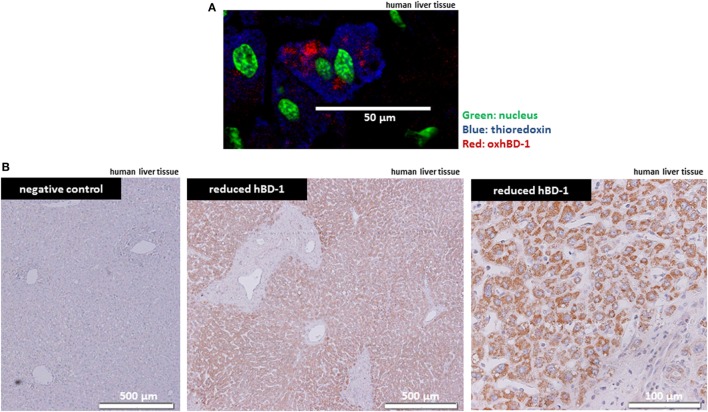
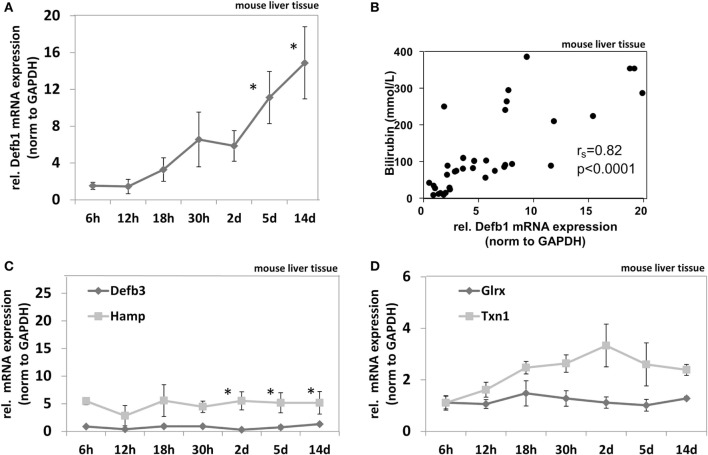
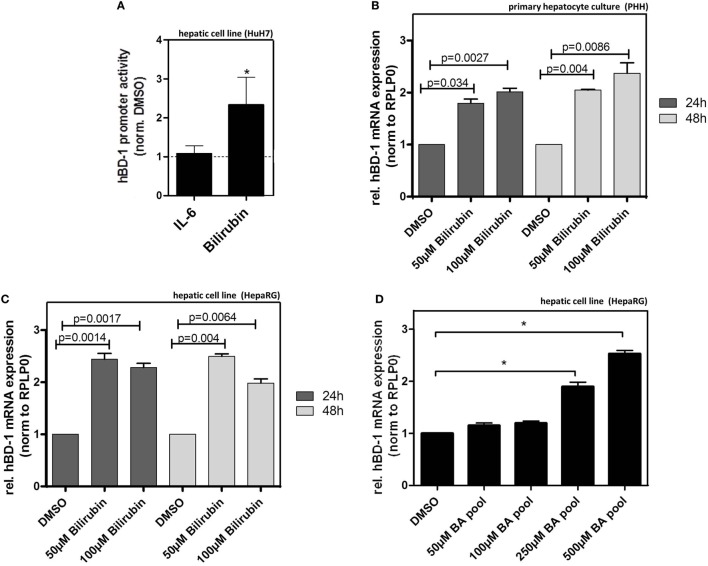
We found strong antimicrobial activity of liver tissue against . As a potential mediator of this antimicrobial activity we detected high expression of hBD-1 and TXN in hepatocytes, whereas other defensins were minimally expressed. Using a specific antibody for the reduced, antimicrobially active form of hBD-1 we found hBD-1 in co-localization with TXN within hepatocytes. hBD-1 was upregulated in cholestasis in a graded fashion. In cholestatic mice hepatic AMP expression (Defb-1 and Hamp) was enhanced. Bilirubin and BAs were able to induce hBD-1 in hepatic cell cultures . Treatment with siRNA and/or agonists demonstrated that the farnesoid X receptor (FXR) mediates basal expression of hBD-1, whereas both constitutive androstane receptor (CAR) and FXR seem to be responsible for the induction of hBD-1 by bilirubin.
hBD-1 is prominently expressed in hepatocytes. It is induced during cholestasis through bilirubin and BAs, mediated by CAR and especially FXR. Reduction by TXN activates hBD-1 to a potential key player in innate antimicrobial defense of the liver.
目前对肝脏固有抗菌防御机制的了解还很有限。我们研究了抗菌肽在肝脏中的表达和调控,重点研究了人β防御素-1(hBD-1)。
采用放射扩散法分析肝组织的抗菌活性。通过 qPCR 和免疫染色分析健康和胆汁淤积肝组织中不同防御素(包括 hBD-1 及其激活剂硫氧还蛋白-1(TXN))的表达。采用胆管结扎小鼠模型研究 hBD-1 的调控机制。通过 siRNA 研究 hBD-1 与胆红素和胆汁酸(BAs)的调控关系。
我们发现肝组织对具有很强的抗菌活性。作为这种抗菌活性的潜在介导物,我们在肝细胞中检测到 hBD-1 和 TXN 的高表达,而其他防御素的表达则很少。使用针对 hBD-1 还原型、具有抗菌活性的特异性抗体,我们发现 hBD-1 与 TXN 在肝细胞中存在共定位。在胆汁淤积中,hBD-1 呈梯度上调。在胆汁淤积小鼠中,肝 AMP 表达(Defb-1 和 Hamp)增强。胆红素和 BAs 能够诱导肝细胞培养物中 hBD-1 的表达。siRNA 治疗和/或激动剂处理表明,法尼醇 X 受体(FXR)介导 hBD-1 的基础表达,而组成型雄烷受体(CAR)和 FXR 似乎都负责胆红素诱导 hBD-1 的表达。
hBD-1 在肝细胞中大量表达。它通过胆红素和 BAs 在胆汁淤积时被诱导,这一过程由 CAR 和 FXR 介导。TXN 的还原使 hBD-1 激活,成为肝脏固有抗菌防御的关键因子。