LoPresti Samuel T, Brown Bryan N
McGowan Institute for Regenerative Medicine, University of Pittsburgh, 450 Technology Drive, Pittsburgh, PA 15219, United States.
Department of Bioengineering, Swanson School of Engineering, University of Pittsburgh, 3700 O'Hara Street, Pittsburgh, PA 15260, United States.
J Immunol Regen Med. 2018 Mar;1:57-66. doi: 10.1016/j.regen.2018.03.004. Epub 2018 Apr 25.
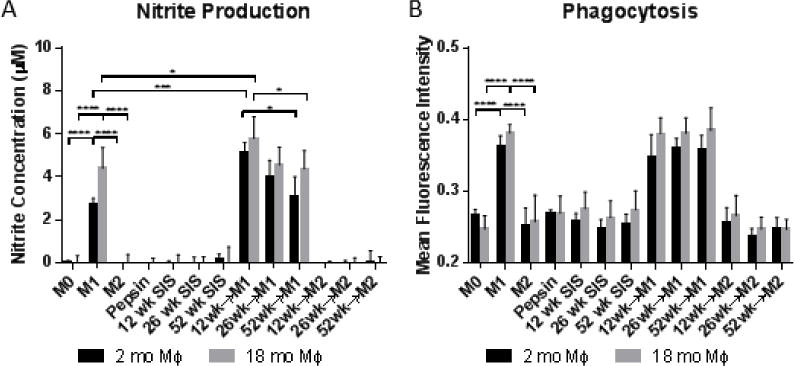
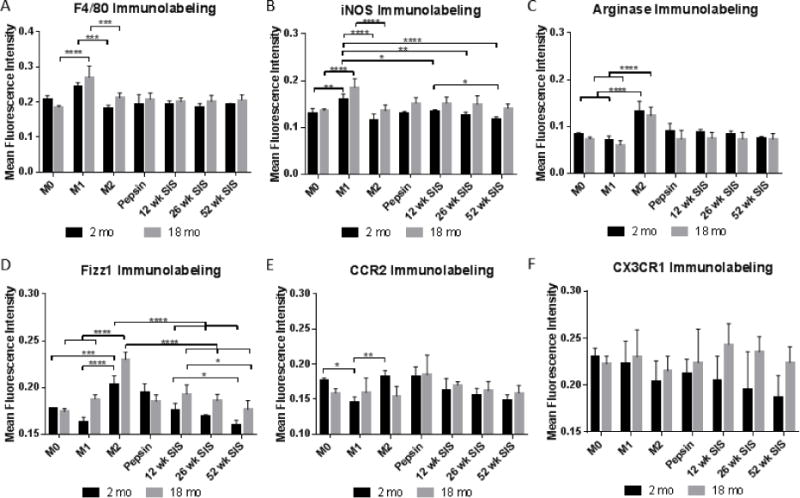
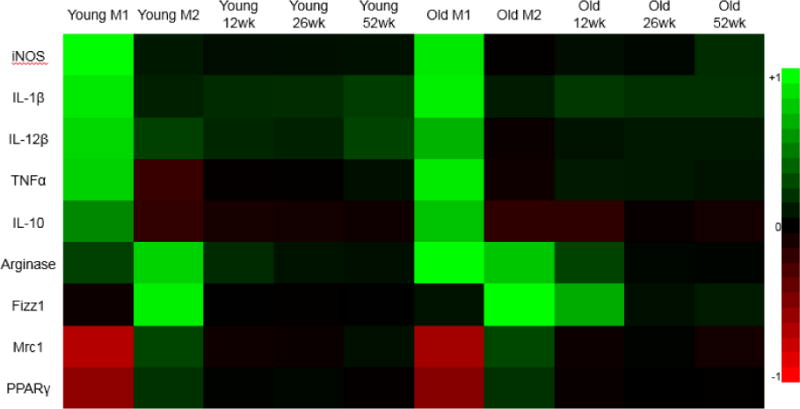
Extracellular matrix biomaterials have been shown to promote constructive remodeling in many preclinical and clinical applications. This response has been associated with the promotion of a timely switch from pro-inflammatory (M1) to anti-inflammatory (M2) macrophages. A previous study has shown that this beneficial response is lost when these biomaterials are derived from aged animals. This study examined the impact of small intestine submucosa (SIS) derived from 12, 26 and 52 week old pigs on the phenotype and function of bone marrow macrophages derived either from 2 or 18 month old mice. Results showed that 52 week old SIS promoted less iNOS in 2 month macrophages and Fizz1 expression in 2 and 18 month compared to 12 week SIS. Pro-inflammatory cytokine exposure to 52 week SIS-treated macrophages resulted in higher iNOS in 18 month macrophages and reduced MHC-II expression in 2 month macrophages, as well as reduced nitric oxide production in comparison to 12 week SIS. These results indicate that ECM derived from aged animals promotes an altered macrophage phenotype compared to young controls. This suggests that sourcing of ECM from young donors is important to preserve constructive remodeling outcomes of ECM biomaterials. Alteration of macrophage phenotype by aged ECM also raises the hypothesis that alterations in aged ECM may play a role in immune dysfunction in aged individuals.
细胞外基质生物材料已被证明在许多临床前和临床应用中能促进建设性重塑。这种反应与促进促炎(M1)巨噬细胞及时向抗炎(M2)巨噬细胞转变有关。先前的一项研究表明,当这些生物材料来源于老龄动物时,这种有益反应就会消失。本研究考察了来自12周龄、26周龄和52周龄猪的小肠黏膜下层(SIS)对来自2月龄或18月龄小鼠的骨髓巨噬细胞的表型和功能的影响。结果显示,与12周龄的SIS相比,52周龄的SIS在2月龄巨噬细胞中促进产生的诱导型一氧化氮合酶(iNOS)较少,在2月龄和18月龄巨噬细胞中促进产生的抵抗素样分子α(Fizz1)表达较少。与12周龄的SIS相比,用促炎细胞因子处理52周龄SIS处理过的巨噬细胞,会使18月龄巨噬细胞中的iNOS增加,2月龄巨噬细胞中的主要组织相容性复合体II类分子(MHC-II)表达减少,以及一氧化氮产生减少。这些结果表明,与年轻对照相比,老龄动物来源的细胞外基质(ECM)会促进巨噬细胞表型改变。这表明从年轻供体获取ECM对于维持ECM生物材料的建设性重塑结果很重要。老龄ECM对巨噬细胞表型的改变也提出了一个假说,即老龄ECM的改变可能在老龄个体的免疫功能障碍中起作用。