Humanitas Research Hospital and Cancer Center, Radiotherapy and Radiosurgery, Milan-Rozzano, Italy.
Humanitas University, Dept. of Biomedical Sciences, Milan-Rozzano, Italy.
PLoS One. 2018 Aug 13;13(8):e0201992. doi: 10.1371/journal.pone.0201992. eCollection 2018.
To investigate the role of intensity modulated proton therapy (IMPT) for advanced hepatocellular carcinoma in comparison with volumetric modulated arc therapy (VMAT).
An in-silico planning study was performed on 20 patients. The prescription dose was 60Gy in 6 fractions. Patients were planned with abdominal compression. IMPT plans were optimized with or without the inclusion of CT calibration (3%) and isocenter positioning (2,4,6mm) uncertainties. Plan robustness was appraised comparing rubust optimized plans vs standard plans and also in terms of the worst-case scenario. VMAT plans were optimized for 10FFF photon beams using 2 partial arcs.
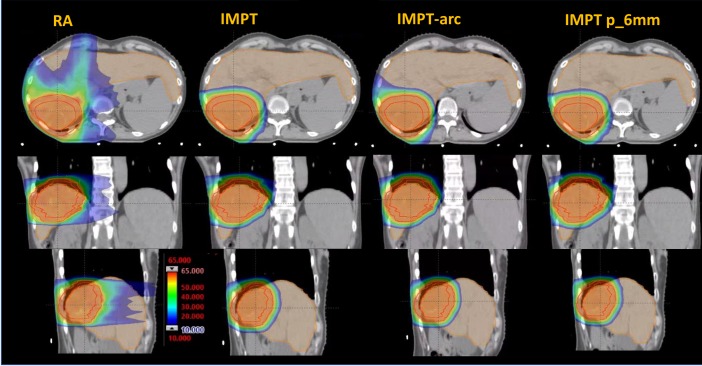
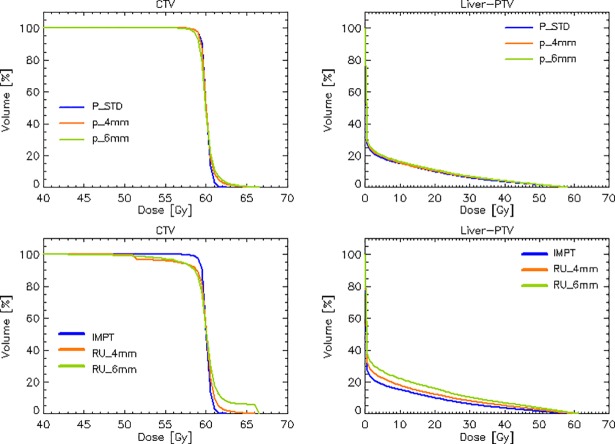
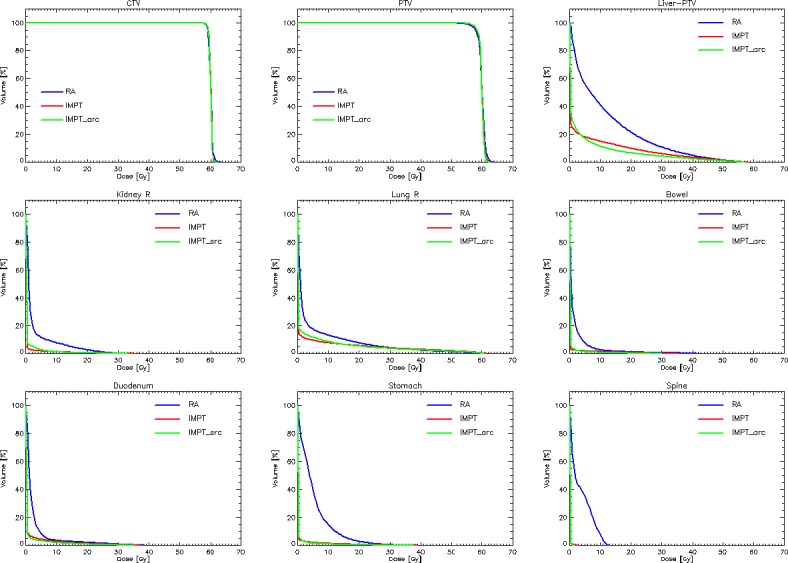
Target coverage was fully achieved by both VMAT and IMPT plans with a significant improvement in homogeneity (~25%) with IMPT. Integral dose was reduced of ~60% with IMPT while the conformality of the dose distributions was similar among techniques. The sparing of the organs at risk was strongly improved with IMPT although all clinical objectives were met for both techniques. The inclusion of the uncertainties in the optimization lead to some deterioration in the target dose homogeneity (from 40 to 80% worse with 4 or 6mm position uncertainty) while none of the coverage parameters or OAR objective was violated. The worst-case scenario analysis demonstrated the risk of a major target underdosage only in the case of the most extreme errors (6mm) with D98% in average ~12% lower than the threshold.
IMPT with the support of abdominal compression, can be considered a viable solution also for advanced hepatocellular carcinoma patients. Great care shall be put in the minimization of the residual respiration and positioning uncertainties but the dosimetric advantage for organs at risk and the relative robustness on target coverage are promising factors.
与容积旋转调强放疗(VMAT)相比,研究强度调制质子治疗(IMPT)在治疗晚期肝细胞癌中的作用。
对 20 名患者进行了一项体内规划研究。处方剂量为 60Gy,分为 6 次。患者接受腹部压缩。IMPT 计划在不包括 CT 校准(3%)和等中心定位(2、4、6mm)不确定性的情况下进行优化。通过比较稳健优化计划与标准计划,以及最坏情况下的计划稳健性来评估计划的稳健性。使用 2 个部分弧对 VMAT 计划进行了优化,以实现 10FFF 光子束。
VMAT 和 IMPT 计划均完全实现了靶区覆盖,IMPT 可显著改善均匀性(~25%)。IMPT 可将整体剂量降低约 60%,而剂量分布的适形性在各种技术之间相似。尽管两种技术都满足了所有临床目标,但 IMPT 可大大改善危及器官的保护。在优化中纳入不确定性会导致靶区剂量均匀性恶化(4 或 6mm 位置不确定性时从 40%恶化至 80%),但没有任何覆盖参数或 OAR 目标受到侵犯。最坏情况场景分析表明,只有在最极端的误差(6mm)情况下,D98%平均约比阈值低 12%,才存在靶区重大剂量不足的风险。
在腹部压缩的支持下,IMPT 也可被视为治疗晚期肝细胞癌患者的可行方案。应特别注意最小化残余呼吸和定位不确定性,但对于危及器官的剂量优势和对靶区覆盖的相对稳健性是有前途的因素。