Instituto para a Valorização da Educação e da Pesquisa no Estado de São Paulo (IVEPESP), São Paulo, SP, Brazil.
Harvard University, Graduate School of Education, Cambridge, United States.
J Pediatr (Rio J). 2020 Jan-Feb;96(1):66-75. doi: 10.1016/j.jped.2018.07.008. Epub 2018 Aug 11.
The present study aims to analyze the psychometric properties and general validity of the Caregiver Reported Early Development Instruments (CREDI) short form for the population-level assessment of early childhood development for Brazilian children under age 3.
The study analyzed the acceptability, test-retest reliability, internal consistency and discriminant validity of the CREDI short-form tool. The study also analyzed the concurrent validity of the CREDI with a direct observational measure (Inter-American Development Bank's Regional Project on Child Development Indicators; PRIDI). The full sample includes 1,265 Brazilian caregivers of children from 0 to 35 months (678 of which comprising an in-person sample and 587 an online sample).
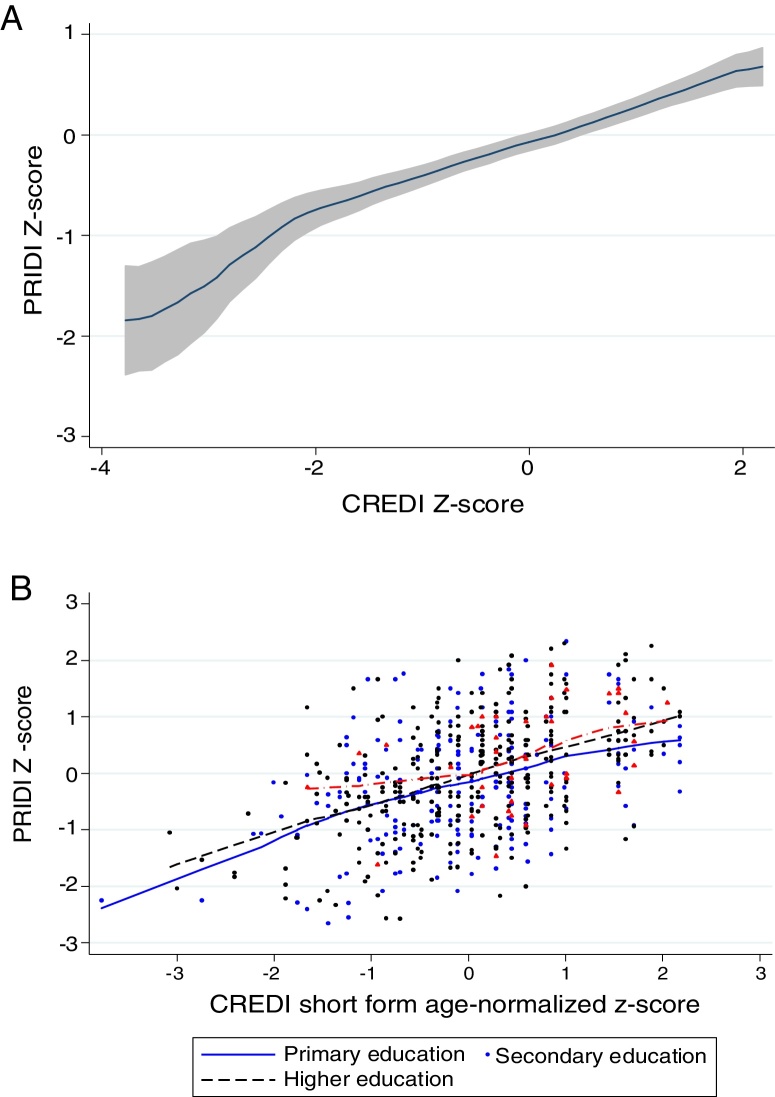
Results from qualitative interviews suggest overall high rates of acceptability. Most of the items showed adequate test-retest reliability, with an average agreement of 84%. Cronbach's alpha suggested adequate internal consistency/inter-item reliability (α>0.80) for the CREDI within each of the six age groups (0-5, 6-11, 12-17, 18-23, 24-29 and 30-35 months of age). Multivariate analyses of construct validity showed that a significant proportion of the variance in CREDI scores could be explained by child gender and family characteristics, most importantly caregiver-reported cognitive stimulation in the home (p<0.0001). Regarding concurrent validity, scores on the CREDI were significantly correlated with overall PRIDI scores within the in-person sample at r=0.46 (p<0.001).
The results suggested that the CREDI short form is a valid, reliable, and acceptable measure of early childhood development for children under the age of 3 years in Brazil.
本研究旨在分析适用于巴西 3 岁以下儿童的婴幼儿早期发展评估工具(CREDI)短式问卷的心理测量学特性和一般有效性。
研究分析了 CREDI 短式问卷的可接受性、重测信度、内部一致性和判别有效性。还分析了 CREDI 与直接观察测量(泛美开发银行儿童发展指标区域项目;PRIDI)的同时效度。全样本包括 1265 名巴西儿童(0-35 个月)的照料者,其中 678 名接受了面对面访谈,587 名接受了在线访谈。
定性访谈结果表明该问卷总体接受度较高。大多数项目的重测信度较好,平均一致性为 84%。克朗巴赫α值表明 CREDI 在每个年龄组(0-5、6-11、12-17、18-23、24-29 和 30-35 个月)内的内部一致性/项目间信度均较高(α>0.80)。结构有效性的多变量分析表明,CREDI 评分的差异可由儿童性别和家庭特征解释,其中最重要的是照料者报告的家庭认知刺激(p<0.0001)。关于同时效度,CREDI 评分与面对面样本中的 PRIDI 总分显著相关,相关系数为 r=0.46(p<0.001)。
结果表明,CREDI 短式问卷是一种有效的、可靠的、可接受的巴西 3 岁以下儿童早期发展测量工具。