Bott Nicholas, Kumar Shefali, Krebs Caitlyn, Glenn Jordan M, Madero Erica N, Juusola Jessie L
Department of Medicine, School of Medicine, Stanford University, Stanford, CA, United States.
Neurotrack Technologies, Inc, Redwood City, CA, United States.
JMIR Res Protoc. 2018 Aug 13;7(8):e11368. doi: 10.2196/11368.
A growing body of evidence supports the use of lifestyle interventions for preventing or delaying the onset of Alzheimer disease and other forms of dementia in at-risk individuals. The development of internet-delivered programs would increase the scalability and reach of these interventions, but requires validation to ensure similar effectiveness to brick-and-mortar options.
We describe the study design, recruitment process, and baseline participant characteristics of the sample in the Virtual Cognitive Health (VC Health) study. Future analyses will assess the impact of the remotely delivered lifestyle intervention on (1) cognitive function, (2) depression and anxiety, and (3) various lifestyle behaviors, including diet, exercise, and sleep, in a cohort of older adults with subjective memory decline. Additional analyses will explore feasibility outcomes, as well as the participants' engagement patterns with the program.
Older adults (aged 60-75 years) with subjective memory decline as measured by the Subjective Cognitive Decline 9-item (SCD-9) questionnaire, and who reported feeling worried about their memory decline, were eligible to participate in this single-arm pre-post study. All participants enrolled in the yearlong digital intervention, which consists of health coach-guided lifestyle change for improving diet, exercise, sleep, stress, and cognition. All components of this study were conducted remotely, including the collection of data and the administration of the intervention. We assessed participants at baseline, 12 weeks, 24 weeks, and 52 weeks with online surveys and the Repeatable Battery for the Assessment of Neuropsychological Status (RBANS) test. We will conduct intention-to-treat analysis on all outcomes.
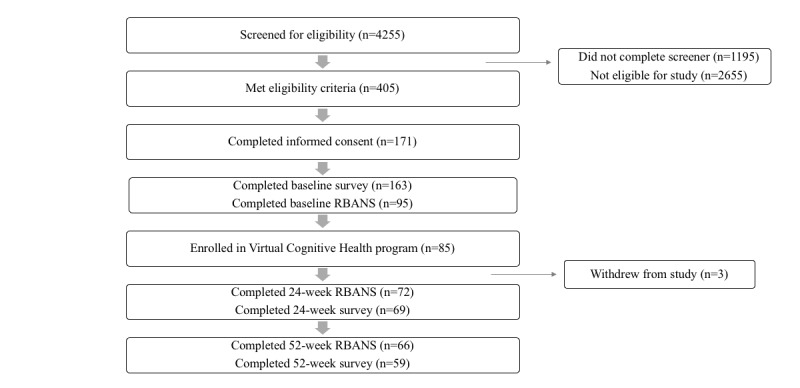
A total of 85 participants enrolled in the intervention and 82 are included in the study sample (3 participants withdrew). The study cohort of 82 participants comprises 61 (74%) female, 72 (88%) white, and 64 (78%) overweight or obese participants, and 55 (67%) have at least a college degree. The average baseline RBANS score was 95.9 (SD 11.1), which is within age-adjusted norms. The average SCD-9 score was 6.0 (SD 2.0), indicating minor subjective cognitive impairment at the beginning of the study. The average baseline Generalized Anxiety Disorder 7-item scale score was 6.2 (SD 4.5), and the average Patient Health Questionnaire 9-item score was 8.5 (SD 4.9), indicating mild levels of anxiety and depression at baseline.
Internet-delivered lifestyle interventions are a scalable solution for the prevention or delay of Alzheimer disease. The results of this study will provide the first evidence for the effectiveness of a fully remote intervention and lay the groundwork for future investigations.
ClinicalTrials.gov NCT02969460; http://clinicaltrials.gov/ct2/show/NCT02969460 (Archived by WebCite at http://www.webcitation.org/71LkYAkSh).
RR1-10.2196/11368.
越来越多的证据支持采用生活方式干预措施来预防或延缓高危个体患阿尔茨海默病及其他形式痴呆症。基于互联网的项目开发将提高这些干预措施的可扩展性和覆盖面,但需要进行验证以确保与实体项目具有相似的效果。
我们描述虚拟认知健康(VC Health)研究中样本的研究设计、招募过程和基线参与者特征。未来的分析将评估远程提供的生活方式干预对一组有主观记忆衰退的老年人在(1)认知功能、(2)抑郁和焦虑以及(3)各种生活方式行为(包括饮食、运动和睡眠)方面的影响。额外的分析将探索可行性结果以及参与者对该项目的参与模式。
年龄在60 - 75岁之间、通过主观认知衰退9项问卷(SCD - 9)测量有主观记忆衰退且表示担心自己记忆衰退的老年人有资格参与这项单组前后对照研究。所有参与者都参加了为期一年的数字干预,该干预包括由健康教练指导的生活方式改变,以改善饮食、运动、睡眠、压力和认知。本研究的所有环节均远程进行,包括数据收集和干预实施。我们在基线、12周、24周和52周时通过在线调查和可重复神经心理状态评估量表(RBANS)测试对参与者进行评估。我们将对所有结果进行意向性分析。
共有85名参与者报名参加干预,82名被纳入研究样本(3名参与者退出)。82名参与者的研究队列包括61名(74%)女性、72名(88%)白人、64名(78%)超重或肥胖参与者,55名(67%)至少拥有大学学位。平均基线RBANS评分为95.9(标准差11.1),在年龄调整后的正常范围内。平均SCD - 9评分为6.0(标准差2.0),表明研究开始时存在轻微主观认知障碍。平均基线广泛性焦虑障碍7项量表评分为6.2(标准差4.5),平均患者健康问卷9项评分为8.5(标准差4.9),表明基线时焦虑和抑郁程度较轻。
基于互联网的生活方式干预是预防或延缓阿尔茨海默病的一种可扩展解决方案。本研究结果将为完全远程干预的有效性提供首个证据,并为未来的研究奠定基础。
ClinicalTrials.gov NCT02969460;http://clinicaltrials.gov/ct2/show/NCT02969460(由WebCite存档于http://www.webcitation.org/71LkYAkSh)。
RR1 - 10.2196/11368。