Castellano-Castillo Daniel, Moreno-Indias Isabel, Fernandez-Garcia Jose Carlos, Clemente-Postigo Mercedes, Castro-Cabezas Manuel, Tinahones Francisco José, Queipo-Ortuño María Isabel, Cardona Fernando
Unidad de Gestión Clínica de Endocrinología y Nutrición del Hospital Virgen de la Victoria, Instituto de Investigación Biomédica de Málaga (IBIMA), Universidad de Malaga, 29010 Malaga, Spain.
Centro de Investigación Biomédica en Red de Fisiopatología de la Obesidad y la Nutrición (CIBERobn), 28029 Madrid, Spain.
Genes (Basel). 2018 Aug 13;9(8):410. doi: 10.3390/genes9080410.
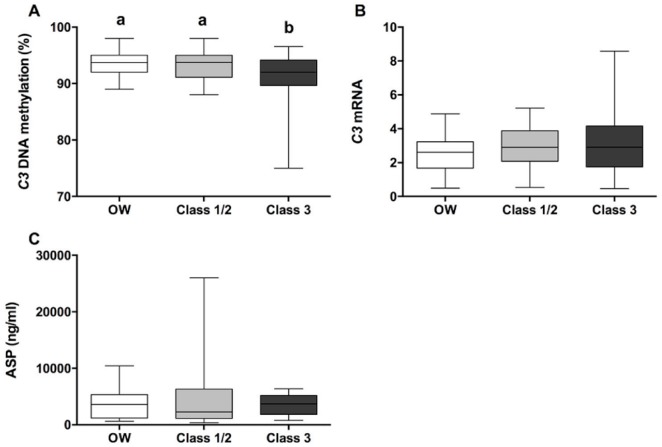
Epigenetic marks, and especially DNA methylation, are becoming an important factor in obesity, which could help to explain its etiology and associated comorbidities. Adipose tissue, now considered as an important endocrine organ, produces complement system factors. Complement component 3 () turns out to be an important protein in metabolic disorders, via either inflammation or the subproduct acylation stimulating protein (ASP) which directly stimulates lipid storage. In this study, we analyze DNA methylation in adipose tissue from subjects with a different grade of obesity. Adipose tissue samples were collected from subjects with a different degree of obesity determined by their body mass index (BMI) as: Overweight subjects (BMI ≥ 25 and <30), obese class 1/2 subjects (BMI ≥ 30 and <40) and obese class 3 subjects (BMI ≥ 40). C3 DNA methylation was measured for 7 CpGs by pyrosequencition using the Pyromark technology (Qiagen, Madrid Spain). C3 messenger RNA (mRNA) levels were analyzed by pre-designed Taqman assays (Applied biosystems, Foster City, CA, USA) and ASP/C3a was measured using a ELISA kit. The data were analyzed using the statistic package SPSS. DNA methylation levels were lower in the morbid obese group. Accordingly, methylation correlated negatively with BMI and leptin. However, mRNA levels were more associated with insulin resistance, and positive correlations with insulin, glucose and homeostasis model assessment-estimated insulin resistance (HOMA-IR) existed. ASP correlated negatively with high density lipoprotein (HDL) cholesterol. methylation levels were associated to adiposity variables, such as BMI and leptin, while the mRNA levels were associated to glucose metabolism.
表观遗传标记,尤其是DNA甲基化,正成为肥胖症中的一个重要因素,这有助于解释其病因及相关合并症。脂肪组织如今被视为一个重要的内分泌器官,可产生补体系统因子。补体成分3(C3)经证实是代谢紊乱中的一种重要蛋白质,其作用途径要么是炎症,要么是通过直接刺激脂质储存的副产物酰化刺激蛋白(ASP)。在本研究中,我们分析了不同肥胖程度受试者脂肪组织中的DNA甲基化情况。根据体重指数(BMI)将受试者分为不同肥胖程度来采集脂肪组织样本:超重受试者(BMI≥25且<30)、1/2级肥胖受试者(BMI≥30且<40)以及3级肥胖受试者(BMI≥40)。使用焦磷酸测序技术(Pyromark技术,Qiagen公司,西班牙马德里)对7个CpG位点的C3 DNA甲基化进行测定。通过预先设计的Taqman分析(Applied biosystems公司,美国加利福尼亚州福斯特城)分析C3信使核糖核酸(mRNA)水平,并使用酶联免疫吸附测定试剂盒测量ASP/C3a。使用统计软件包SPSS对数据进行分析。病态肥胖组的DNA甲基化水平较低。相应地,C3甲基化与BMI和瘦素呈负相关。然而,C3 mRNA水平与胰岛素抵抗的关联更强,且与胰岛素、葡萄糖和稳态模型评估估计的胰岛素抵抗(HOMA-IR)呈正相关。ASP与高密度脂蛋白(HDL)胆固醇呈负相关。C3甲基化水平与肥胖变量如BMI和瘦素相关,而C3 mRNA水平与葡萄糖代谢相关。