Department of Biomedical Engineering, The University of Texas at Austin, Austin, Texas, 78712, USA.
Department of Chemical Engineering, The University of Texas at Austin, Austin, Texas, 78712, USA.
Sci Rep. 2018 Aug 13;8(1):12058. doi: 10.1038/s41598-018-30467-w.
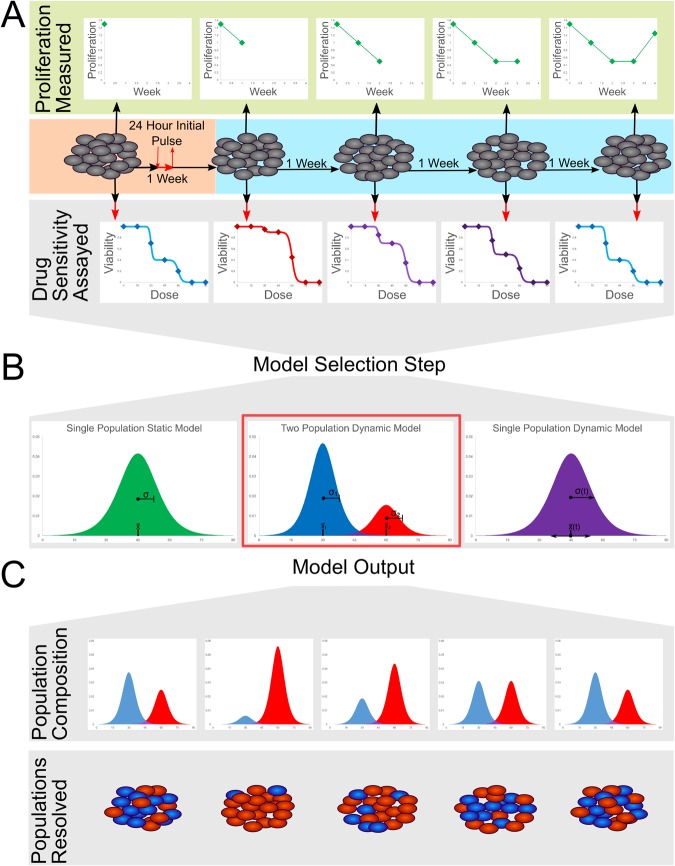
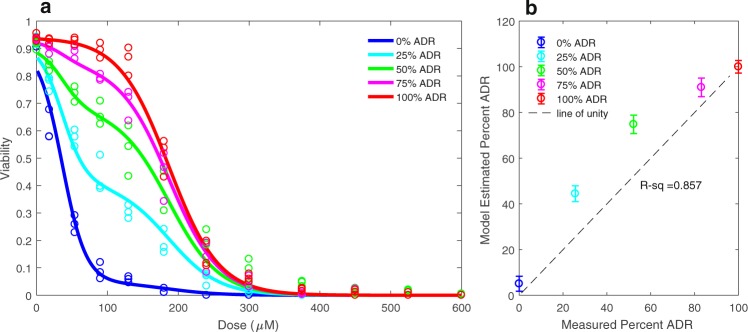
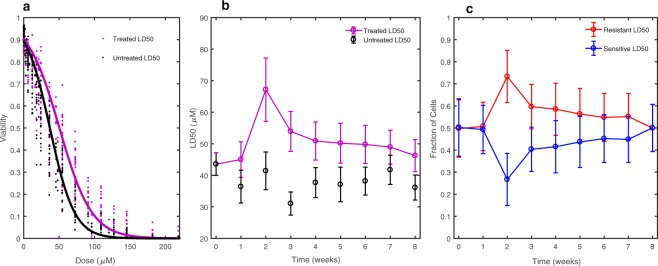
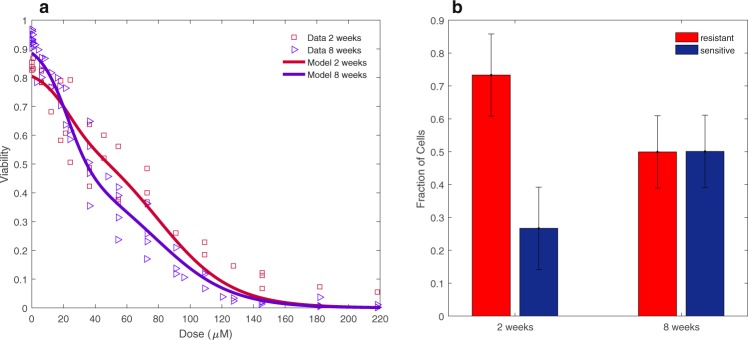
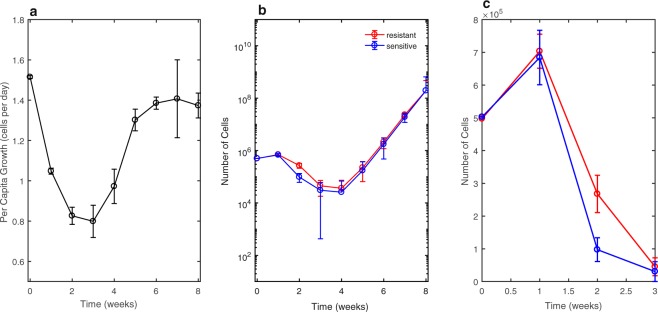
The development of resistance to chemotherapy is a major cause of treatment failure in breast cancer. While mathematical models describing the dynamics of resistant cancer cell subpopulations have been proposed, experimental validation has been difficult due to the complex nature of resistance that limits the ability of a single phenotypic marker to sufficiently identify the drug resistant subpopulations. We address this problem with a coupled experimental/modeling approach to reveal the composition of drug resistant subpopulations changing in time following drug exposure. We calibrate time-resolved drug sensitivity assays to three mathematical models to interrogate the models' ability to capture drug response dynamics. The Akaike information criterion was employed to evaluate the three models, and it identified a multi-state model incorporating the role of population heterogeneity and cellular plasticity as the optimal model. To validate the model's ability to identify subpopulation composition, we mixed different proportions of wild-type MCF-7 and MCF-7/ADR resistant cells and evaluated the corresponding model output. Our blinded two-state model was able to estimate the proportions of cell types with an R-squared value of 0.857. To the best of our knowledge, this is the first work to combine experimental time-resolved drug sensitivity data with a mathematical model of resistance development.
化疗耐药的发展是乳腺癌治疗失败的主要原因。虽然已经提出了描述耐药癌细胞亚群动力学的数学模型,但由于耐药的复杂性限制了单一表型标志物充分识别耐药亚群的能力,因此实验验证一直很困难。我们采用耦合的实验/建模方法来解决这个问题,以揭示药物暴露后耐药亚群随时间变化的组成。我们对三种数学模型进行了时间分辨药物敏感性测定,以检查这些模型捕获药物反应动力学的能力。Akaike 信息准则用于评估这三个模型,结果表明,包含群体异质性和细胞可塑性作用的多状态模型是最佳模型。为了验证模型识别亚群组成的能力,我们混合了不同比例的野生型 MCF-7 和 MCF-7/ADR 耐药细胞,并评估了相应的模型输出。我们的盲法两状态模型能够以 0.857 的 R 平方值估计细胞类型的比例。据我们所知,这是首次将实验时间分辨药物敏感性数据与耐药发展的数学模型相结合的工作。