Department of Naval Architecture and Ocean Engineering, Inha University, Incheon, 22212, South Korea.
School of Nano & Adv. Mater. Engineering, Kyungpook National University, Sangju, 37224, South Korea.
Sci Rep. 2018 Aug 13;8(1):12023. doi: 10.1038/s41598-018-30633-0.
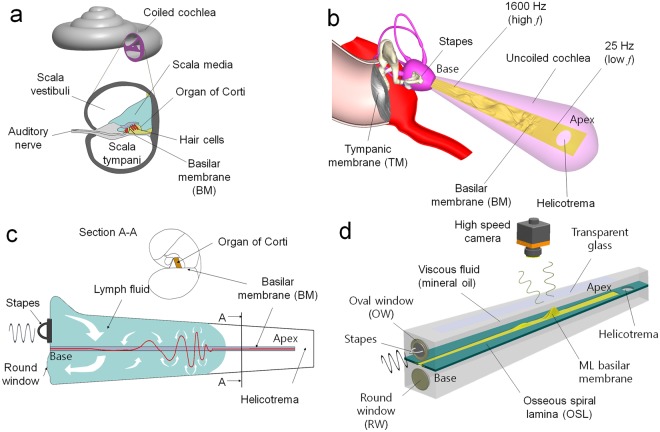
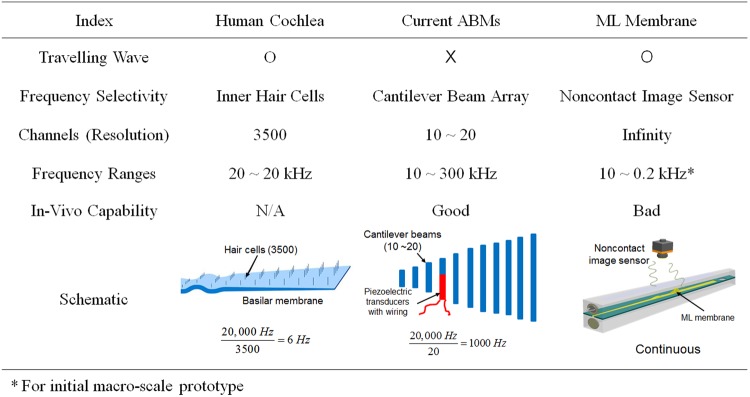
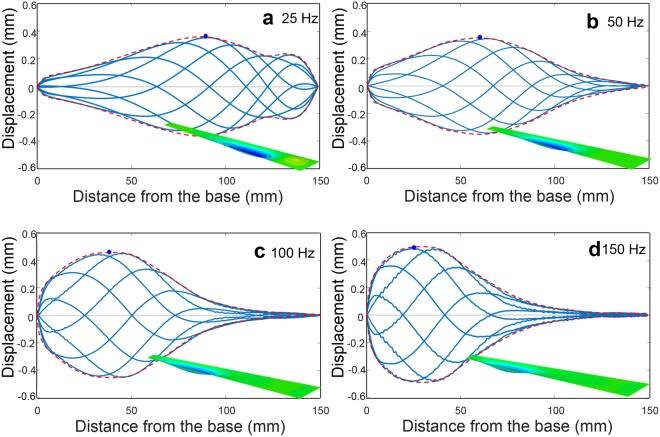
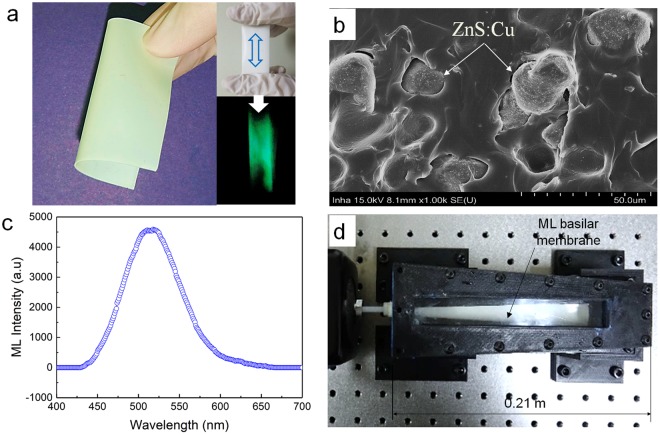
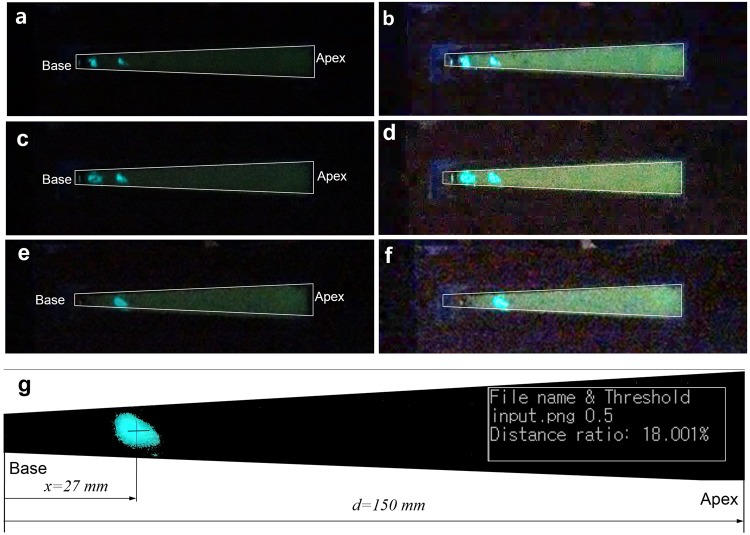
This study presents the initial assessment for a new approach to frequency selectivity aimed at mimicking the function of the basilar membrane within the human cochlea. The term cochlea tonotopy refers to the passive frequency selectivity and a transformation from the acoustic wave into a frequency signal assisted by the hair cells in the organ of Corti. While high-frequency sound waves vibrate near the base of the cochlea (near the oval windows), low-frequency waves vibrate near the apex (at the maximum distance from the base), which suggests the existence of continuous frequency selectivity. Over the past few decades, frequency selectivity using artificial membranes has been utilized in acoustic transducers by mimicking cochlea tonotopy using cantilever-beam arrays with defined physical parameters such as length and thickness. Unlike the conventional cantilever-beam array type, the travelling wave propagation based-mechanoluminescence (ML) membrane made of ZnS:Cu- polydimethylsiloxane (ZnS:Cu-PDMS) composite that we describe here provides new frequency selectivity more similar to that demonstrated by the human membrane. Here, we explored the potential of the ML membrane to deliver new frequency selectivity by using a non-contact image sensor to measure visualized frequencies. We report that the ML basilar membrane can provide effective visualization of the distribution of strain rate associated with the position of maximal amplitude of the travelling wave.
本研究提出了一种新的频率选择性方法的初步评估,旨在模拟人耳蜗中基底膜的功能。术语耳蜗调谐指的是被动频率选择性,以及由柯蒂氏器中的毛细胞辅助将声波转换为频率信号的过程。虽然高频声波在耳蜗底部附近(靠近卵圆窗)振动,而低频波在顶部附近振动(距底部最大距离处),这表明存在连续的频率选择性。在过去的几十年中,使用人工膜的频率选择性已经在声换能器中得到了应用,通过使用具有定义物理参数(如长度和厚度)的悬臂梁阵列模拟耳蜗调谐来实现。与传统的悬臂梁阵列类型不同,我们在这里描述的基于行波传播的机械发光(ML)膜由 ZnS:Cu-聚二甲基硅氧烷(ZnS:Cu-PDMS)复合材料制成,提供了更类似于人膜的新频率选择性。在这里,我们通过使用非接触式图像传感器来测量可视化频率,探索了 ML 膜提供新频率选择性的潜力。我们报告称,ML 基底膜可以有效地可视化与行波最大振幅位置相关的应变速率分布。