Department of Internal Medicine, University of Iowa, Iowa city, IA, USA.
Sci Rep. 2018 Aug 13;8(1):12026. doi: 10.1038/s41598-018-30462-1.
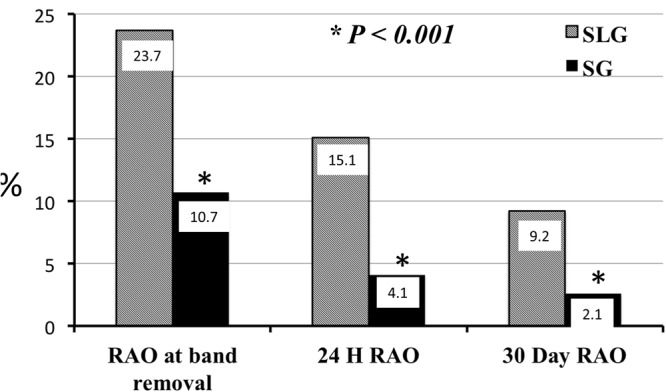
We compared the risk of radial artery occlusion (RAO) in patients undergoing coronary intervention with introducer sheath (SG) or without introducer sheath (SLG). 1251 consecutive patients, from 2 tertiary care center in Pennsylvania, USA, undergoing percutaneous coronary interventions (PCI) between 2008-2013 formed the study cohort (SLG: 161 patients, SG: 1090 patients). Radial artery patency was assessed using plethysmography. The association between sheath use and RAO was assessed using unadjusted, adjusted and propensity macthed logistic regression analyses. Mean age: 65 years, men: 63%, diabetics: 37%. SG was associated with lower RAO at band removal [unadjusted (OR: 0.31, 95% CI: 0.21-0.46), adjusted (OR: 0.10, 95% CI: 0.05-0.20) and propensity matched (OR: 0.20, 95% CI: 0.13-0.32)], at 24 hours [unadjusted (OR: 0.20, 95% CI: 0.12-0.34), adjusted (OR: 0.12, 95% CI: 0.06-0.24) and propensity matched (OR: 0.13, 95% CI: 0.07-0.25)] and 30 days [unadjusted (OR: 0.28, 95% CI: 0.14-0.54), adjusted (OR: 0.22, 95% CI: 0.10-0.50) and propensity matched (OR: 0.18, 95% CI: 0.10-0.40)], compared to SLG. Sheath use during radial access for PCI is associated with less RAO. It is unclear if use of introducer sheath during radial access for PCI reduces incidence of RAO. In this prospective cohort study involving 1251 concecutive patients undergoing PCI via radial access between 2008-2013, we assessed the difference in incidence of RAO between the SG (n = 1090) and the SLG (n = 161 patients) groups. SG group experienced lower incidence of RAO at band removal, 24 hours and 30 days post PCI in the unadjusted, adjusted, and propensity matched analyses compared to the SLG group. In conclusion sheath use during radial access for PCI is associated with less RAO.
我们比较了在宾夕法尼亚州 2 家三级护理中心接受经皮冠状动脉介入治疗(PCI)的患者中,使用导引导管鞘(SG)和不使用导引导管鞘(SLG)的桡动脉闭塞(RAO)风险。该研究队列由 2008-2013 年间接受 PCI 的 1251 例连续患者组成(SLG:161 例,SG:1090 例)。使用体积描记法评估桡动脉通畅性。使用未调整、调整和倾向匹配逻辑回归分析评估鞘的使用与 RAO 之间的关系。平均年龄为 65 岁,男性占 63%,糖尿病患者占 37%。SG 组在去除绷带时 RAO 的发生率较低[未调整(OR:0.31,95%CI:0.21-0.46),调整(OR:0.10,95%CI:0.05-0.20)和倾向匹配(OR:0.20,95%CI:0.13-0.32)],24 小时[未调整(OR:0.20,95%CI:0.12-0.34),调整(OR:0.12,95%CI:0.06-0.24)和倾向匹配(OR:0.13,95%CI:0.07-0.25)]和 30 天[未调整(OR:0.28,95%CI:0.14-0.54),调整(OR:0.22,95%CI:0.10-0.50)和倾向匹配(OR:0.18,95%CI:0.10-0.40)]与 SLG 相比。与 SLG 相比,PCI 时桡动脉入路使用鞘管与 RAO 发生率较低相关。鞘管在 PCI 时桡动脉入路中的使用是否降低 RAO 发生率尚不清楚。在这项涉及 2008-2013 年间经桡动脉入路接受 PCI 的 1251 例连续患者的前瞻性队列研究中,我们评估了 SG(n=1090)和 SLG(n=161 例)组之间 RAO 发生率的差异。与 SLG 组相比,SG 组在未调整、调整和倾向匹配分析中,在去除绷带、24 小时和 30 天的桡动脉闭塞发生率较低。总之,PCI 时桡动脉入路使用鞘管与 RAO 发生率较低有关。