Department of BioNano Technology, Gachon Medical Research Institute, Gachon University, Seongnam, South Korea,
Department of Neurology, Seoul National University College of Medicine & Neurocognitive Behavior Center, Seoul National University Bundang Hospital, Seongnam, South Korea,
Clin Interv Aging. 2018 Jul 31;13:1321-1329. doi: 10.2147/CIA.S170374. eCollection 2018.
Autosomal dominant early-onset Alzheimer's disease (EOAD) is genetically heterogeneous and has been associated with mutations in 3 different genes, coding for amyloid precursor protein (APP), presenilin 1 (PSEN1), and presenilin 2 (PSEN2). Most frequent cases are associated with mutations in the gene, whereas mutations in the and genes are rare.
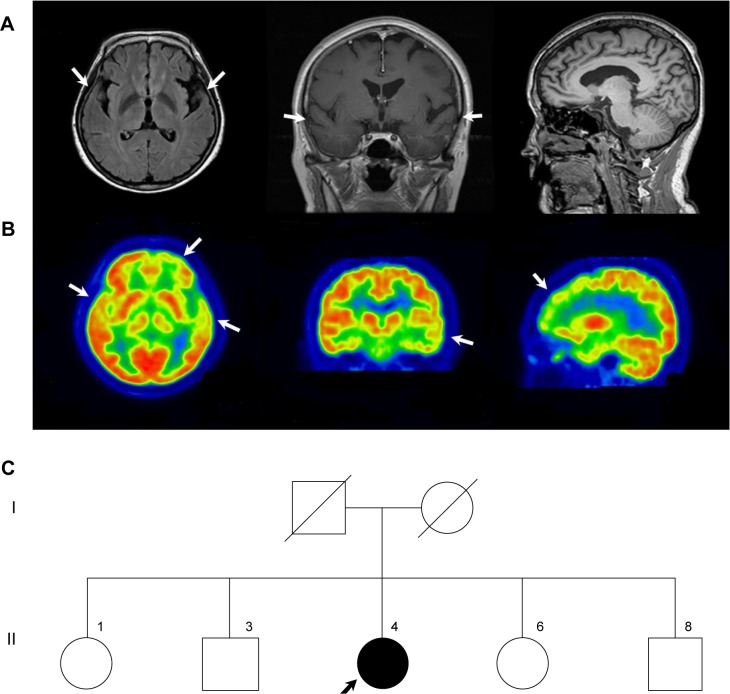
Patient who presented progressive memory decline in her 50s was enrolled in this study. A broad battery of neuropsychological tests and neuroimaging was applied to make the diagnosis. Genetic tests were performed in the patient to evaluate possible mutations using next-generation sequencing (NGS). The pathogenic nature of missense mutation and its 3D protein structure prediction were performed by in silico prediction programs.
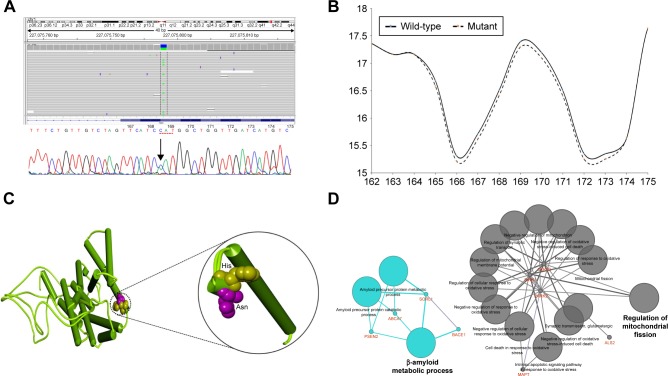
A pathogenic mutation in the PSEN2 gene in a Korean patient associated with EOAD was identified. Targeted Next-generation sequencing and Sanger sequencing revealed a heterozygous C to A transition at position 505 (c.505C>A), resulting in a probably missense mutation at codon 169 (p.His169Asn) in PSEN2. PolyPhen-2 and SIFT software analyses predicted this mutation to be a probable damaging variant. This hypothesis was supported by the results of 3D in silico modelling analyses that predicted the p.His169Asn may result in major helix torsion due to histidine to asparagine substitution. Mutation may cause additional stresses with hydrophobic residues on the surface that interact inside the transmembrane domain III, which is a conserved domain in PSEN2 His169.
These findings revealed that the p.His169Asn might be an important residue in PSEN2, which may alter the functions of PSEN2, suggesting its potential involvement with AD phenotype. Future functional studies are needed to evaluate the role of PSEN2 p.His169Asn mutation in AD disease progression.
常染色体显性早发性阿尔茨海默病(EOAD)在遗传上具有异质性,与 3 种不同基因的突变有关,这些基因分别编码淀粉样前体蛋白(APP)、早老素 1(PSEN1)和早老素 2(PSEN2)。最常见的病例与 基因的突变有关,而 和 基因的突变则很少见。
本研究纳入了一位在 50 多岁时出现进行性记忆减退的患者。应用广泛的神经心理学测试和神经影像学来做出诊断。对患者进行基因检测,使用下一代测序(NGS)评估可能的突变。通过计算机预测程序对错义突变的致病性及其 3D 蛋白结构预测进行分析。
在一名韩国 EOAD 患者中发现了 PSEN2 基因的致病性突变。靶向下一代测序和 Sanger 测序显示,505 位的 C 到 A 颠换(c.505C>A),导致 PSEN2 中 169 号密码子的脯氨酸(p.His169Asn)可能发生错义突变。PolyPhen-2 和 SIFT 软件分析预测该突变可能是一种可能的有害变异。该假设得到了 3D 计算机建模分析结果的支持,该分析预测 p.His169Asn 可能导致由于组氨酸替换为天冬酰胺而导致主要螺旋扭转。突变可能导致跨膜域 III 内相互作用的表面上的疏水性残基产生额外的应力,这是 PSEN2 His169 中的保守域。
这些发现表明 p.His169Asn 可能是 PSEN2 中的一个重要残基,可能改变 PSEN2 的功能,提示其可能与 AD 表型有关。需要进行未来的功能研究来评估 PSEN2 p.His169Asn 突变在 AD 疾病进展中的作用。