Roda Alejandro R, Serra-Mir Gabriel, Montoliu-Gaya Laia, Tiessler Lidia, Villegas Sandra
Protein Design and Immunotherapy Group, Departament de Bioquímica i Biologia Molecular, Facultat de Biociències, Universitat Autònoma de Barcelona, Bellaterra, Barcelona, Spain.
Department of Psychiatry and Neurochemistry, Institute of Neuroscience and Physiology, The Sahlgrenska Academy, University of Gothenburg, Sweden.
Neural Regen Res. 2022 Aug;17(8):1666-1674. doi: 10.4103/1673-5374.332127.
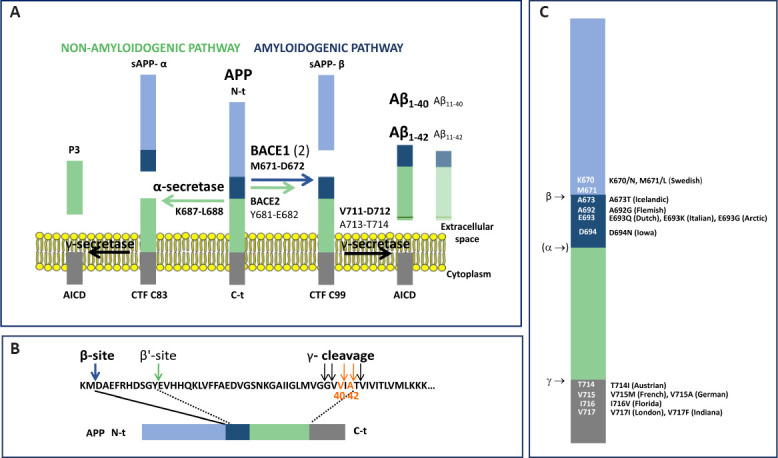
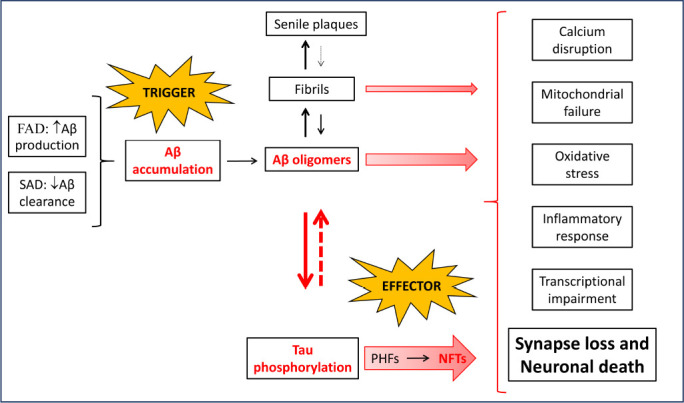
Alzheimer's disease is a neurodegenerative disease that accounts for most of the 50-million dementia cases worldwide in 2018. A large amount of evidence supports the amyloid cascade hypothesis, which states that amyloid-beta accumulation triggers tau hyperphosphorylation and aggregation in form of neurofibrillary tangles, and these aggregates lead to inflammation, synaptic impairment, neuronal loss, and thus to cognitive decline and behavioral abnormalities. The poor correlation found between cognitive decline and amyloid plaques, have led the scientific community to question whether amyloid-beta accumulation is actually triggering neurodegeneration in Alzheimer's disease. The occurrence of tau neurofibrillary tangles better correlates to neuronal loss and clinical symptoms and, although amyloid-beta may initiate the cascade of events, tau impairment is likely the effector molecule of neurodegeneration. Recently, it has been shown that amyloid-beta and tau cooperatively work to impair transcription of genes involved in synaptic function and, more importantly, that downregulation of tau partially reverses transcriptional perturbations. Despite mounting evidence points to an interplay between amyloid-beta and tau, some factors could independently affect both pathologies. Thus, the dual pathway hypothesis, which states that there are common upstream triggers causing both amyloid-beta and tau abnormalities has been proposed. Among others, the immune system seems to be strongly involved in amyloid-beta and tau pathologies. Other factors, as the apolipoprotein E ε4 isoform has been suggested to act as a link between amyloid-beta and tau hyperphosphorylation. Interestingly, amyloid-beta-immunotherapy reduces not only amyloid-beta but also tau levels in animal models and in clinical trials. Likewise, it has been shown that tau-immunotherapy also reduces amyloid-beta levels. Thus, even though amyloid-beta immunotherapy is more advanced than tau-immunotherapy, combined amyloid-beta and tau-directed therapies at early stages of the disease have recently been proposed as a strategy to stop the progression of Alzheimer's disease.
阿尔茨海默病是一种神经退行性疾病,在2018年全球5000万例痴呆病例中占大多数。大量证据支持淀粉样蛋白级联假说,该假说认为β淀粉样蛋白的积累会触发tau蛋白的过度磷酸化,并以神经原纤维缠结的形式聚集,这些聚集体会导致炎症、突触损伤、神经元丧失,进而导致认知能力下降和行为异常。认知能力下降与淀粉样斑块之间的相关性较差,这使得科学界质疑β淀粉样蛋白的积累是否真的会引发阿尔茨海默病中的神经退行性变。tau神经原纤维缠结的出现与神经元丧失和临床症状的相关性更好,尽管β淀粉样蛋白可能引发一系列事件,但tau蛋白功能障碍可能是神经退行性变的效应分子。最近的研究表明,β淀粉样蛋白和tau蛋白共同作用会损害参与突触功能的基因的转录,更重要的是,tau蛋白的下调部分逆转了转录紊乱。尽管越来越多的证据表明β淀粉样蛋白和tau蛋白之间存在相互作用,但一些因素可能独立影响这两种病理状态。因此,有人提出了双途径假说,即存在共同的上游触发因素导致β淀粉样蛋白和tau蛋白异常。其中,免疫系统似乎与β淀粉样蛋白和tau蛋白的病理状态密切相关。其他因素,如载脂蛋白Eε4亚型,被认为是β淀粉样蛋白和tau蛋白过度磷酸化之间的联系。有趣的是,在动物模型和临床试验中,β淀粉样蛋白免疫疗法不仅能降低β淀粉样蛋白水平,还能降低tau蛋白水平。同样,研究表明tau蛋白免疫疗法也能降低β淀粉样蛋白水平。因此,尽管β淀粉样蛋白免疫疗法比tau蛋白免疫疗法更先进,但最近有人提出在疾病早期联合使用针对β淀粉样蛋白和tau蛋白的疗法,作为阻止阿尔茨海默病进展的策略。