Rahimzadeh Poupak, Imani Farnad, Ghahremani Mohammad, Faiz Seyed Hamid Reza
Pain Research Center, Iran University of Medical Sciences, Tehran, Iran,
Anesthesiology Department, Iran University of Medical Sciences, Tehran, Iran.
J Pain Res. 2018 Jul 31;11:1405-1410. doi: 10.2147/JPR.S164335. eCollection 2018.
Intervertebral disc herniation with the pressure on the surrounding neural structures is one of the most important causes of chronic low back pain, which sometimes leads to open surgery. Reducing the pressure inside the disc with intradiscal intervention such as laser irradiation or ozone injection is a minimally invasive method and an alternative to surgery with satisfactory results. These two methods were compared with each other in this research.
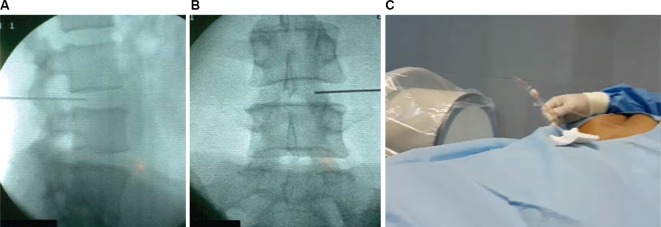
In this clinical trial, 40 patients with back pain radiating to lower limb due to lumbar intervertebral disc herniation were selected. These patients were randomly divided into two equal groups for percutaneous intradiscal intervention. The Laser Disc Decompression Group (LDG) (n=20) was exposed to 1500 J of laser irradiation into the disc center. In the Ozone Injection Group (OZG) patients (n=20), 6 mL of ozone 30 µg/mL was injected into the center of the disc. Considering the level of neural root involvement, both groups received 20 mg of triamcinolone injection via transforaminal epidural. Patients were followed up for 12 months regarding score on visual analogue scale and life performance improvement based on Oswestry Disability Index (ODI) and satisfaction level.
According to the results, no difference was found between the two groups for ODI variable before intervention, whereas OZG showed better ODI scores in the measured time intervals. In LDG, only a significant difference in terms of ODI score was found between the times of before surgery and the first month.
Intradiscal ozone injection could be an effective and cost-effective method for treatment of patients with discogenic back pain.
椎间盘突出并压迫周围神经结构是慢性下腰痛的最重要原因之一,有时会导致开放性手术。通过椎间盘内干预如激光照射或臭氧注射来降低椎间盘内压力是一种微创方法,也是手术的替代方法,效果令人满意。本研究对这两种方法进行了比较。
在这项临床试验中,选择了40例因腰椎间盘突出导致背痛向下肢放射的患者。这些患者被随机分为两组进行经皮椎间盘内干预。激光椎间盘减压组(LDG)(n = 20)接受向椎间盘中心照射1500焦耳激光。在臭氧注射组(OZG)患者(n = 20)中,向椎间盘中心注射6毫升30微克/毫升的臭氧。考虑到神经根受累程度,两组均通过椎间孔硬膜外注射20毫克曲安奈德。根据视觉模拟评分、基于奥斯维斯特里残疾指数(ODI)的生活表现改善情况和满意度水平,对患者进行了12个月的随访。
根据结果,干预前两组的ODI变量无差异,而OZG在测量的时间间隔内显示出更好的ODI评分。在LDG中,仅在手术前和第一个月的ODI评分方面存在显著差异。
椎间盘内臭氧注射可能是治疗椎间盘源性背痛患者的一种有效且经济高效的方法。