Lu Yanliu, Du Yimei, Qin Lin, Wu Di, Wang Wei, Ling Lei, Ma Feifei, Ling Hua, Yang Li, Wang Changhong, Wang Zhengtao, Zhou Xumei, He Yuqi
Key Lab of the Basic Pharmacology of the Ministry of Education, Zunyi Medical University, 6 West Xue-Fu Road, Zunyi City, Guizhou 563009, China.
Shanghai Key Laboratory of Complex Prescription, Shanghai University of Traditional Chinese Medicine, 1200 Cai-Lun Road, Shanghai 201203, China.
Evid Based Complement Alternat Med. 2018 Jul 12;2018:8098059. doi: 10.1155/2018/8098059. eCollection 2018.
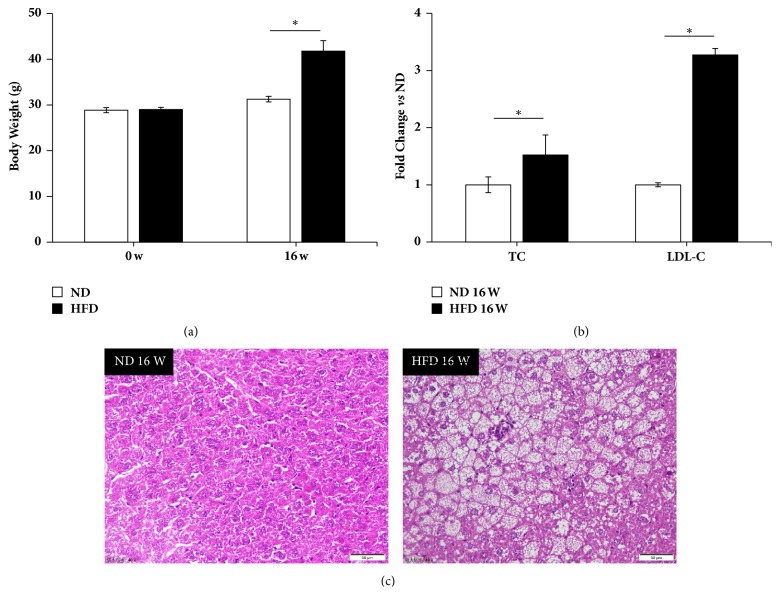
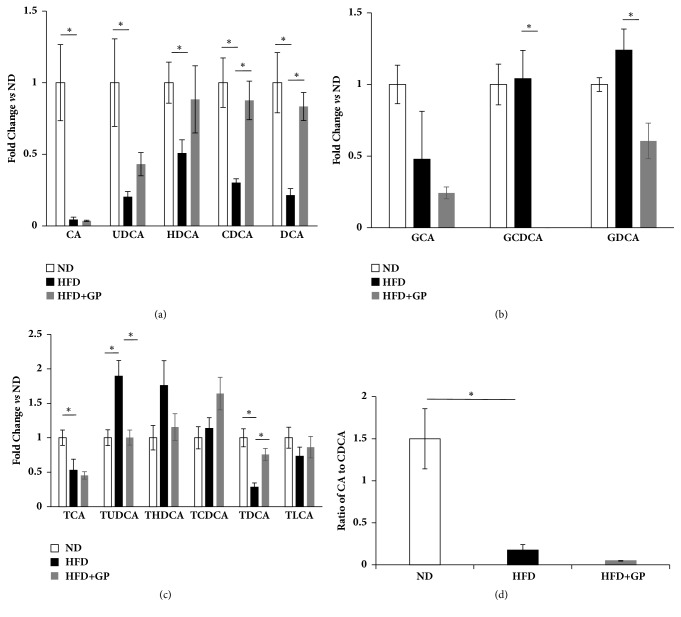
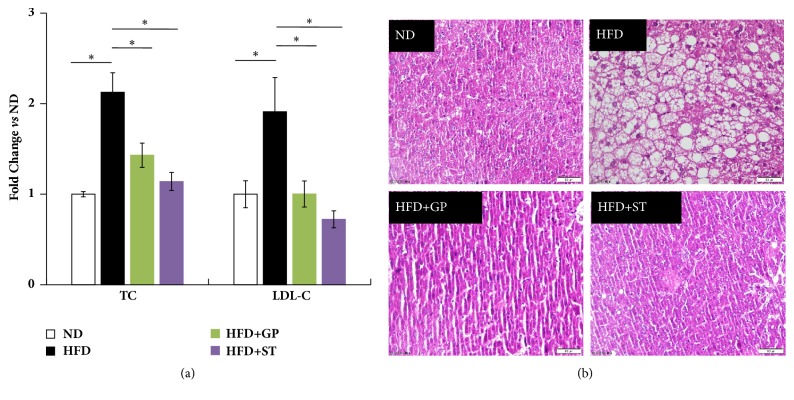
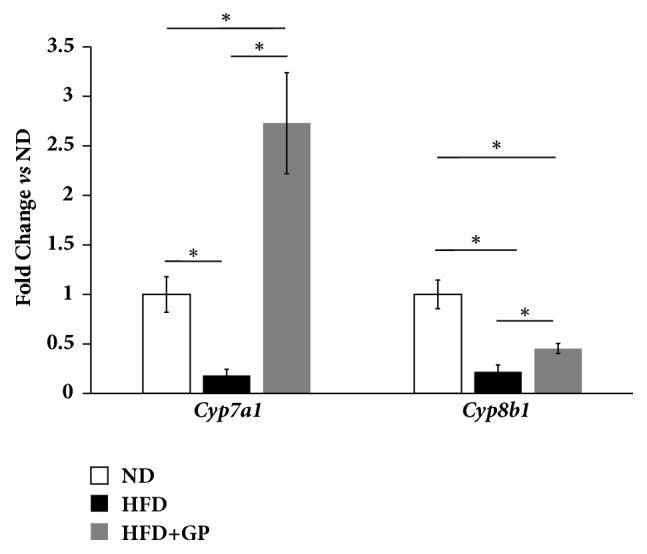
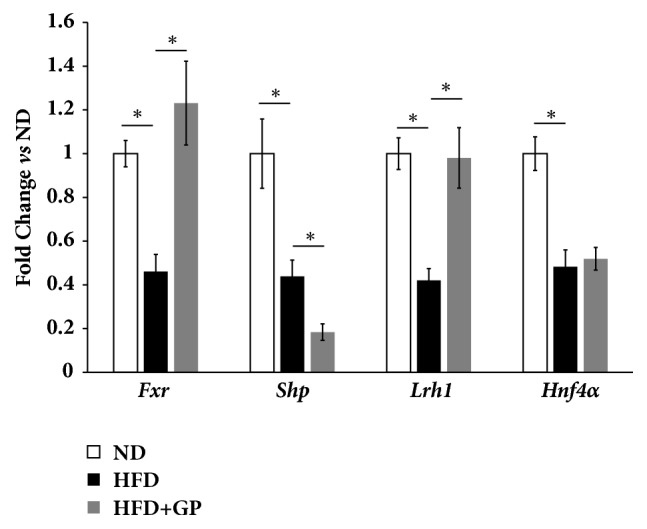
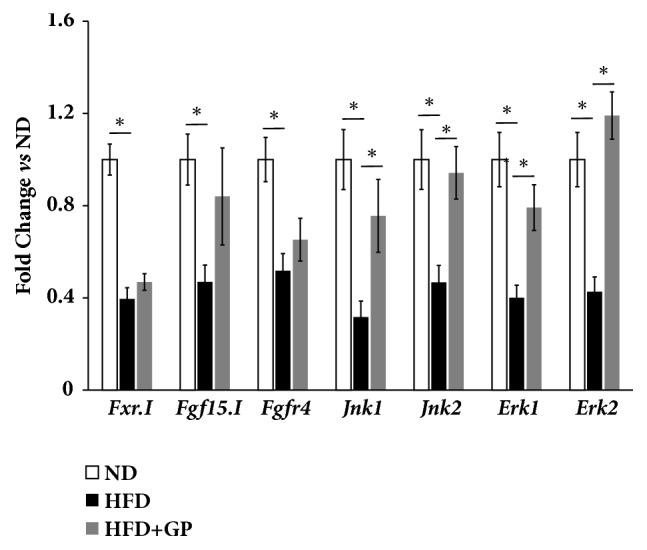
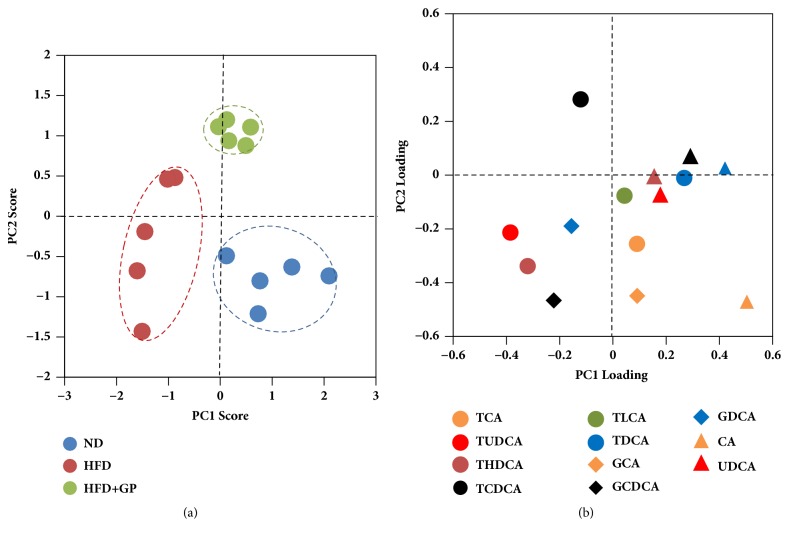
Gypenosides extracted from (Thunb.) Makino have significant role in reducing serum lipid level and treating fatty liver diseases, however, without clear mechanism. As gypenosides share the similar core structures with bile acids (the endogenous ligands of nuclear receptor FXR), we hypothesize that gypenosides may improve hypercholesterolemia via FXR-mediated bile acids signaling. The present study was designed to validate the role of gypenosides in reducing levels of serum total cholesterol (TC) and low density lipoprotein cholesterol (LDL-C), as well as in regulating bile acids homeostasis and related gene expression levels. The C57BL/6 male mice were divided into four groups. Mice in groups ND and HFD were fed with normal diet and high fat diet for 38 weeks, respectively. In groups HFD+GP and HFD+ST, mice were fed with high fat diet for 38 weeks and treated with gypenosides and simvastatin (positive control) from weeks 16 to 38, respectively. Serum TC and LDL-C levels were assayed by commercially available kits. Expression levels of genes were tested by the quantitative real-time PCR. The LC-MS/MS was applied to quantify major bile acids in mice livers. Our results showed that gypenosides significantly decreased serum TC and LDL-C levels. The gene expression level of was downregulated while the levels of , , , , , and were upregulated by gypenosides. Indicated by LC-MS/MS technology, gypenosides increased the hepatic levels of several free bile acids and most taurine-conjugated bile acids while decreasing glycine-conjugated bile acids levels. In addition, gypenosides decreased the CA/CDCA ratio. Gypenosides may improve the abnormal lipid profile of HFD-fed mice via two pathways: (1) enhancing the bile acids biosynthesis from cholesterol; (2) decreasing the CA/CDCA ratio which is positively related to cholesterol absorption.
从绞股蓝(Thunb.)Makino中提取的绞股蓝皂苷在降低血脂水平和治疗脂肪肝疾病方面具有重要作用,然而,其作用机制尚不清楚。由于绞股蓝皂苷与胆汁酸(核受体FXR的内源性配体)具有相似的核心结构,我们推测绞股蓝皂苷可能通过FXR介导的胆汁酸信号通路改善高胆固醇血症。本研究旨在验证绞股蓝皂苷在降低血清总胆固醇(TC)和低密度脂蛋白胆固醇(LDL-C)水平以及调节胆汁酸稳态和相关基因表达水平方面的作用。将C57BL/6雄性小鼠分为四组。ND组和HFD组小鼠分别给予正常饮食和高脂饮食38周。在HFD+GP组和HFD+ST组中,小鼠给予高脂饮食38周,并分别在第16至38周用绞股蓝皂苷和辛伐他汀(阳性对照)进行治疗。用市售试剂盒测定血清TC和LDL-C水平。通过定量实时PCR检测基因表达水平。应用LC-MS/MS定量小鼠肝脏中的主要胆汁酸。我们的结果表明,绞股蓝皂苷显著降低血清TC和LDL-C水平。绞股蓝皂苷下调了[具体基因名称未给出]的基因表达水平,而上调了[具体基因名称未给出]、[具体基因名称未给出]、[具体基因名称未给出]、[具体基因名称未给出]、[具体基因名称未给出]和[具体基因名称未给出]的水平。LC-MS/MS技术表明,绞股蓝皂苷增加了几种游离胆汁酸和大多数牛磺酸结合胆汁酸的肝脏水平,同时降低了甘氨酸结合胆汁酸水平。此外,绞股蓝皂苷降低了CA/CDCA比值。绞股蓝皂苷可能通过两条途径改善高脂饮食喂养小鼠的脂质异常:(1)增强胆固醇的胆汁酸生物合成;(2)降低与胆固醇吸收呈正相关的CA/CDCA比值。