Division of General Pediatric Surgery, Johns Hopkins University, Johns Hopkins Hospital, Baltimore, Maryland.
Johns Hopkins Children's Center, Johns Hopkins Hospital, Baltimore, Maryland.
Cell Mol Gastroenterol Hepatol. 2018 Apr 6;6(2):229-238.e1. doi: 10.1016/j.jcmgh.2018.04.001. eCollection 2018.
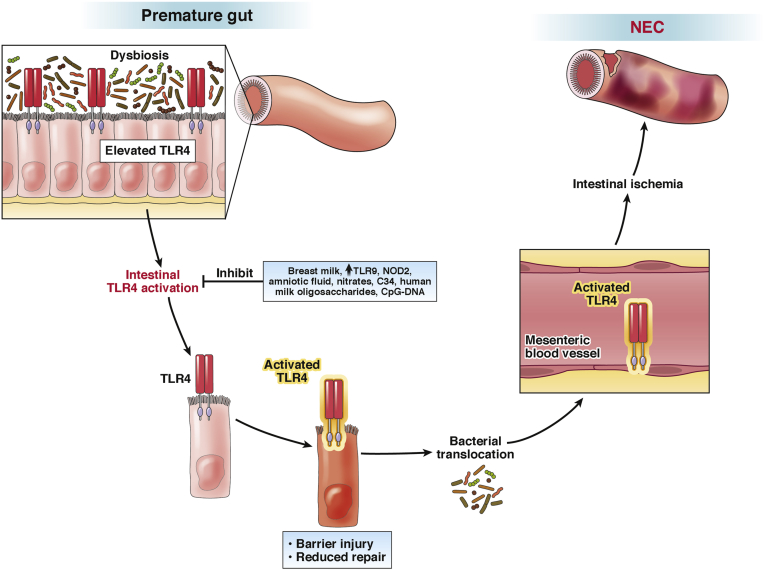
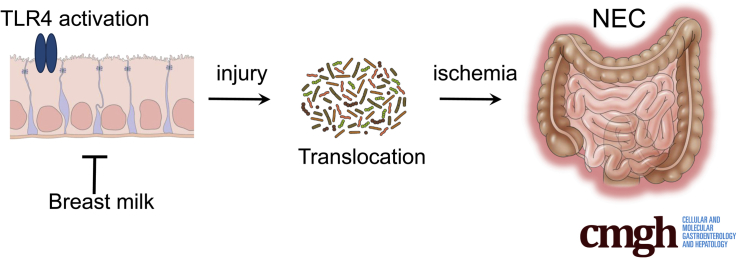
Necrotizing enterocolitis (NEC) remains the leading cause of death from gastrointestinal disease in premature infants and attacks the most fragile patients at a time when they appear to be the most stable. Despite significant advances in our overall care of the premature infant, NEC mortality remains stubbornly high. There is no specific treatment for NEC beyond broad-spectrum antibiotics and intestinal resection, and current efforts have focused on preventive strategies. Over the past decade, we have proposed a unifying hypothesis to explain the pathogenesis of NEC in premature infants that suggests that NEC develops in response to an imbalance between exaggerated proinflammatory signaling in the mucosa of the premature gut leading to mucosal injury, which is not countered effectively by endogenous repair processes, and in the setting of impaired mesenteric perfusion leads to intestinal ischemia and disease development. One of the most important pathways that mediates the balance between injury and repair in the premature intestine, and that plays a key role in NEC pathogenesis, is Toll-like receptor 4 (TLR4), which recognizes lipopolysaccharide on gram-negative bacteria. This review focuses on the role that the TLR4-mediated imbalance between proinflammatory and anti-inflammatory signaling in the premature intestinal epithelium leads to the development of NEC, and will explore how an understanding of the role of TLR4 in NEC pathogenesis has led to the identification of novel preventive or treatment approaches for this devastating disease.
新生儿坏死性小肠结肠炎(NEC)仍然是早产儿胃肠道疾病死亡的主要原因,而且在早产儿看似最稳定的时候,它会攻击最脆弱的患者。尽管我们在早产儿整体护理方面取得了重大进展,但 NEC 的死亡率仍然居高不下。除了广谱抗生素和肠切除术之外,目前还没有针对 NEC 的具体治疗方法,目前的努力集中在预防策略上。在过去的十年中,我们提出了一个统一的假设来解释早产儿 NEC 的发病机制,该假设表明 NEC 是对早产儿肠道黏膜中过度炎症信号的反应,导致黏膜损伤,而内源性修复过程不能有效对抗这种损伤,同时伴有肠系膜灌注受损导致肠缺血和疾病发展。在早产儿肠道中,介导损伤和修复平衡的最重要途径之一,也是 NEC 发病机制的关键途径之一,是 Toll 样受体 4(TLR4),它识别革兰氏阴性菌的脂多糖。这篇综述重点介绍了 TLR4 介导的早产儿肠上皮细胞中促炎和抗炎信号之间的失衡如何导致 NEC 的发展,并将探讨对 TLR4 在 NEC 发病机制中的作用的理解如何导致这种破坏性疾病的新的预防或治疗方法的确定。