Freitas Milton Halyson Benevides de, Lima Luciana Cavalcanti, Couceiro Tania Cursino de Menezes, Silva Wilton Bernadino da, Andrade João Marcelo de, Freitas Marcio Handerson Benevides de
Instituto de Medicina Integral Professor Fernando Figueira, Recife, PE, Brasil.
Universidade Federal de Pernambuco, Recife, PE, Brasil.
J Bras Nefrol. 2018 Oct-Dec;40(4):360-365. doi: 10.1590/2175-8239-JBN-2018-0020. Epub 2018 Aug 13.
Successful renal transplant and consequent good graft function depend on a good surgical technique, an anesthetic that ensures the hemodynamic stability of the receiver, and appropriate conditions of graft and recipient. Several factors can interfere with the perfusion of the graft and compromise its viability. The objective of this study was to evaluate perioperative factors associated with delayed graft function (DGF) in renal transplantation patients.
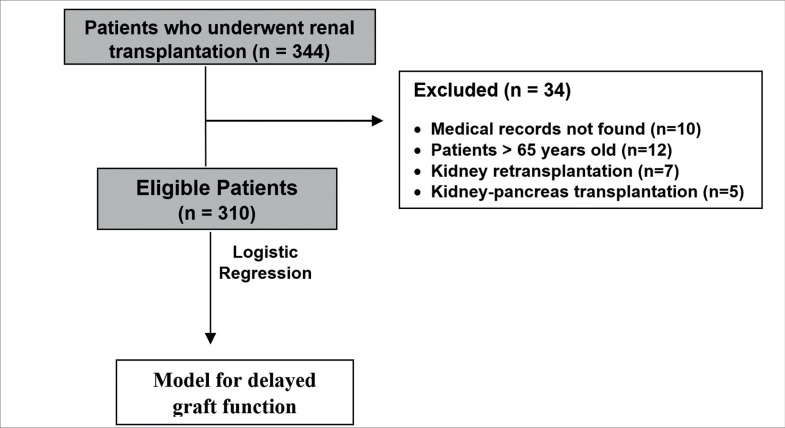
This is a historical cohort study of patients who underwent renal transplantation between 2011 and 2013. Three hundred and ten transplants were analyzed. DGF was defined as the need for dialysis during the first week post-transplant. Logistic regression with a stepwise technique was used to build statistical models.
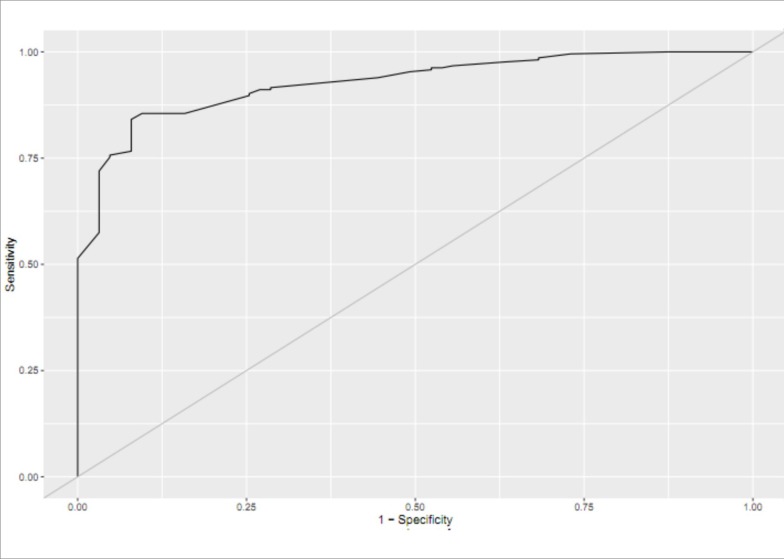
Multivariate analysis revealed the following risk factor for DGF: combined anesthesia technique (OR = 3.81, 95%CI, 1.71 to 9.19), a fluid regimen < 50 mL·kg-1 (OR = 3.71, 95%CI, 1.68 to 8.61), dialysis for more than 60 months (OR = 4.77, 95%CI, 1.93 to 12.80), basiliximab (OR = 3.34, 95%CI, 1.14 to 10.48), cold ischemia time > 12 hour (OR = 5.26, 95%CI, 2.62 to 11.31), living donor (OR = 0.19, 95%CI, 0.02 to 0.65), and early diuresis (OR = 0.02, 95%CI, 0.008 to 0.059). The accuracy of this model was 92.6%, calculated using the area under the ROC curve. The incidence of DGF in the study population was 76.1%.
Combined anesthesia technique, dialysis for more than 60 months, basiliximab, and cold ischemia time > 12 hours are risk factor for DGF, while liberal fluid regimens and kidneys from living donors are protective factors.
成功的肾移植及随之而来的良好移植肾功能取决于良好的手术技术、确保受者血流动力学稳定的麻醉方法以及移植肾和受者的适宜条件。多种因素可干扰移植肾灌注并损害其活力。本研究的目的是评估肾移植患者中与移植肾功能延迟恢复(DGF)相关的围手术期因素。
这是一项对2011年至2013年间接受肾移植患者的历史性队列研究。分析了310例移植病例。DGF定义为移植后第一周内需要进行透析。采用逐步法的逻辑回归来构建统计模型。
多因素分析显示DGF的以下危险因素:联合麻醉技术(比值比[OR]=3.81,95%可信区间[CI],1.71至9.19)、液体输注量<50 mL·kg-1(OR = 3.71,95%CI,1.68至8.61)、透析超过60个月(OR = 4.77,95%CI,1.93至12.80)、巴利昔单抗(OR = 3.34,95%CI,1.14至10.48)、冷缺血时间>12小时(OR = 5.26,95%CI,2.62至11.31)、活体供者(OR = 0.19,95%CI,0.02至0.65)以及早期利尿(OR = 0.02,95%CI,0.008至0.059)。使用ROC曲线下面积计算,该模型的准确性为92.6%。研究人群中DGF的发生率为76.1%。
联合麻醉技术、透析超过60个月、巴利昔单抗以及冷缺血时间>12小时是DGF的危险因素,而充足的液体输注量和活体供肾是保护因素。