Department of Respiratory Medicine, Peking Union Medical College Hospital, Peking Union Medical College, Chinese Academy of Medical Sciences, Beijing, China.
School of Statistics, Shandong University of Finance and Economics, Jinan, China.
Orphanet J Rare Dis. 2018 Aug 14;13(1):134. doi: 10.1186/s13023-018-0874-7.
Lymphangioleiomyomatosis (LAM) is a rare lung disease and the mammalian target of the rapamycin (mTOR) inhibitors has been used as an effective therapy. Here we conducted a systematic review and meta-analysis with the aims to quantify the efficacy and safety of mTOR inhibitors in LAM patients.
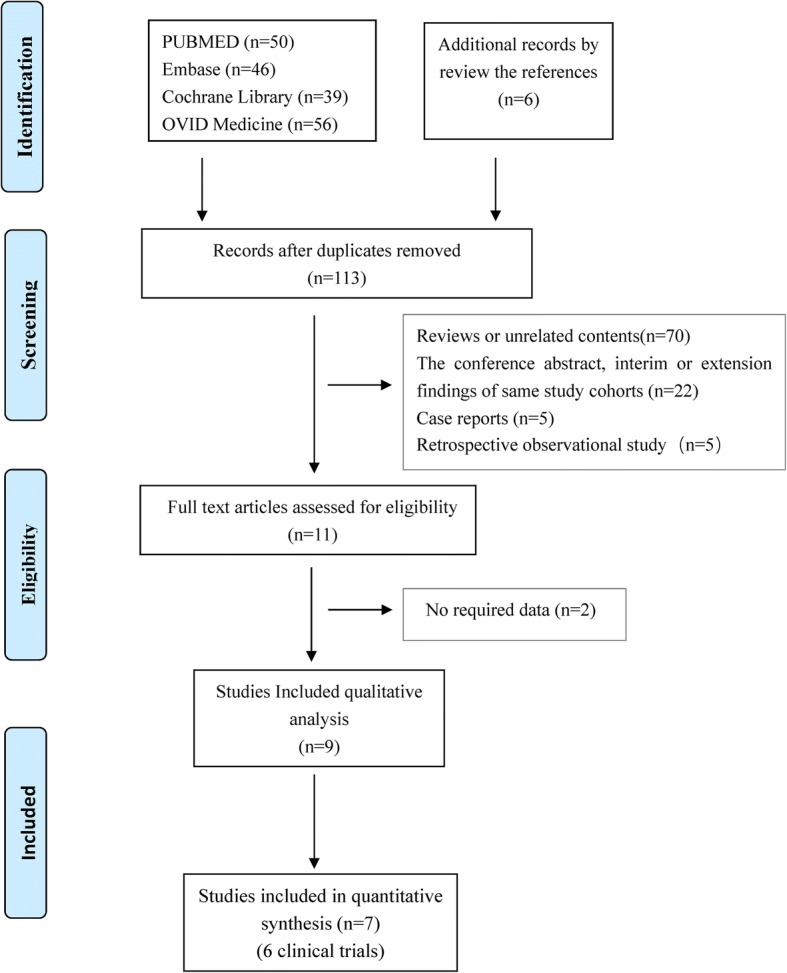
The following databases were searched for clinical trials regarding LAM patients treated with mTOR inhibitors until December 2017: Pubmed, Embase, Cochrane Library and OVID medicine. Random effect models were used for the quantitative analysis.
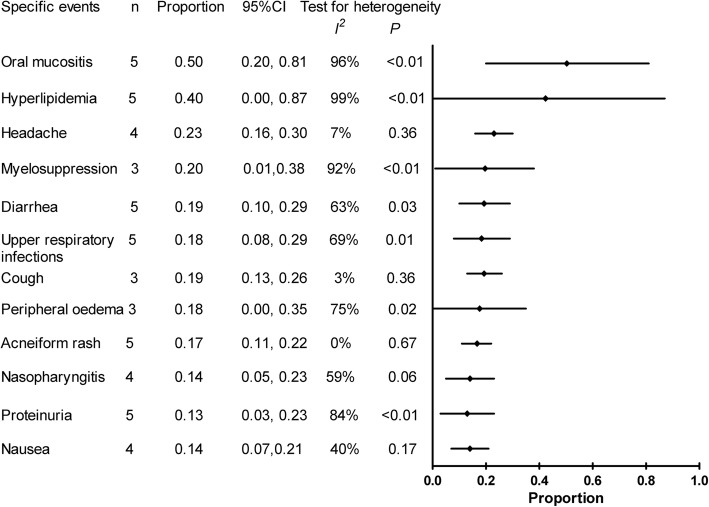
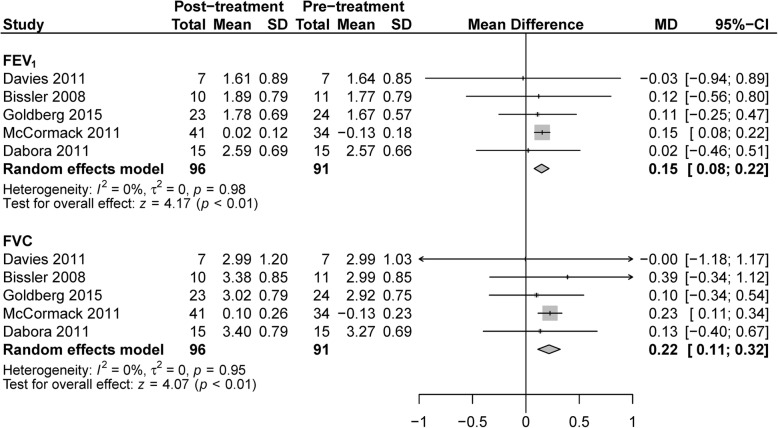
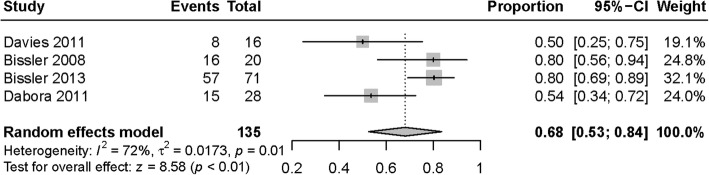
Nine eligible studies were included in our systematic review, 7 of which were used for the meta-analysis. In LAM patients, mTOR inhibitors improved forced expiratory volume in 1 s (FEV) and forced vital capacity (FVC) significantly, with the weighted mean difference (WMD) 0.15 L (95%CI: 0.08 to 0.22, P < 0.01, I = 0%) and 0.22 L (95%: 0.11 to 0.32, P < 0.01, I = 0%) respectively. There was no significant change in neither the diffusing capacity for carbon monoxide (WMD: 0.51 ml/mm Hg/min, 95%CI: -0.48 to 1.49, P = 0.31, I = 0%) nor 6-min walking distance (WMD: 5.29 m, 95%CI: -18.01 to 28.59, P = 0.66, I = 1%). The weighted partial response rate was 0.68 (95%CI: 0.53 to 0.84, P < 0.01, I = 72%) for renal angiomylipoma. The cumulative incidence rates of common safety events were 50, 40, 23, 20 and 19% for oral mucositis, hyperlipidemia, headache, bone marrow suppression, and diarrhea, respectively. And most events were low grade and tolerant.
In LAM patients, there are improvements of FEV and FVC after the application of mTOR inhibitors and over a half achieved the shrinkage of renal angiomyolipoma.
PROSPERO registration number: CRD42018085470. Registered 22 January 2018.
淋巴管平滑肌瘤病(LAM)是一种罕见的肺部疾病,哺乳动物雷帕霉素靶蛋白(mTOR)抑制剂已被用作有效的治疗方法。在这里,我们进行了一项系统评价和荟萃分析,旨在量化 mTOR 抑制剂在 LAM 患者中的疗效和安全性。
我们检索了截至 2017 年 12 月有关接受 mTOR 抑制剂治疗的 LAM 患者的临床试验的以下数据库:Pubmed、Embase、Cochrane 图书馆和 OVID 医学。对于定量分析,使用随机效应模型。
我们的系统评价纳入了 9 项符合条件的研究,其中 7 项用于荟萃分析。在 LAM 患者中,mTOR 抑制剂可显著改善用力呼气量(FEV)和用力肺活量(FVC),加权均数差值(WMD)分别为 0.15L(95%CI:0.08 至 0.22,P<0.01,I=0%)和 0.22L(95%CI:0.11 至 0.32,P<0.01,I=0%)。一氧化碳弥散量(WMD:0.51ml/mm Hg/min,95%CI:-0.48 至 1.49,P=0.31,I=0%)和 6 分钟步行距离(WMD:5.29m,95%CI:-18.01 至 28.59,P=0.66,I=1%)均无显著变化。肾血管平滑肌脂肪瘤的部分缓解率为 0.68(95%CI:0.53 至 0.84,P<0.01,I=72%)。口腔粘膜炎、高脂血症、头痛、骨髓抑制和腹泻的常见不良事件累积发生率分别为 50%、40%、23%、20%和 19%。并且大多数事件为低级别且可耐受。
在 LAM 患者中,应用 mTOR 抑制剂后 FEV 和 FVC 均有改善,超过一半的患者肾血管平滑肌脂肪瘤缩小。
PROSPERO 注册号:CRD42018085470。于 2018 年 1 月 22 日注册。