Division of Public Health Sciences, Department of Surgery, Washington University School of Medicine, St. Louis, Missouri.
Alvin J. Siteman Cancer Center at Barnes-Jewish Hospital and Washington University School of Medicine, St. Louis, Missouri.
Cancer Epidemiol Biomarkers Prev. 2018 Nov;27(11):1298-1306. doi: 10.1158/1055-9965.EPI-17-1102. Epub 2018 Aug 14.
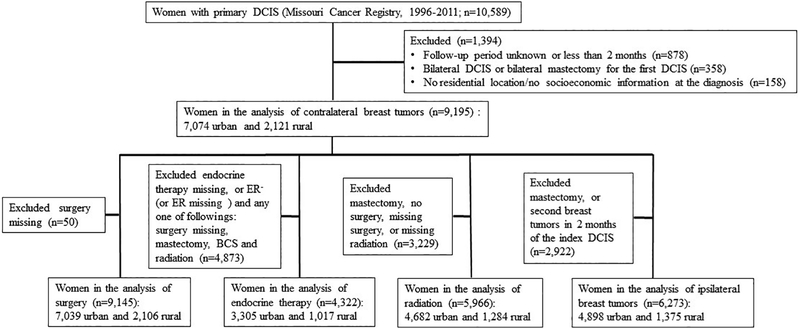
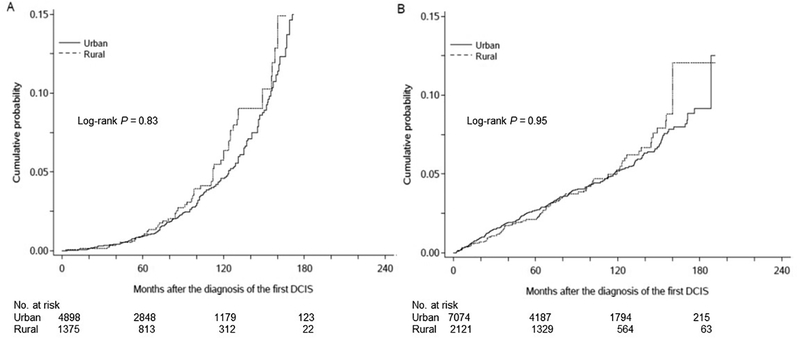
This study examines associations of neighborhood characteristics with treatment and outcomes of ductal carcinoma (DCIS) of the breast. From the Missouri Cancer Registry, we identified 9,195 women with DCIS diagnosed between 1996 and 2011. A composite index using U.S. Census data and American Community Survey data was developed to assess census tract-level socioeconomic deprivation, and rural-urban commuting area codes were used to define rural census tracts. ORs and 95% confidence intervals (CIs) of the treatment were estimated using logistic regression. Hazard ratios (HRs) of DCIS outcomes were estimated using Cox proportional hazards regression. Women in the most socioeconomically deprived census tracts were more likely than those in the least deprived to have mastectomy (OR = 1.44; 95% CI, 1.25-1.66; < 0.0001), no surgery (OR = 1.54; 95% CI, 1.02-2.30; = 0.04), no radiotherapy post-breast conserving surgery (OR = 1.90; 95% CI, 1.56-2.31; <0.0001), delayed radiotherapy (OR = 1.26; 95% CI, 1.01-1.57; = 0.02), and ipsilateral breast tumors (HR = 1.59; 95% CI, 1.07-2.38; = 0.03). There was no significant difference in risk of contralateral breast tumors. Compared with urban women, rural women had significantly higher odds of underutilization of radiotherapy (OR = 1.29; 95% CI, 1.08-1.53). Rural locations were not associated with risk of ipsilateral or contralateral breast tumors. Neighborhood socioeconomic deprivation was associated with higher risks of suboptimal treatment and ipsilateral breast tumors. While DCIS treatment significantly varied by rural/urban locations, we did not observe any statistically significant rural-urban differences in risks of second breast tumors. Neighborhood attributes may affect treatment and outcomes of patients with DCIS.
本研究探讨了社区特征与乳腺导管癌(DCIS)的治疗和结局之间的关系。我们从密苏里州癌症登记处确定了 1996 年至 2011 年间诊断为 DCIS 的 9195 名女性。使用美国人口普查数据和美国社区调查数据开发了一个综合指数,用于评估普查区层面的社会经济剥夺情况,并使用城乡通勤区代码来定义农村普查区。使用逻辑回归估计治疗的比值比(OR)和 95%置信区间(CI)。使用 Cox 比例风险回归估计 DCIS 结局的风险比(HR)。处于最贫困社会经济地位的普查区的女性比处于最不贫困的女性更有可能接受乳房切除术(OR=1.44;95%CI,1.25-1.66; < 0.0001)、不接受手术(OR=1.54;95%CI,1.02-2.30; = 0.04)、不保乳手术后不接受放疗(OR=1.90;95%CI,1.56-2.31; < 0.0001)、延迟放疗(OR=1.26;95%CI,1.01-1.57; = 0.02)和同侧乳房肿瘤(HR=1.59;95%CI,1.07-2.38; = 0.03)。同侧乳房肿瘤的风险无显著差异。与城市女性相比,农村女性放疗利用率显著降低(OR=1.29;95%CI,1.08-1.53)。农村地区与同侧或对侧乳房肿瘤的风险无显著相关性。社区社会经济剥夺与治疗效果不佳和同侧乳房肿瘤的风险增加有关。虽然 DCIS 治疗的城乡差异显著,但我们没有观察到任何统计学意义上的城乡第二乳房肿瘤风险差异。邻里属性可能会影响 DCIS 患者的治疗和结局。