Department of Oral and Maxillofacial Surgery, University of Groningen, University Medical Center Groningen, Hanzeplein 1, 9713 GZ, Groningen, The Netherlands.
Department of Rehabilitation, University of Groningen, University Medical Center Groningen, Hanzeplein 1, 9713 GZ, Groningen, The Netherlands.
Support Care Cancer. 2019 Mar;27(3):1129-1137. doi: 10.1007/s00520-018-4402-z. Epub 2018 Aug 14.
Several cut-off points for trismus in head and neck cancer patients have been used. A mouth opening of 35 mm or less is most frequently used as cut-off point. Due to the variation in cut-off points, prevalence, risk factors and treatment outcomes of trismus cannot be studied in a uniform manner. To provide uniformity, we aimed to verify the cut-off point of 35 mm or less. Additionally, we aimed to determine associated covariates with reported difficulties when opening the mouth.
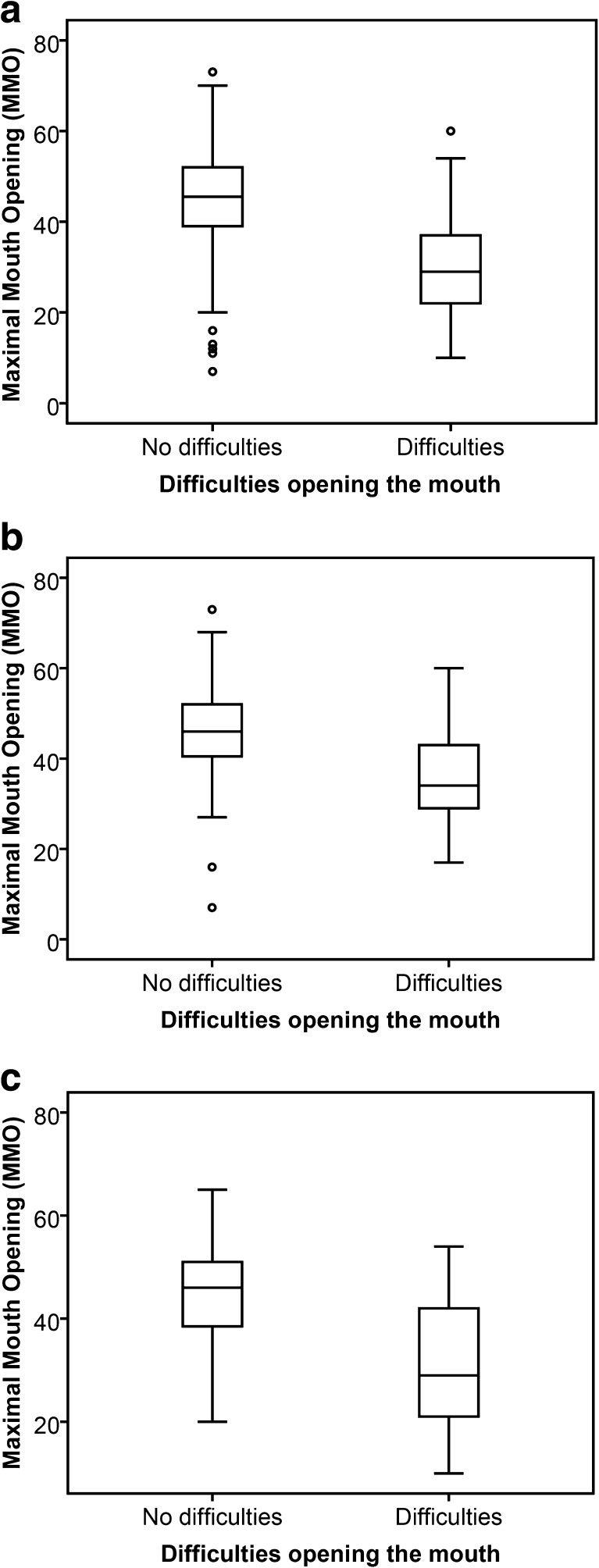
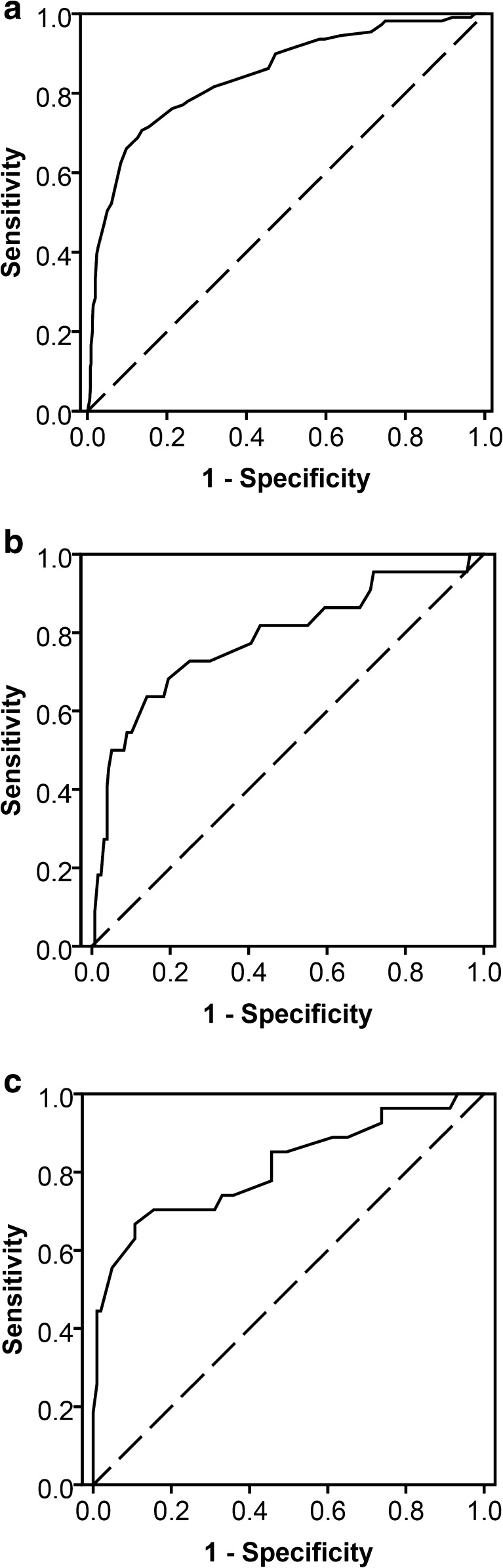
In a cross-sectional design, we measured the mouth opening in 671 head and neck cancer patients at the Department of Oral and Maxillofacial Surgery, at the University Medical Center Groningen. The cut-off point was determined using the receiver operating characteristic curve and Youden index, with reported difficulties when opening the mouth as criterion for trismus. Cut-off points for significant covariates were also determined.
The Youden index was highest at 35 mm, with a sensitivity of 0.71 and a specificity of 0.86. Of the covariates analysed, type of treatment modality was significantly associated with reported difficulties when opening the mouth. The highest Youden index for patients treated with surgery alone was 37 mm and for patients treated with radiotherapy alone 33 mm.
The cut-off point of 35 mm or less for trismus was confirmed in a head and neck cancer population and is recommended to be used in future studies. Patients receiving different treatment modalities experience difficulty when opening the mouth differently.
已经使用了几种头颈部癌症患者张口困难的截断点。最常用的截断点是张口 35mm 或更小。由于截断点的变化,张口困难的患病率、危险因素和治疗结果不能以统一的方式进行研究。为了提供一致性,我们旨在验证 35mm 或更小的截断点。此外,我们旨在确定与张口困难相关的协变量。
在横断面设计中,我们在格罗宁根大学医学中心口腔颌面外科测量了 671 名头颈部癌症患者的张口度。使用受试者工作特征曲线和约登指数确定截断点,以张口困难作为诊断张口困难的标准。还确定了与报告的张口困难相关的显著协变量的截断点。
约登指数在 35mm 时最高,敏感性为 0.71,特异性为 0.86。在分析的协变量中,治疗方式与报告的张口困难显著相关。单独接受手术治疗的患者的最佳约登指数为 37mm,单独接受放射治疗的患者为 33mm。
在头颈部癌症人群中,确认了 35mm 或更小的截断点用于诊断张口困难,建议在未来的研究中使用。接受不同治疗方式的患者在张口困难方面的体验不同。