Xsens Technologies B.V, Pantheon 6, Enschede, 7521 PR, The Netherlands.
Department of Biomedical Signals and Systems (BSS), Technical Medical Centre, University of Twente, Enschede, The Netherlands.
J Neuroeng Rehabil. 2018 Aug 15;15(1):78. doi: 10.1186/s12984-018-0419-2.
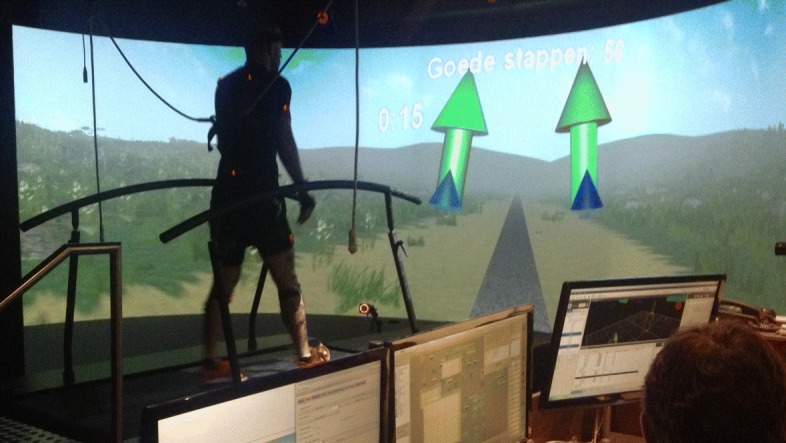
Gait retraining interventions using real-time biofeedback have been proposed to alter the loading across the knee joint in patients with knee osteoarthritis. Despite the demonstrated benefits of these conservative treatments, their clinical adoption is currently obstructed by the high complexity, spatial demands, and cost of optical motion capture systems. In this study we propose and evaluate a wearable visual feedback system for gait retraining of the foot progression angle (FPA).
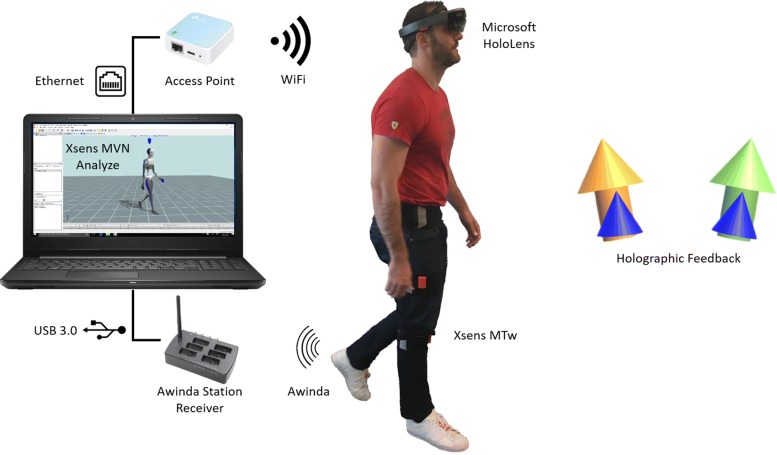
The primary components of the system are inertial measurement units, which track the human movement without spatial limitations, and an augmented reality headset used to project the visual feedback in the visual field. The adapted gait protocol contained five different target angles ranging from 15 degrees toe-out to 5 degrees toe-in. Eleven healthy participants walked on an instrumented treadmill, and the protocol was performed using both an established laboratory visual feedback driven by optical motion capture, and the proposed wearable system.
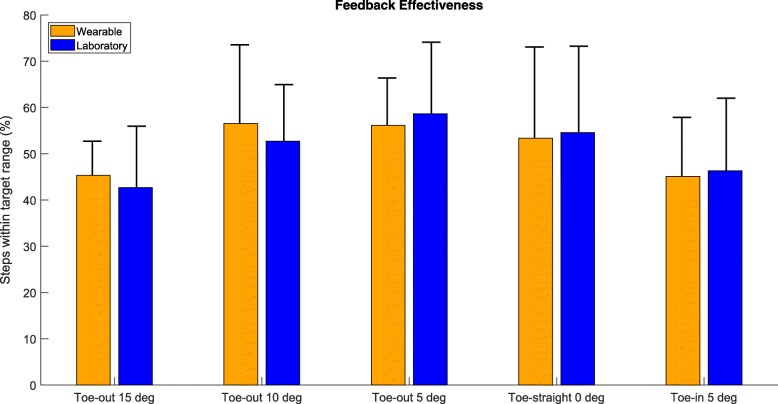
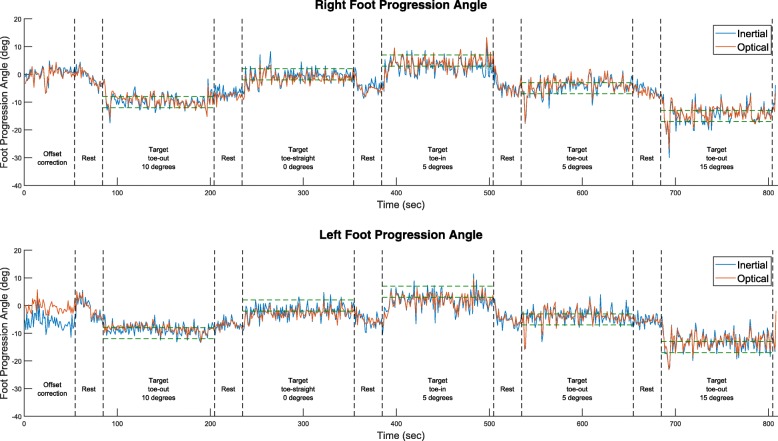
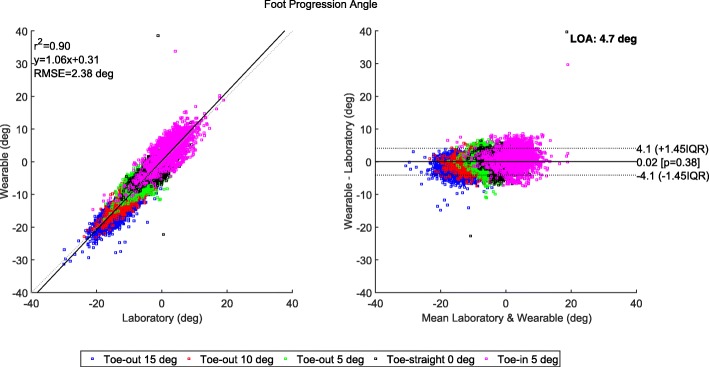
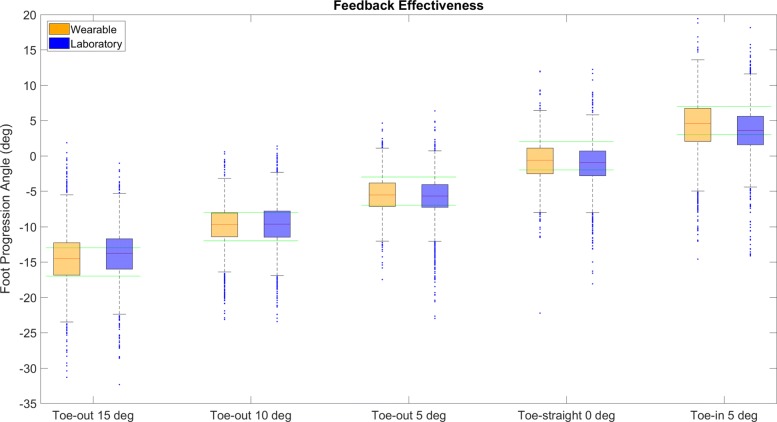
The wearable system tracked FPA with an accuracy of 2.4 degrees RMS and ICC=0.94 across all target angles and subjects, when compared to an optical motion capture reference. In addition, the effectiveness of the biofeedback, reflected by the number of steps with FPA value ±2 degrees from the target, was found to be around 50% in both wearable and laboratory approaches. These findings demonstrate that retraining of the FPA using wearable inertial sensing and visual feedback is feasible with effectiveness matching closely an established laboratory method. The proposed wearable setup may reduce the complexity of gait retraining applications and facilitate their transfer to routine clinical practice.
使用实时生物反馈的步态再训练干预措施被提议用于改变膝骨关节炎患者膝关节的负荷。尽管这些保守治疗方法已经被证明具有益处,但由于光学运动捕捉系统的复杂性高、空间要求高和成本高,其临床应用目前受到阻碍。在这项研究中,我们提出并评估了一种用于足进步角(FPA)步态再训练的可穿戴视觉反馈系统。
该系统的主要组件是惯性测量单元,它可以在没有空间限制的情况下跟踪人体运动,以及一个增强现实耳机,用于在视野中投射视觉反馈。适应的步态方案包含五个不同的目标角度,从 15 度外展到 5 度内收。11 名健康参与者在一台仪器化跑步机上行走,该方案分别使用基于光学运动捕捉的既定实验室视觉反馈和提出的可穿戴系统进行。
与光学运动捕捉参考相比,可穿戴系统以 2.4 度 RMS 的精度跟踪 FPA,ICC=0.94,适用于所有目标角度和受试者。此外,生物反馈的有效性,反映在与目标角度相差±2 度的 FPA 值的步数,在可穿戴和实验室方法中都约为 50%。这些发现表明,使用可穿戴惯性传感和视觉反馈进行 FPA 的再训练是可行的,其有效性与既定的实验室方法非常匹配。所提出的可穿戴设置可以降低步态再训练应用的复杂性,并促进它们转移到常规临床实践中。