Chauhan Nikhil, Bukovcan Janet, Boucher Eveline, Cosgrove David, Edeline Julien, Hamilton Bonnie, Kulik Laura, Master Fayaz, Salem Riad
Research and Development, BTG International Group Companies, London, United Kingdom.
Division of Medical Oncology, Compass Oncology, Vancouver Cancer Center, Vancouver, WA, United States.
JMIR Res Protoc. 2018 Aug 15;7(8):e11234. doi: 10.2196/11234.
Globally, hepatocellular carcinoma is the second most common cause of cancer deaths. It remains challenging to intensify cancer treatment without impairing liver function.
The objective of the TheraSphere in the Treatment of Patients with Unresectable Hepatocellular Carcinoma (STOP-HCC) study is to examine the hypothesis that transarterial radioembolization (TheraSphere yttrium-90 glass microspheres) combined with standard first-line treatment with sorafenib will improve outcomes over treatment with sorafenib alone in unresectable hepatocellular carcinoma. The STOP-HCC study is the largest international, multicenter, prospective study of intra-arterial treatment in combination with sorafenib in unresectable hepatocellular carcinoma. Here we report the study design.
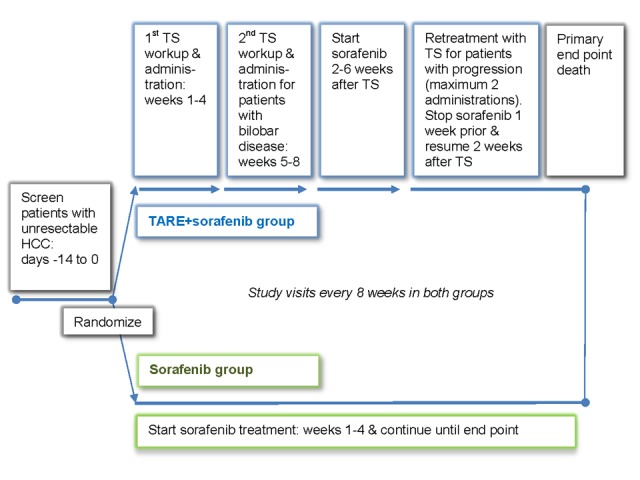
STOP-HCC is a prospective, phase 3, open-label, randomized controlled study conducted across up to 105 sites in North America, Europe, and Asia. Eligible adults have unresectable hepatocellular carcinoma and a life expectancy of at least 12 weeks, 1 or more unidimensional measurable lesions, Child-Pugh score 7 points or less, and Eastern Cooperative Oncology Group Performance Status score 1 or lower, and are candidates for treatment with sorafenib. Presence of branch portal vein tumor thrombosis is permitted. Patients were randomly assigned in a 1:1 ratio to receive either sorafenib alone or transarterial radioembolization followed by sorafenib within 2 to 6 weeks. The primary outcome is overall survival. Secondary outcomes are time to progression, time to untreatable progression, time to symptomatic progression, tumor response, quality of life, and adverse event occurrence. The study is an adaptive trial, comprising a group-sequential design with 2 interim analyses with 520 patients, and an option to increase the sample size to 700 patients at the second interim analysis. The sample size of 520 patients allows for 417 deaths to give 80% power to detect an increase in median overall survival from 10.7 months for the sorafenib group (based on the Sorafenib Hepatocellular Carcinoma Assessment Randomized Protocol [SHARP] trial) to 14.2 months for the transarterial radioembolization+sorafenib group (hazard ratio 0.754) with 2-sided alpha of .05. The increased sample size of 700 patients allows for 564 deaths to give 80% power to detect a smaller difference in median overall survival from 10.7 months for the sorafenib group to 13.7 months for the transarterial radioembolization+sorafenib group (hazard ratio 0.781).
Enrollment for the study completed in September 2017. Results of the first and second interim analyses were reviewed by the Independent Data Monitoring Committee. The recommendation of the committee, at both interim analyses, was to continue the study without any changes.
The STOP-HCC study will contribute toward the establishment of the role of combination therapy with transarterial radioembolization and sorafenib in the treatment of unresectable hepatocellular carcinoma with and without branch portal vein tumor thrombosis.
ClinicalTrials.gov NCT01556490; https://clinicaltrials.gov/ct2/show/NCT01556490 (Archived by WebCite at http://www.webcitation.org/7188iygKs).
RR1-10.2196/11234.
在全球范围内,肝细胞癌是癌症死亡的第二大常见原因。在不损害肝功能的情况下强化癌症治疗仍然具有挑战性。
“TheraSphere治疗不可切除肝细胞癌患者(STOP-HCC)”研究的目的是检验以下假设:经动脉放射性栓塞(TheraSphere钇-90玻璃微球)联合索拉非尼标准一线治疗,相较于单独使用索拉非尼治疗不可切除肝细胞癌,将改善治疗效果。STOP-HCC研究是关于动脉内治疗联合索拉非尼治疗不可切除肝细胞癌的最大规模国际多中心前瞻性研究。在此我们报告该研究设计。
STOP-HCC是一项前瞻性3期开放标签随机对照研究,在北美、欧洲和亚洲多达105个地点开展。符合条件的成年人患有不可切除的肝细胞癌,预期寿命至少12周,有1个或更多一维可测量病灶,Child-Pugh评分7分或更低,东部肿瘤协作组体能状态评分1分或更低,并且是索拉非尼治疗的候选者。允许存在分支门静脉肿瘤血栓形成。患者按1:1比例随机分配,分别接受单独索拉非尼治疗或经动脉放射性栓塞,随后在2至6周内接受索拉非尼治疗。主要结局是总生存期。次要结局包括疾病进展时间、不可治疗进展时间、有症状进展时间、肿瘤反应、生活质量和不良事件发生情况。该研究是一项适应性试验,采用成组序贯设计,对520例患者进行2次中期分析,并且在第二次中期分析时有将样本量增加至700例患者的选项。520例患者的样本量允许出现417例死亡,以80%的检验效能检测索拉非尼组中位总生存期从10.7个月(基于索拉非尼肝细胞癌评估随机方案[SHARP]试验)增加至经动脉放射性栓塞+索拉非尼组的14.2个月(风险比0.754),双侧α为0.05。700例患者增加后的样本量允许出现56例死亡,以80%的检验效能检测索拉非尼组中位总生存期从10.7个月至经动脉放射性栓塞+索拉非尼组的13.7个月(风险比0.781)的较小差异。
该研究的入组于2017年9月完成。独立数据监测委员会对第一次和第二次中期分析的结果进行了审查。在两次中期分析中,委员会的建议都是继续该研究且不作任何更改。
STOP-HCC研究将有助于确立经动脉放射性栓塞与索拉非尼联合治疗在伴有或不伴有分支门静脉肿瘤血栓形成的不可切除肝细胞癌治疗中的作用。
ClinicalTrials.gov NCT01556490;https://clinicaltrials.gov/ct2/show/NCT01556490(由WebCite存档于http://www.webcitation.org/7188iygKs)。
RR1-10.2196/11234。