Department of Horticulture, Michigan State University, East Lansing, Michigan, United States of America.
PLoS One. 2018 Aug 16;13(8):e0202386. doi: 10.1371/journal.pone.0202386. eCollection 2018.
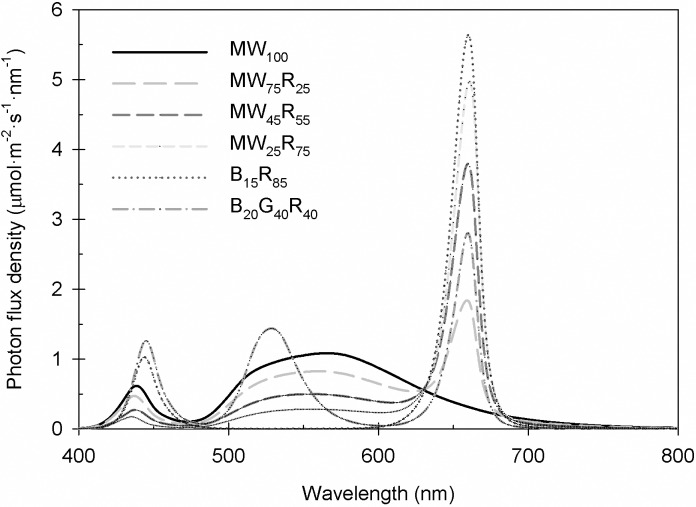
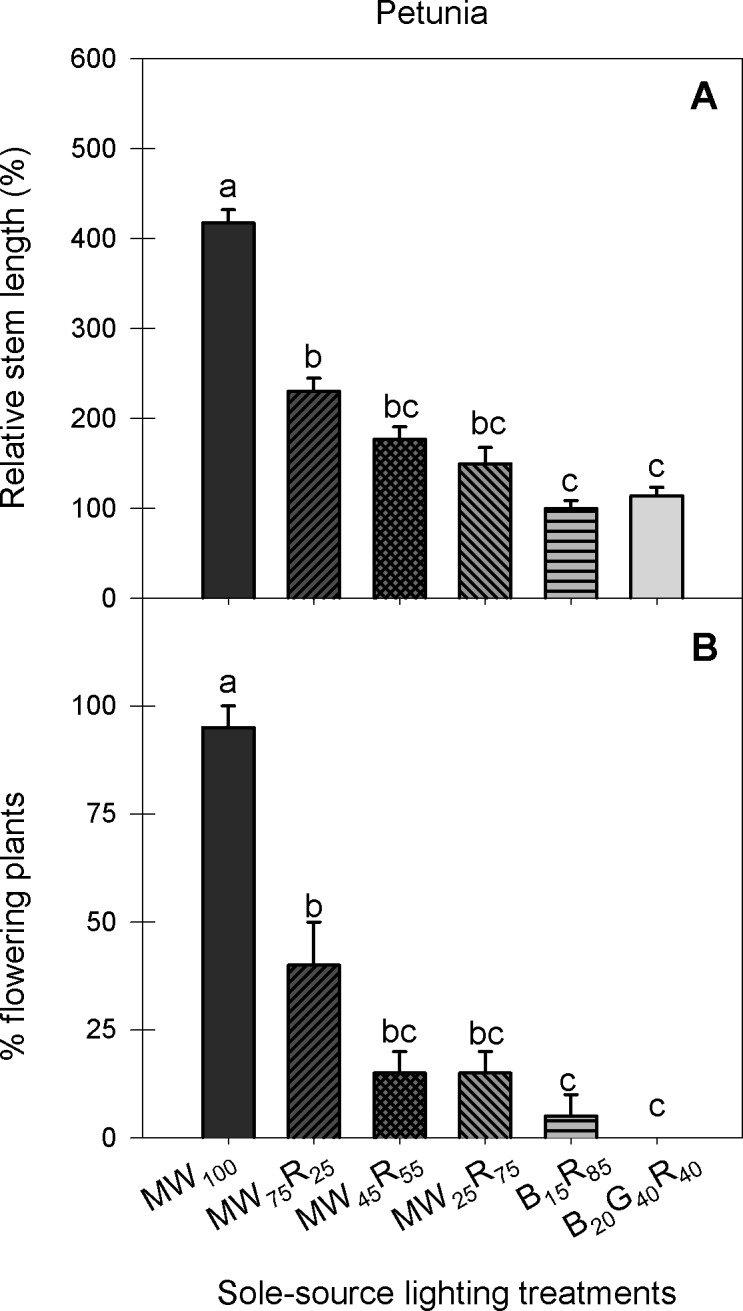
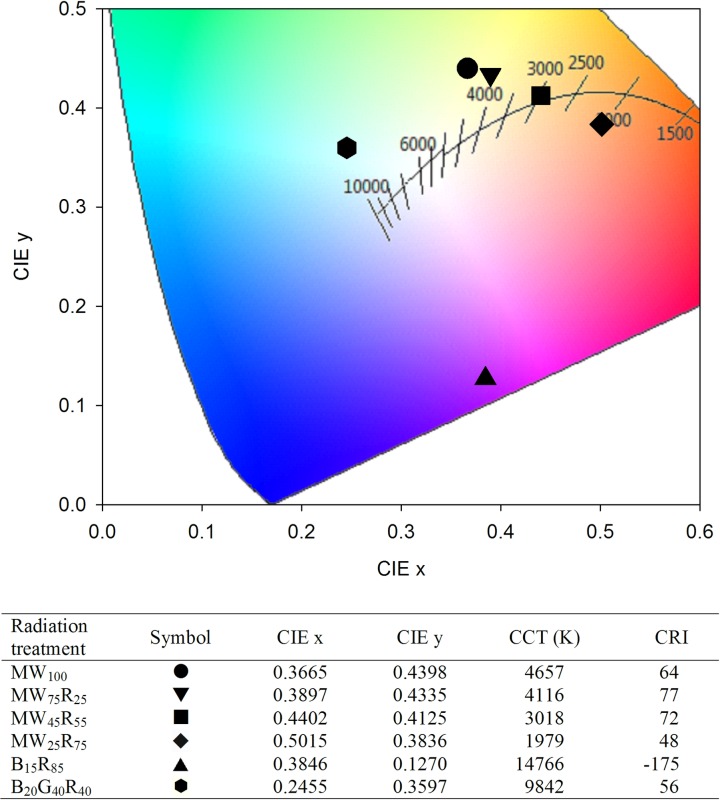
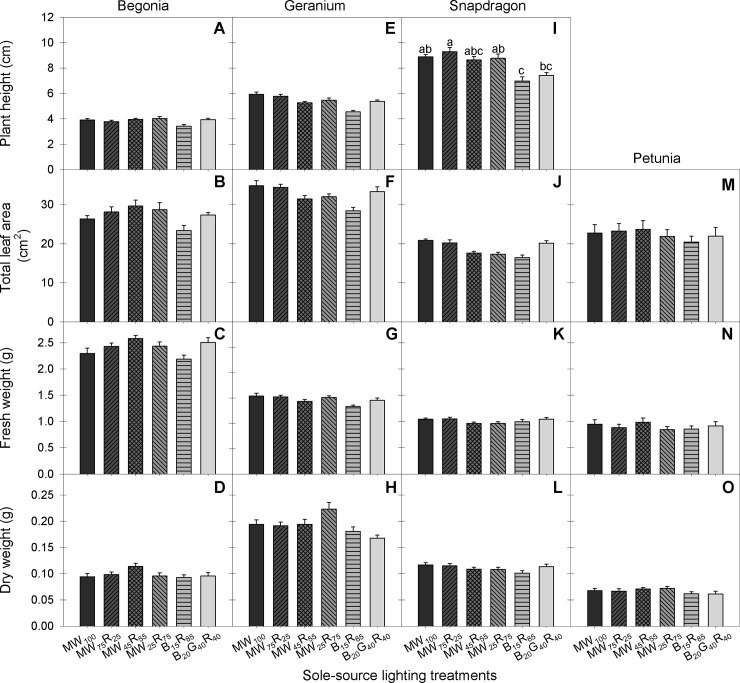
Arrays of blue (B, 400-500 nm) and red (R, 600-700 nm) light-emitting diodes (LEDs) used for plant growth applications make visual assessment of plants difficult compared to a broad (white, W) spectrum. Although W LEDs are sometimes used in horticultural lighting fixtures, little research has been published using them for sole-source lighting. We grew seedlings of begonia (Begonia ×semperflorens), geranium (Pelargonium ×horturum), petunia (Petunia ×hybrida), and snapdragon (Antirrhinum majus) at 20°C under six sole-source LED lighting treatments with a photosynthetic photon flux density (PPFD) of 160 μmol∙m-2∙s-1 using B (peak = 447 nm), green (G, peak = 531 nm), R (peak = 660 nm), and/or mint W (MW, peak = 558 nm) LEDs that emitted 15% B, 59% G, and 26% R plus 6 μmol∙m-2∙s-1 of far-red radiation. The lighting treatments (with percentage from each LED in subscript) were MW100, MW75R25, MW45R55, MW25R75, B15R85, and B20G40R40. At the transplant stage, total leaf area, and fresh and dry weight were similar among treatments in all species. Surprisingly, when petunia seedlings were grown longer (beyond the transplant stage) under sole-source lighting treatments, the primary stem elongated and had flower buds earlier under MW100 and MW75R25 compared to under B15R85. The color rendering index of MW75R25 and MW45R55 were 72, and 77, respectively, which was higher than those of other treatments, which were ≤64. While photosynthetic photon efficacy of B15R85 (2.25 μmol∙J-1) was higher than the W light treatments (1.51-2.13 μmol∙J-1), the dry weight gain per unit electric energy consumption (in g∙kWh-1) of B15R85 was similar to those of MW25R75, MW45R55, and MW75R25 in three species. We conclude that compared to B+R radiation, W radiation had generally similar effects on seedling growth at the same PPFD with similar electric energy consumption, and improved the visual color quality of sole-source lighting.
蓝色(B,400-500nm)和红色(R,600-700nm)发光二极管(LED)阵列用于植物生长应用,与宽(白,W)光谱相比,植物的外观评估变得更加困难。尽管 W LED 有时用于园艺照明灯具,但很少有研究使用它们作为单一光源进行照明。我们在 20°C 下使用光合光子通量密度(PPFD)为 160 μmol·m-2·s-1 的六种单一光源 LED 照明处理下种植秋海棠(Begonia×semperflorens)、天竺葵(Pelargonium×horturum)、矮牵牛(Petunia×hybrida)和金鱼草(Antirrhinum majus)的幼苗,这些 LED 的峰值分别为 447nm 的 B、531nm 的 G、660nm 的 R 和/或薄荷 W(MW,峰值为 558nm),发出 15%B、59%G 和 26%R,外加 6μmol·m-2·s-1 的远红辐射。照明处理(每个 LED 的百分比用下标表示)分别为 MW100、MW75R25、MW45R55、MW25R75、B15R85 和 B20G40R40。在移植阶段,所有物种在单一光源处理下的总叶面积、鲜重和干重相似。令人惊讶的是,当矮牵牛幼苗在单一光源处理下生长更长时间(超过移植阶段)时,与 B15R85 相比,MW100 和 MW75R25 下主茎伸长且更早有花蕾。MW75R25 和 MW45R55 的显色指数分别为 72 和 77,高于其他处理(≤64)。虽然 B15R85 的光合光子效率(2.25μmol·J-1)高于 W 光处理(1.51-2.13μmol·J-1),但 B15R85 每单位电能消耗的干重增重(以 g·kWh-1 计)与 MW25R75、MW45R55 和 MW75R25 在三种物种中相似。我们得出的结论是,与 B+R 辐射相比,在相同的 PPFD 下,W 辐射对幼苗生长具有相似的影响,且具有相似的电能消耗,并且提高了单一光源照明的视觉颜色质量。