WHO Collaborating Centre for Infectious Disease Epidemiology and Control, School of Public Health, Li Ka Shing Faculty of Medicine, The University of Hong Kong, 1/F North Wing, Patrick Manson Building, 7 Sassoon Road, Pok Fu Lam, Hong Kong.
Department of Systems Engineering and Engineering Management, City University of Hong Kong, Kowloon Tong, Hong Kong.
BMC Med. 2018 Aug 17;16(1):127. doi: 10.1186/s12916-018-1118-3.
Although routine vaccination of females before sexual debut against human papillomavirus (HPV) has been found to be cost-effective around the world, its cost-benefit has rarely been examined. We evaluate both the cost-effectiveness and cost-benefit of routine female adolescent nonavalent HPV vaccination in Hong Kong to guide its policy, and by extension that of mainland China, on HPV vaccination. One major obstacle is the lack of data on assortativity of sexual mixing. Such difficulty could be overcome by inferring sexual mixing parameters from HPV epidemiologic data.
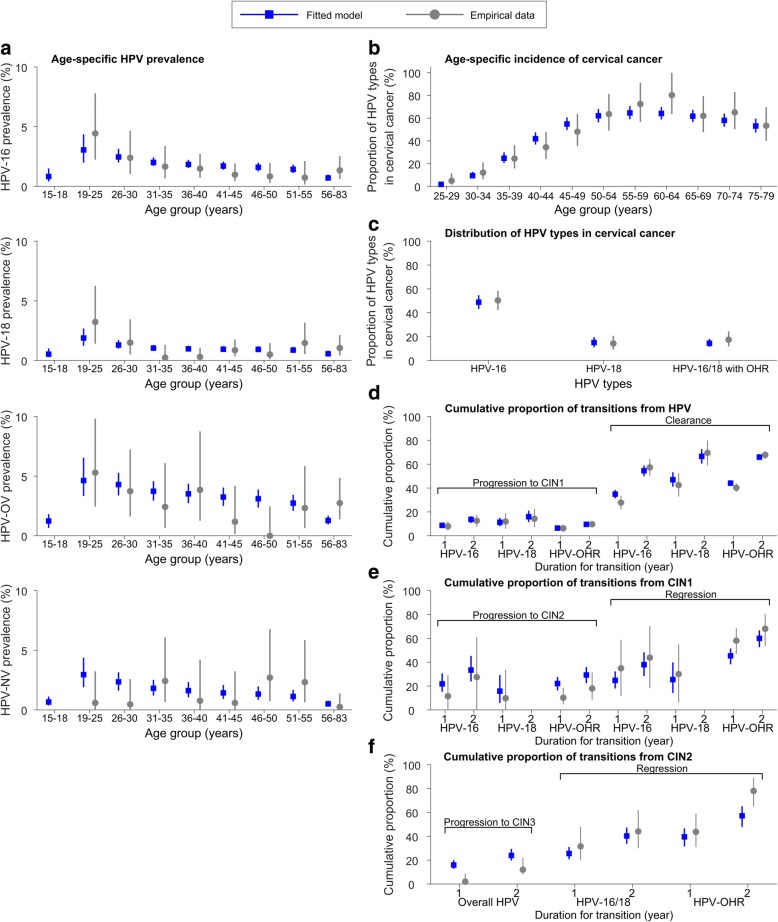
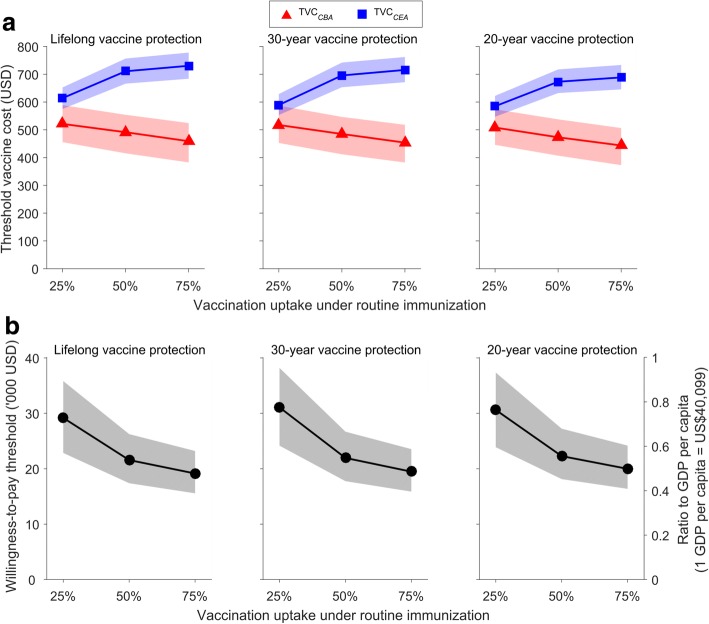
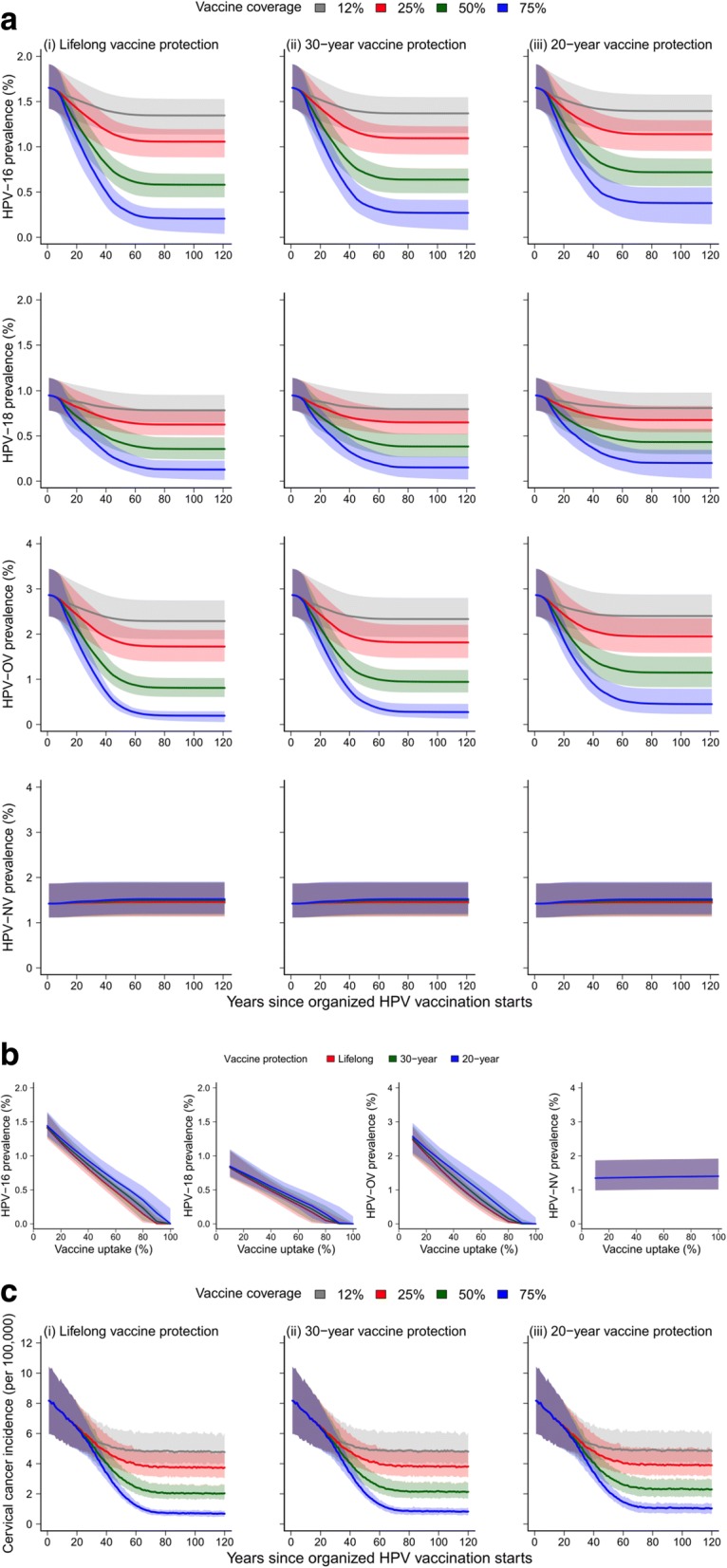
We use an age-structured transmission model coupled with stochastic individual-based simulations to estimate the health and economic impact of routine nonavalent HPV vaccination for girls at age 12 on cervical cancer burden and consider vaccine uptake at 25%, 50%, and 75% with at least 20 years of vaccine protection. Bayesian inference was employed to parameterize the model using local data on HPV prevalence and cervical cancer incidence. We use the human capital approach in the cost-benefit analysis (CBA) and GDP per capita as the indicative willingness-to-pay threshold in the cost-effectiveness analysis (CEA). Finally, we estimate the threshold vaccine cost (TVC), which is the maximum cost for fully vaccinating one girl at which routine female adolescent nonavalent HPV vaccination is cost-beneficial or cost-effective.
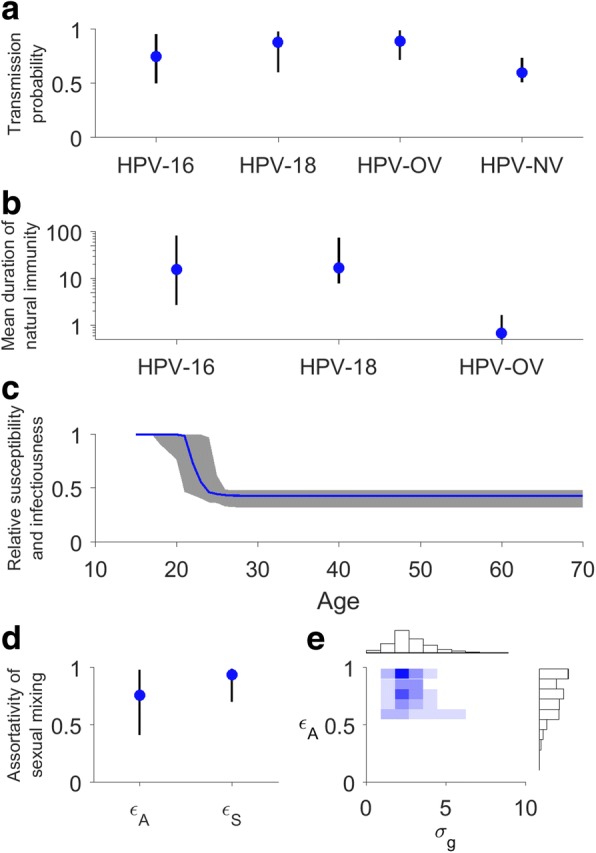
As vaccine uptake increased, TVC decreased (i.e., economically more stringent) in the CBA but increased in the CEA. When vaccine uptake was 75% and the vaccine provided only 20 years of protection, the TVC was US$444 ($373-506) and $689 ($646-734) in the CBA and CEA, respectively, increasing by approximately 2-4% if vaccine protection was assumed lifelong. TVC is likely to be far higher when non-cervical diseases are included. The inferred sexual mixing parameters suggest that sexual mixing in Hong Kong is highly assortative by both age and sexual activity level.
Routine HPV vaccination of 12-year-old females is highly likely to be cost-beneficial and cost-effective in Hong Kong. Inference of sexual mixing parameters from epidemiologic data of prevalent sexually transmitted diseases (i.e., HPV, chlamydia, etc.) is a potentially fruitful but largely untapped methodology for understanding sexual behaviors in the population.
虽然在全球范围内,针对女性在初次性行为前接种人乳头瘤病毒(HPV)疫苗的常规接种已被证明具有成本效益,但针对其成本效益的研究却很少。我们评估了在香港对青少年女性进行常规九价 HPV 疫苗接种的成本效益和成本效益,以指导其 HPV 疫苗接种政策,进而指导中国大陆的 HPV 疫苗接种政策。一个主要障碍是缺乏性行为混合的相关性数据。通过从 HPV 流行病学数据中推断性行为混合参数,可以克服这种困难。
我们使用年龄结构传播模型和随机个体模拟来估计在 12 岁时对女孩进行常规九价 HPV 疫苗接种对宫颈癌负担的健康和经济影响,并考虑了 25%、50%和 75%的疫苗接种率,疫苗至少有 20 年的保护作用。贝叶斯推理被用于使用 HPV 流行率和宫颈癌发病率的本地数据对模型进行参数化。我们在成本效益分析(CEA)中使用人均 GDP 作为指示性支付意愿阈值,在成本效益分析(CBA)中使用人力资本方法。最后,我们估计了最大疫苗接种成本(TVC),即完全接种一名女孩所需的最大成本,在此成本下,对青少年女性进行常规九价 HPV 疫苗接种是具有成本效益或成本有效的。
随着疫苗接种率的提高,CBA 中的 TVC 降低(即经济上更为严格),但 CEA 中的 TVC 却增加了。当疫苗接种率为 75%,疫苗仅提供 20 年的保护时,CBA 和 CEA 中的 TVC 分别为 444 美元(373-506 美元)和 689 美元(646-734 美元),如果假设疫苗保护终身,大约增加 2-4%。如果包括非宫颈癌疾病,TVC 可能会高得多。推断出的性行为混合参数表明,香港的性行为混合在年龄和性行为活跃程度上高度相关。
在香港,对 12 岁女性进行常规 HPV 疫苗接种极有可能具有成本效益和成本效益。从流行的性传播疾病(即 HPV、衣原体等)的流行病学数据中推断性行为混合参数是一种潜在的富有成效但尚未充分开发的方法,可以帮助了解人群中的性行为。