Yunnan provincial Center for Disease Control and Prevention, Kunming, China.
National Institute of Parasitic Diseases, Chinese Center for Disease Control and Prevention, Ruijing Er road 207, Shanghai, 200025, China.
Infect Dis Poverty. 2018 Aug 17;7(1):91. doi: 10.1186/s40249-018-0470-z.
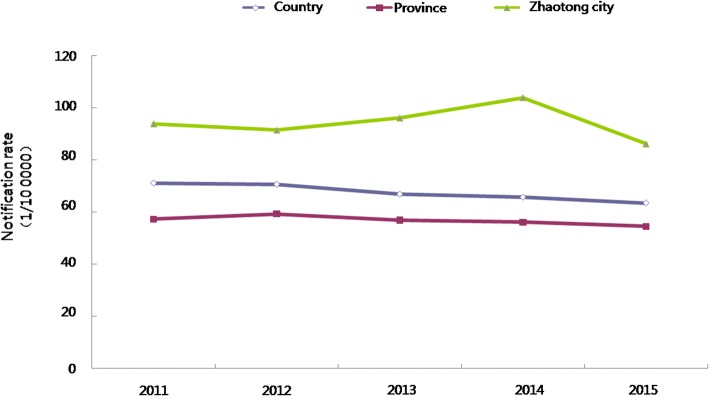
Pulmonary tuberculosis (PTB,both smear positive and smear negative) is an airborne infectious disease of major public health concern in China and other parts of the world where PTB endemicity is reported. This study aims at identifying PTB spatio-temporal clusters and associated risk factors in Zhaotong prefecture-level city, located in southwest China, where the PTB notification rate was higher than the average rate in the entire country.
Space-time scan statistics were carried out using PTB registered data in the nationwide TB online registration system from 2011 to 2015, to identify spatial clusters. PTB patients diagnosed between October 2015 and February 2016 were selected and a structured questionnaire was administered to collect a set of variables that includes socio-economic status, behavioural characteristics, local environmental and biological characteristics. Based on the discovery of detailed town-level spatio-temporal PTB clusters, we divided selected subjects into two groups including the cases that resides within and outside identified clusters. Then, logistic regression analysis was applied comparing the results of variables between the two groups.
A total of 1508 subjects consented and participated in the survey. Clusters for PTB cases were identified in 38 towns distributed over south-western Zhaotong. Logistic regression analysis showed that history of chronic bronchitis (OR = 3.683, 95% CI: 2.180-6.223), living in an urban area (OR = 5.876, 95% CI: 2.381-14.502) and using coal as the main fuel (OR = 9.356, 95% CI: 5.620-15.576) were independently associated with clustering. While, not smoking (OR = 0.340, 95% CI: 0.137-0.843) is the protection factor of spatial clustering.
We found PTB specially clustered in south-western Zhaotong. The strong associated factors influencing the PTB spatial cluster including: the history of chronic bronchitis, living in the urban area, smoking and the use of coal as the main fuel for cooking and heating. Therefore, efforts should be made to curtail these associated factors.
肺结核(PTB,包括涂片阳性和涂片阴性)是一种传染性呼吸道疾病,在中国和世界其他地方都存在公共卫生问题,这些地方的肺结核流行率报告较高。本研究旨在确定位于中国西南部的昭通地级市的肺结核时空聚集性及其相关危险因素,该地区的肺结核报告发病率高于全国平均水平。
利用全国结核病在线登记系统中 2011 年至 2015 年登记的肺结核病例数据,采用时空扫描统计方法识别空间聚集性。选择 2015 年 10 月至 2016 年 2 月期间诊断的肺结核患者,并采用结构化问卷收集一套包括社会经济状况、行为特征、当地环境和生物特征在内的变量。基于详细的城镇层面时空肺结核聚集性发现,我们将选定的研究对象分为两组,包括居住在确定的聚集区内和区外的病例。然后,应用逻辑回归分析比较两组间变量的结果。
共 1508 名研究对象同意并参与了调查。在西南部的 38 个城镇发现了肺结核病例聚集区。逻辑回归分析显示,慢性支气管炎史(OR=3.683,95%CI:2.180-6.223)、居住在城区(OR=5.876,95%CI:2.381-14.502)和主要使用煤炭作为燃料(OR=9.356,95%CI:5.620-15.576)与聚集有关。而不吸烟(OR=0.340,95%CI:0.137-0.843)是空间聚集的保护因素。
我们发现昭通西南部的肺结核呈特殊聚集性。影响肺结核空间聚集的主要相关因素包括:慢性支气管炎史、居住在城区、吸烟和使用煤炭作为烹饪和取暖的主要燃料。因此,应努力减少这些相关因素。