
结核病的空间模式检测:以泰国四色菊府为例的研究
Spatial Pattern Detection of Tuberculosis: A Case Study of Si Sa Ket Province, Thailand.
作者信息
Hassarangsee Siriwan, Tripathi Nitin Kumar, Souris Marc
机构信息
Remote Sensing and Geographic Information System Field of Study, School of Engineering and Technology, Asian Institute of Technology, P.O. Box 4, Klong Luang, Pathumthani 12120, Thailand.
UMR_D 190 "Emergence des Pathologies Virales", IRD, Aix-Marseille University, EHESP, INSERM, IFS, 13385 Marseille, France.
出版信息
Int J Environ Res Public Health. 2015 Dec 17;12(12):16005-18. doi: 10.3390/ijerph121215040.
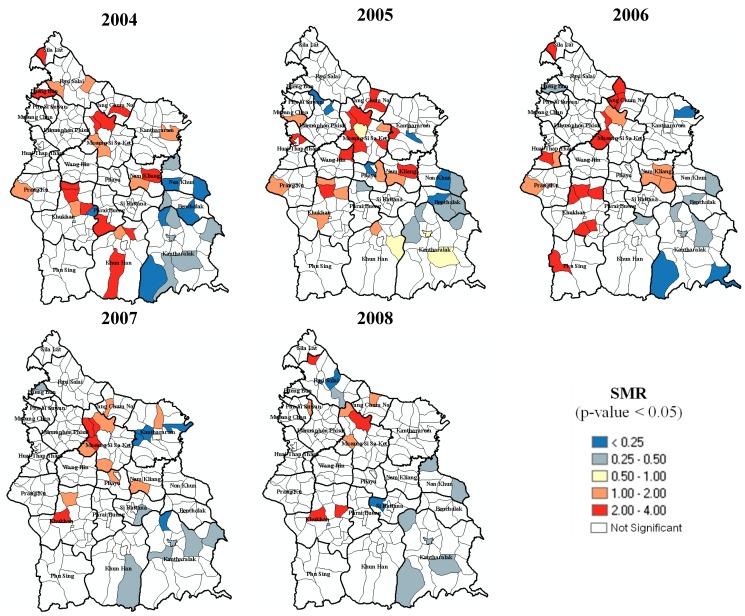
This retrospective population-based study was conducted to analyze spatial patterns of tuberculosis (TB) incidence in Si Sa Ket province, Thailand. TB notification data from 2004 to 2008 collected from TB clinics throughout the province was used along with population data to reveal a descriptive epidemiology of TB incidences. Global clustering patterns of the occurrence were assessed by using global spatial autocorrelation techniques. Additionally, local spatial pattern detection was performed by using local spatial autocorrelation and spatial scan statistic methods. The findings indicated clusters of the disease occurred in the study area. More specifically, significantly high-rate clusters were mostly detected in Mueang Si Sa Ket and Khukhan districts, which are located in the northwestern part of the province, while significantly low-rate clusters were persistent in Kantharalak and Benchalak districts, which are located at the southeastern area.
这项基于人群的回顾性研究旨在分析泰国四色菊府结核病(TB)发病率的空间模式。研究使用了2004年至2008年期间从该府各地结核病诊所收集的结核病通报数据以及人口数据,以揭示结核病发病率的描述性流行病学特征。通过使用全局空间自相关技术评估发病情况的全局聚类模式。此外,通过使用局部空间自相关和空间扫描统计方法进行局部空间模式检测。研究结果表明,该疾病在研究区域存在聚集现象。更具体地说,高发病率聚集区大多出现在该府西北部的四色菊直辖县和空堪县,而低发病率聚集区则持续出现在东南部的坎他拉勒县和班乍拉县。


 Zotero 插件