Cádiz Antonio, Nagata Nobuaki, Díaz Luis M, Suzuki-Ohno Yukari, Echenique-Díaz Lázaro M, Akashi Hiroshi D, Makino Takashi, Kawata Masakado
1Graduate School of Life Sciences, Tohoku University, Sendai, Japan.
2Faculty of Biology, Havana University, Havana, Cuba.
Zoological Lett. 2018 Aug 9;4:21. doi: 10.1186/s40851-018-0107-x. eCollection 2018.
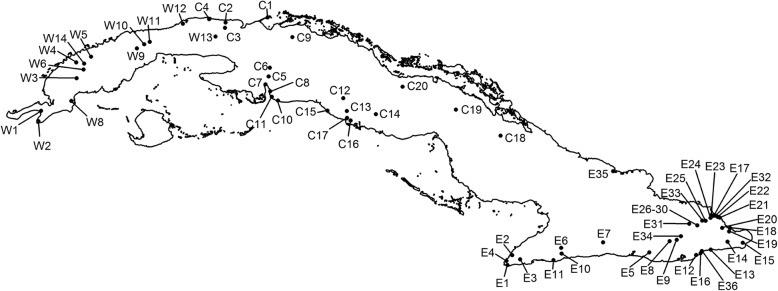
Geographical patterns and degrees of genetic divergence among populations differ between species, reflecting relative potentials for speciation or cladogenesis and differing capacities for environmental adaptation. Identification of factors that contribute to genetic divergence among populations is important to the understanding of why some species exhibit greater interpopulation genetic divergence. In this study, we calculated the mean pairwise genetic distances among populations as species' average genetic divergence by a phylogeny using nuclear and mitochondrial genes of 303 individuals from 33 Cuban species and estimated species ages by another phylogeny using nuclear and mitochondrial genes of 51 Cuban and 47 non-Cuban species. We identified factors that influence species' differences in genetic divergence among 26 species of lizards from Cuba. Species ages, environmental heterogeneity within species ranges, and ecomorph types were considered as factors affecting average genetic divergences among populations.
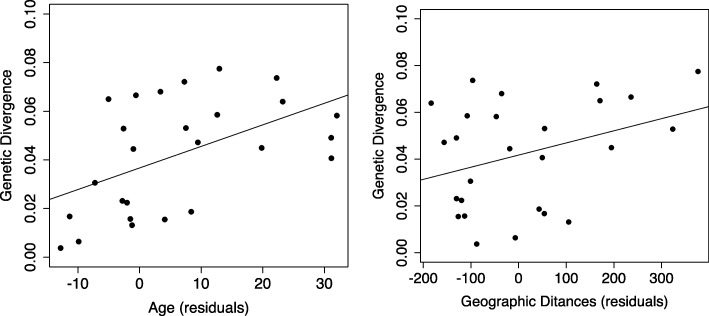
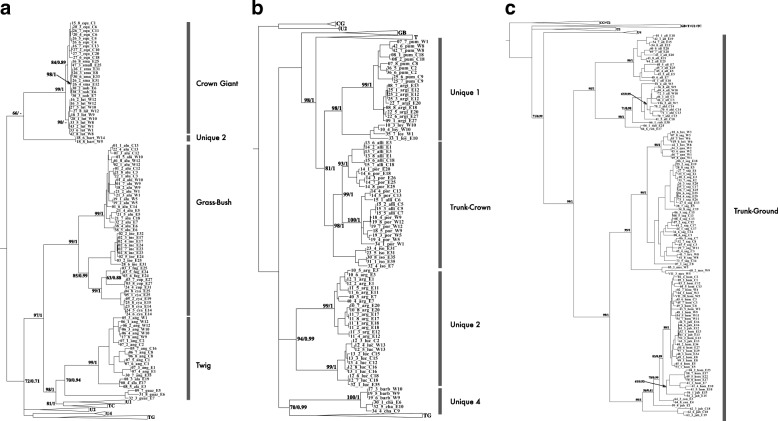
The phylogenies presented in this study provide the most comprehensive sampling of Cuban species to date. The phylogeny showed more conservative evolution of ecomorphs within Cuba and identified twig anoles as a monophyletic group. Subsequent Phylogenetic Generalized Least Squares (PGLS) analyses showed that species age was positively correlated with species' average genetic divergence among populations.
Although previous studies have focused on factors affecting genetic divergence within species, the present study showed for the first time that species differences in genetic divergence could be largely affected by species age.
不同物种的种群间地理模式和遗传分化程度存在差异,这反映了物种形成或分支发生的相对潜力以及环境适应能力的不同。确定导致种群间遗传分化的因素对于理解为何有些物种表现出更大的种群间遗传分化至关重要。在本研究中,我们通过系统发育分析,利用来自33个古巴物种的303个个体的核基因和线粒体基因计算种群间的平均成对遗传距离,以此作为物种的平均遗传分化,并通过另一个系统发育分析,利用51个古巴物种和47个非古巴物种的核基因和线粒体基因估算物种年龄。我们确定了影响来自古巴的26种蜥蜴物种间遗传分化差异的因素。物种年龄、物种分布范围内的环境异质性以及生态形态类型被视为影响种群间平均遗传分化的因素。
本研究中呈现的系统发育关系提供了迄今为止对古巴物种最全面的采样。该系统发育关系显示古巴境内生态形态的进化更为保守,并确定细枝安乐蜥为一个单系类群。随后的系统发育广义最小二乘法(PGLS)分析表明,物种年龄与种群间物种的平均遗传分化呈正相关。
尽管先前的研究集中于影响物种内遗传分化的因素,但本研究首次表明,物种间遗传分化差异可能在很大程度上受物种年龄的影响。