Division of Molecular and Experimental Surgery, Translational Research Center, Department of Surgery, University Medical Center Erlangen, Friedrich-Alexander-Universität Erlangen-Nürnberg (FAU), Schwabachanlage 12, 91054 Erlangen, Germany.
Fraunhofer Institute for Integrated Circuits IIS, Department of Image Processing and Medical Engineering, Am Wolfsmantel 33, 91058 Erlangen, Germany.
Biochem J. 2018 Sep 25;475(18):2955-2967. doi: 10.1042/BCJ20180123.
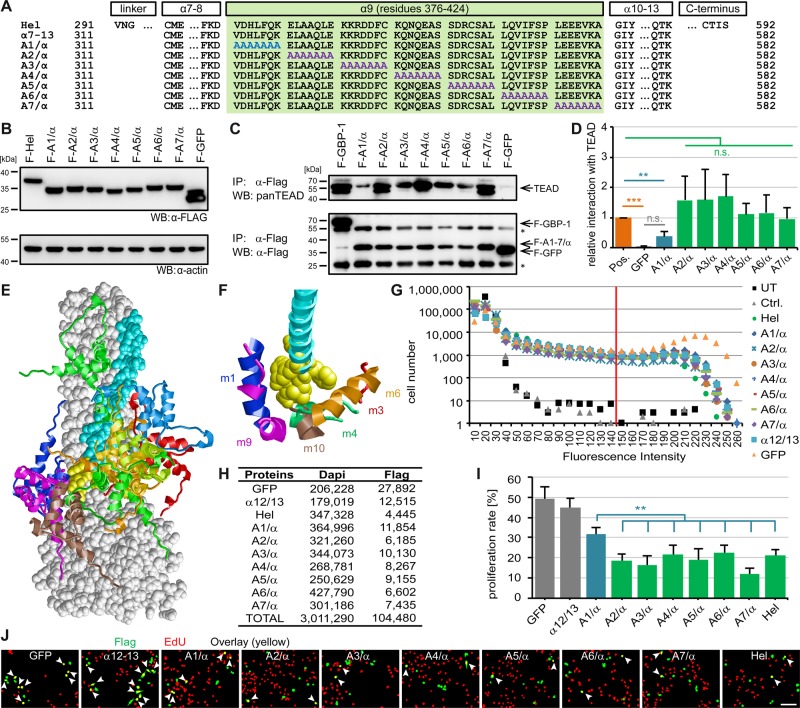
Interferon-gamma (IFN-γ) is a pleiotropic cytokine that exerts important functions in inflammation, infectious diseases, and cancer. The large GTPase human guanylate-binding protein 1 (GBP-1) is among the most strongly IFN-γ-induced cellular proteins. Previously, it has been shown that GBP-1 mediates manifold cellular responses to IFN-γ including the inhibition of proliferation, spreading, migration, and invasion and through this exerts anti-tumorigenic activity. However, the mechanisms of GBP-1 anti-tumorigenic activities remain poorly understood. Here, we elucidated the molecular mechanism of the human GBP-1-mediated suppression of proliferation by demonstrating for the first time a cross-talk between the anti-tumorigenic IFN-γ and Hippo pathways. The α9-helix of GBP-1 was found to be sufficient to inhibit proliferation. Protein-binding and molecular modeling studies revealed that the α9-helix binds to the DNA-binding domain of the Hippo signaling transcription factor TEA domain protein (TEAD) mediated by the VDHLFQK sequence at the N-terminus of the GBP-1-α9-helix. Mutation of this sequence resulted in abrogation of both TEAD interaction and suppression of proliferation. Further on, the interaction caused inhibition of TEAD transcriptional activity associated with the down-regulation of TEAD-target genes. In agreement with these results, IFN-γ treatment of the cells also impaired TEAD activity, and this effect was abrogated by siRNA-mediated inhibition of GBP-1 expression. Altogether, this demonstrated that the α9-helix is the proliferation inhibitory domain of GBP-1, which acts independent of the GTPase activity through the inhibition of the Hippo transcription factor TEAD in mediating the anti-proliferative cell response to IFN-γ.
干扰素-γ(IFN-γ)是一种多功能细胞因子,在炎症、传染病和癌症中发挥着重要作用。人鸟苷酸结合蛋白 1(GBP-1)是 IFN-γ 诱导的细胞蛋白中最强的一种。先前的研究表明,GBP-1 介导了 IFN-γ 诱导的多种细胞反应,包括抑制增殖、扩散、迁移和侵袭,从而发挥抗肿瘤活性。然而,GBP-1 抗肿瘤活性的机制仍知之甚少。在这里,我们通过首次证明 IFN-γ 和 Hippo 信号通路之间的交叉对话,阐明了人 GBP-1 介导的增殖抑制的分子机制。我们发现 GBP-1 的α9-螺旋足以抑制增殖。蛋白结合和分子建模研究表明,α9-螺旋通过 GBP-1-α9-螺旋 N 端的 VDHLFQK 序列与 Hippo 信号转导转录因子 TEA 结构域蛋白(TEAD)的 DNA 结合域结合。该序列的突变导致 TEAD 相互作用和增殖抑制的丧失。此外,这种相互作用抑制了 TEAD 的转录活性,与 TEAD 靶基因的下调有关。与此结果一致,IFN-γ 处理细胞也会损害 TEAD 活性,而 GBP-1 表达的 siRNA 抑制可消除这种作用。总之,这表明α9-螺旋是 GBP-1 的增殖抑制结构域,它通过抑制 Hippo 转录因子 TEAD 来介导 IFN-γ 诱导的抗增殖细胞反应,而不依赖于 GTP 酶活性。