Department of Psychosis Studies, South London and Maudsley NHS Foundation Trust, Institute of Psychiatry, Psychology & Neuroscience, King's College London, London, United Kingdom; National Institute for Health Research Maudsley Mental Health Biomedical Research Centre, South London and Maudsley NHS Foundation Trust, Institute of Psychiatry, Psychology & Neuroscience, King's College London, London, United Kingdom.
Department of Psychosis Studies, South London and Maudsley NHS Foundation Trust, Institute of Psychiatry, Psychology & Neuroscience, King's College London, London, United Kingdom; National Institute for Health Research Maudsley Mental Health Biomedical Research Centre, South London and Maudsley NHS Foundation Trust, Institute of Psychiatry, Psychology & Neuroscience, King's College London, London, United Kingdom.
Biol Psychiatry. 2019 Jan 1;85(1):35-48. doi: 10.1016/j.biopsych.2018.06.016. Epub 2018 Jun 28.
A relationship between non-neurological autoimmune (NNAI) disorders and psychosis has been widely reported but not yet subjected to meta-analysis. We conducted the first meta-analysis examining the association between NNAI disorders and psychosis and investigated the effect of 1) temporality (as determined by study design), 2) psychiatric diagnosis, and 3) specific autoimmune disorders.
Major databases were searched for articles published until April 2018; 31 studies, comprising data for >25 million individuals, were eligible. Using random-effects models, we examined the overall association between all NNAI disorders and psychosis; rheumatoid arthritis was examined separately given the well-established negative association with psychosis. Stratified analyses investigated the effect of temporality, psychiatric diagnosis, and specific NNAI disorders.
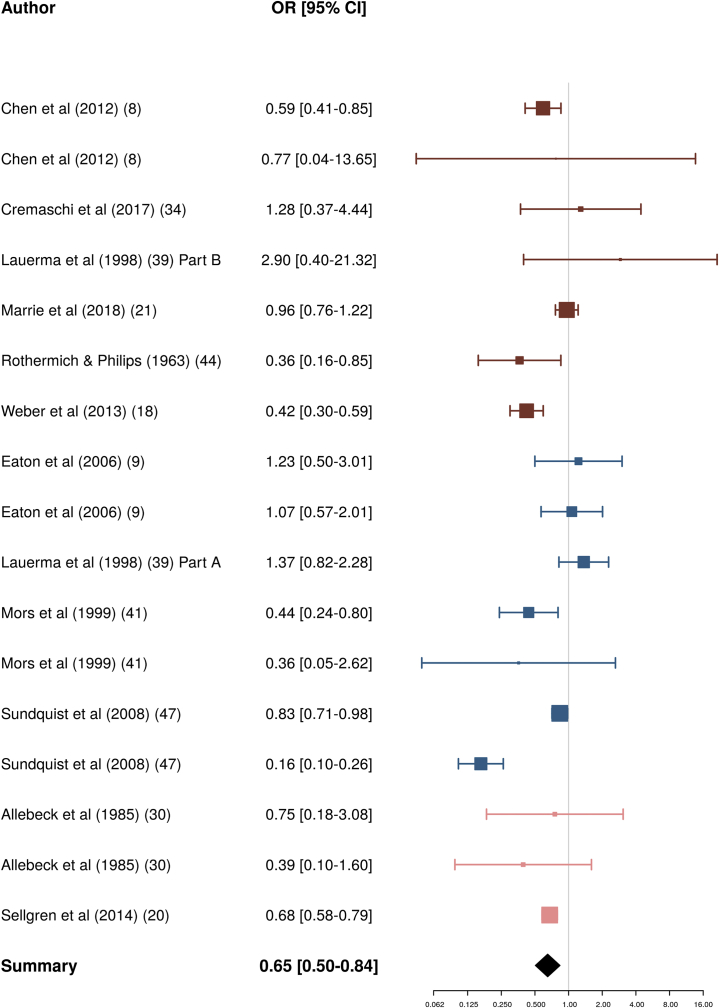
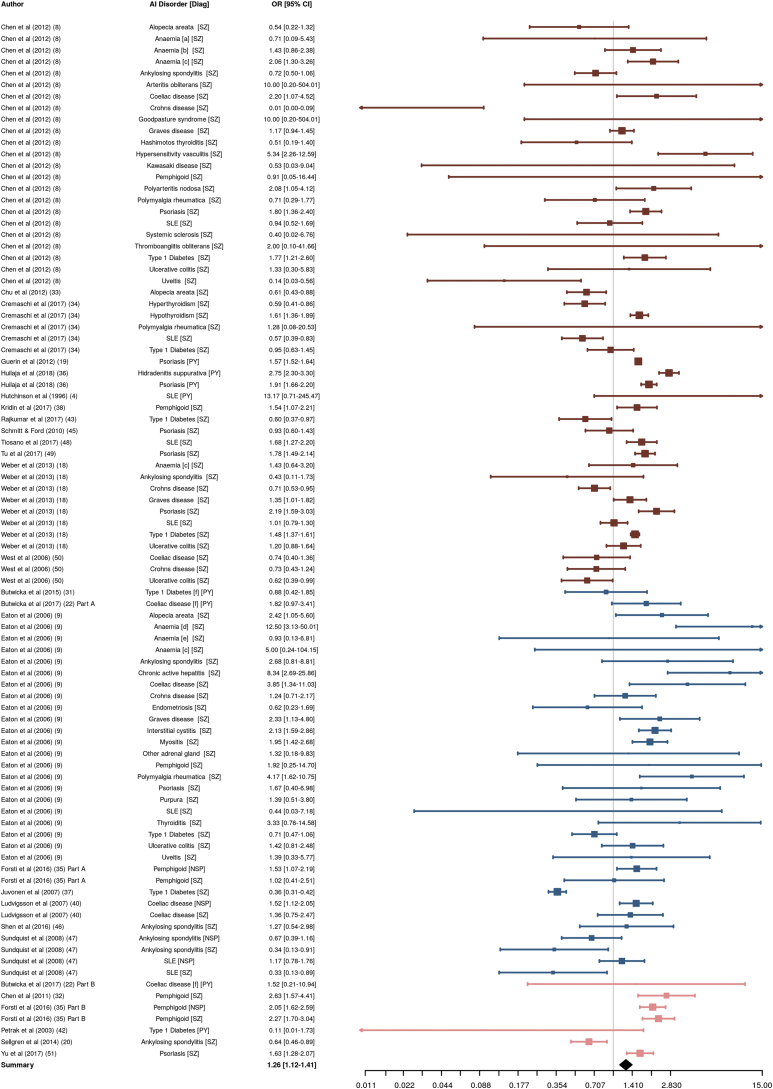
We observed a positive overall association between NNAI disorders and psychosis (odds ratio [OR] = 1.26; 95% confidence interval [CI], 1.12-1.41) that was consistent across study designs and psychiatric diagnoses; however, considerable heterogeneity was detected (I = 88.08). Patterns varied across individual NNAI disorders; associations were positive for pernicious anemia (OR = 1.91; 95% CI, 1.29-2.84), pemphigoid (OR = 1.90; 95% CI, 1.62-2.24), psoriasis (OR = 1.70; 95% CI, 1.51-1.91), celiac disease (OR = 1.53; 95% CI, 1.12-2.10), and Graves' disease (OR = 1.33; 95% CI, 1.03-1.72) and negative for ankylosing spondylitis (OR = 0.72; 95% CI, 0.54-0.98) and rheumatoid arthritis (OR = 0.65; 95% CI, 0.50-0.84).
While we observed a positive overall association between NNAI disorders and psychosis, this was not consistent across all NNAI disorders. Specific factors, including distinct inflammatory pathways, genetic influences, autoantibodies targeting brain proteins, and exposure to corticosteroid treatment, may therefore underlie this association.
非神经自身免疫性(NNAI)疾病与精神病之间的关系已被广泛报道,但尚未进行荟萃分析。我们进行了首次荟萃分析,以检查 NNAI 疾病与精神病之间的关联,并研究了以下因素的影响:1)时间性(由研究设计确定),2)精神科诊断,和 3)特定的自身免疫性疾病。
主要数据库检索了截至 2018 年 4 月发表的文章;有 31 项研究纳入了超过 2500 万人的数据,符合条件。我们使用随机效应模型,检查了所有 NNAI 疾病与精神病之间的总体关联;由于类风湿性关节炎与精神病之间存在明确的负相关关系,因此对其进行了单独检查。分层分析研究了时间性、精神科诊断和特定 NNAI 疾病的影响。
我们观察到 NNAI 疾病与精神病之间存在正相关(比值比[OR] = 1.26;95%置信区间[CI],1.12-1.41),这种关联在研究设计和精神科诊断上都是一致的;然而,存在很大的异质性(I = 88.08)。个体 NNAI 疾病的模式各不相同;恶性贫血(OR = 1.91;95% CI,1.29-2.84)、天疱疮(OR = 1.90;95% CI,1.62-2.24)、银屑病(OR = 1.70;95% CI,1.51-1.91)、乳糜泻(OR = 1.53;95% CI,1.12-2.10)和格雷夫斯病(OR = 1.33;95% CI,1.03-1.72)与精神病之间存在正相关,而强直性脊柱炎(OR = 0.72;95% CI,0.54-0.98)和类风湿性关节炎(OR = 0.65;95% CI,0.50-0.84)与精神病之间存在负相关。
虽然我们观察到 NNAI 疾病与精神病之间存在正相关,但这并不是所有 NNAI 疾病都存在的。因此,特定的因素,包括不同的炎症途径、遗传影响、针对大脑蛋白的自身抗体和皮质类固醇治疗的暴露,可能是这种关联的基础。