Chaudhry Neera, Aswani Nishant, Khwaja Geeta Anjum, Rani Puja
Department of Neurology, Govind Ballabh Pant Institute of Postgraduate Medical Education and Research, New Delhi, India.
Ann Indian Acad Neurol. 2018 Apr-Jun;21(2):158-160. doi: 10.4103/aian.AIAN_40_18.
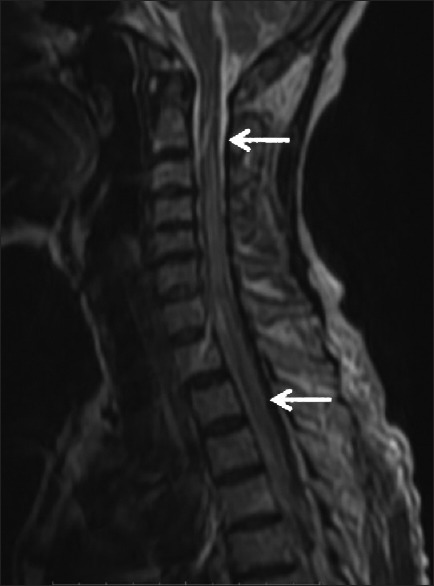
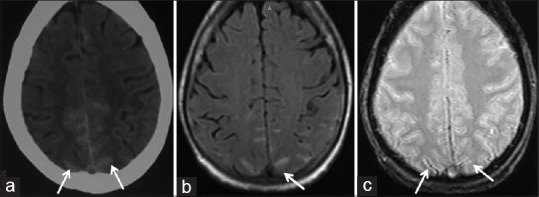
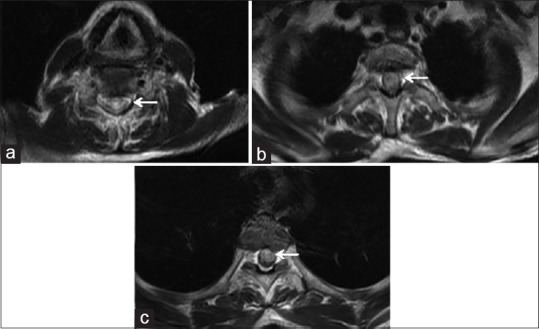
Association of dengue fever with transverse myelitis is a rare phenomenon; involvement of a long segment is even rarer. We describe a middle-aged female who presented with weakness of bilateral lower limbs and urinary retention 4 days after recovery from dengue fever. She, in addition, had a sensory level up to the level of nipples. Magnetic resonance imaging confirmed the diagnosis of longitudinally extensive transverse myelitis. Besides, the patient had spontaneous subarachnoid hemorrhage (SAH) in the absence of dengue hemorrhagic fever. The patient was started on steroids along with rehabilitation. Our case highlights the extensive involvement of spinal cord in the postinfectious phase of dengue and inclusion of this arboviral disease in the differential diagnoses of myelitis as well as an etiology of SAH.
登革热与横贯性脊髓炎相关是一种罕见现象;累及长节段的情况更为罕见。我们描述了一名中年女性,她在登革热康复4天后出现双侧下肢无力和尿潴留。此外,她的感觉平面高达乳头水平。磁共振成像证实了纵向广泛横贯性脊髓炎的诊断。此外,该患者在无登革出血热的情况下发生了自发性蛛网膜下腔出血(SAH)。患者开始接受类固醇治疗并进行康复治疗。我们的病例突出了登革热感染后阶段脊髓的广泛受累情况,以及将这种虫媒病毒疾病纳入脊髓炎鉴别诊断和SAH病因的范畴。