Alsafadi Samah, Abaalkhail Bahaa, Wali Siraj Omar, Aljammali Khaled, Alotaiby Bedor, Zakaria Ibrahim, Sabbahi Hanadi
Department of Family and Community Medicine, Faculty of Medicine, King Abdulaziz University, Jeddah, Saudi Arabia.
Sleep Medicine and Research Center, King Abdulaziz University Hospital, Jeddah, Saudi Arabia.
Ann Thorac Med. 2018 Jul-Sep;13(3):175-181. doi: 10.4103/atm.ATM_344_17.
Restless legs syndrome (RLS) is etiologically divided into primary and secondary syndromes. However, a comparative description of both types is lacking in the literature. We compared primary and secondary RLS with respect to demographic determinants, associated risk factors, and comorbidities.
Following a cross-sectional survey on the prevalence of RLS in a Saudi population, RLS cases were identified using the International RLS Study Group (IRLSSG) criteria. Cases were assessed with an interview-based questionnaire regarding baseline characteristics, risk factors, and comorbidities and with lower limb examinations and laboratory measurements. RLS severity was assessed using the IRLSSG Severity Rating Scale.
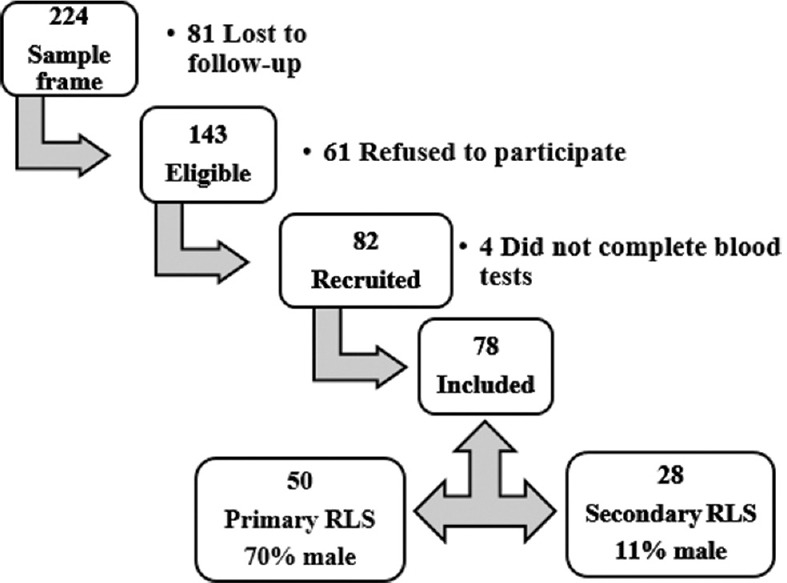
In total, 78 patients with RLS, including 50 (64.1%) primary and 28 (35.9%) secondary cases, were examined. Of the primary cases, 35 (70%) were male; of the secondary cases, 25 (89.3%) were female ( < 0.001). Multivariate regression confirmed the association of male gender with primary RLS (odds ratio = 14.53, 95% confidence interval [2.9-75], = 0.001). There were more dark- and black-skinned participants in the primary RLS group (38, 72%) than in the secondary group (15, 28%) ( = 0.042). Iron deficiency was observed in most (26, 92%) of the secondary cases. More severe symptoms were reported in secondary than in primary RLS cases ( < 0.05).
Primary RLS is more common but less severe than secondary RLS. Male gender and ethnicity play significant roles in primary RLS, whereas female gender and iron deficiency may be the main risk factors associated with secondary RLS.
不宁腿综合征(RLS)在病因上分为原发性和继发性综合征。然而,文献中缺乏对这两种类型的比较描述。我们比较了原发性和继发性RLS在人口统计学决定因素、相关危险因素和合并症方面的情况。
在对沙特人群中RLS患病率进行横断面调查后,根据国际RLS研究组(IRLSSG)标准确定RLS病例。通过基于访谈的问卷对病例进行基线特征、危险因素和合并症评估,并进行下肢检查和实验室测量。使用IRLSSG严重程度评定量表评估RLS严重程度。
共检查了78例RLS患者,其中50例(64.1%)为原发性,28例(35.9%)为继发性。原发性病例中,35例(70%)为男性;继发性病例中,25例(89.3%)为女性(P<0.001)。多因素回归证实男性性别与原发性RLS相关(优势比=14.53,95%置信区间[2.9-75],P=0.001)。原发性RLS组中深色和黑色皮肤参与者(38例,72%)比继发性组(15例,28%)更多(P=0.042)。大多数继发性病例(26例,92%)存在缺铁。继发性RLS病例报告的症状比原发性更严重(P<0.05)。
原发性RLS比继发性RLS更常见但症状较轻。男性性别和种族在原发性RLS中起重要作用,而女性性别和缺铁可能是与继发性RLS相关的主要危险因素。