Shiryaev Anton G
Institute of Plant and Animal Ecology, Russian Academy of Sciences, Ekaterinburg, Russia.
Mycology. 2017 Jul 3;8(3):135-146. doi: 10.1080/21501203.2017.1345801. eCollection 2017.
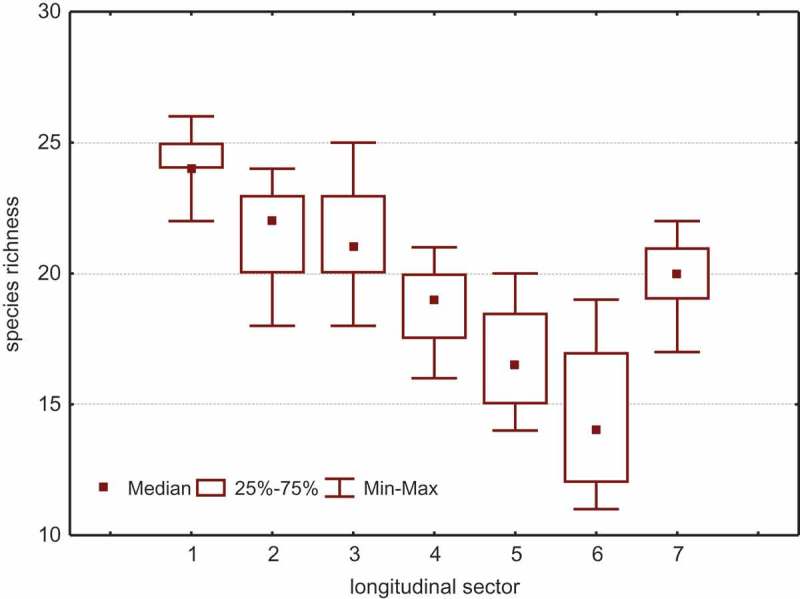
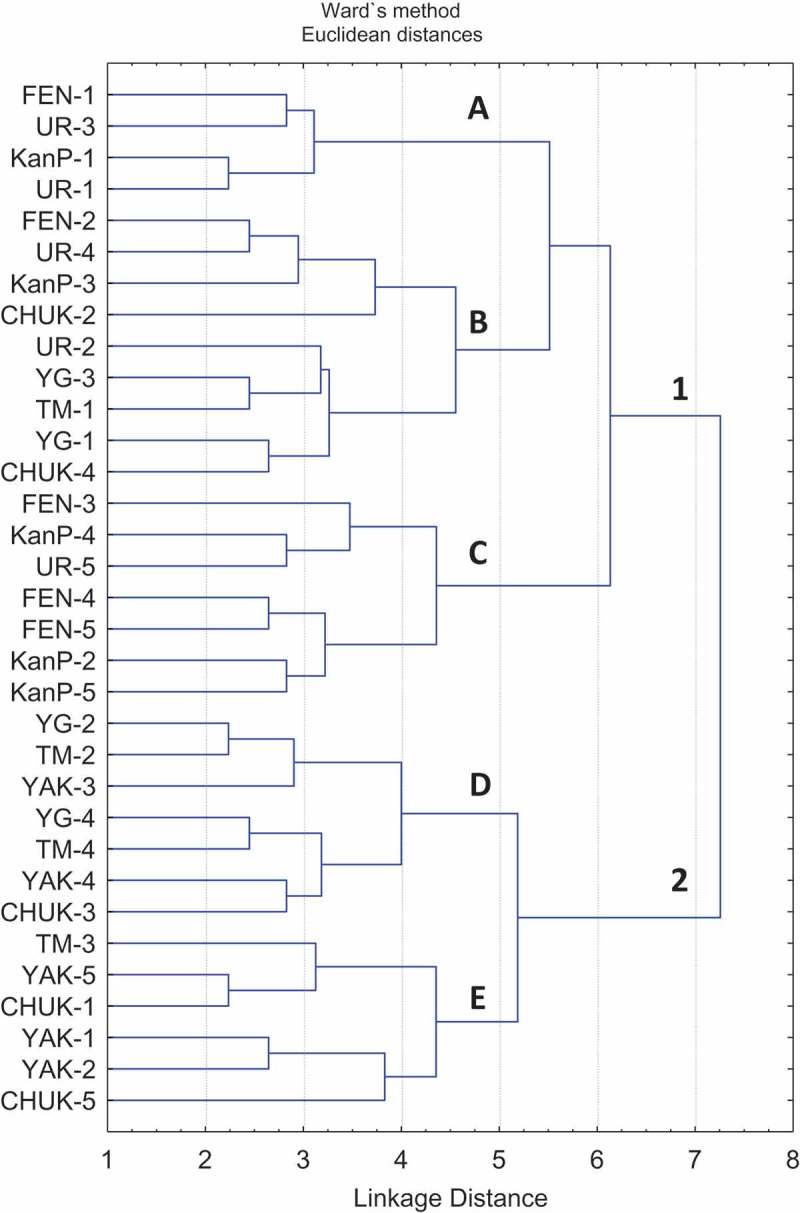
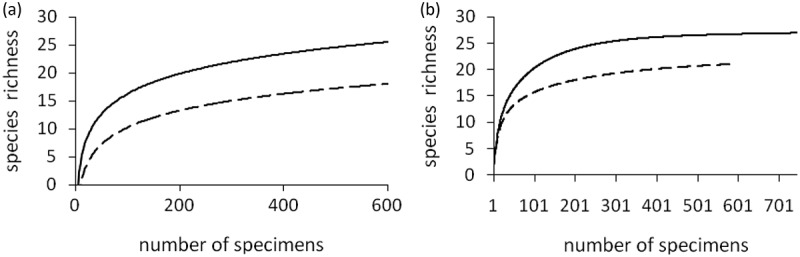
The study deals with certain variations of the diversity level of clavarioid funga in the 33 localities (100 km each) inside seven longitudinal sectors (100,000 km) situated along the gradient of the climatic continentality of the Eurasian tundra zone. As continentality increases, from the maritime climate of Fennoscandia to the continental climate of Yakutia, α-diversity and γ-diversity decrease considerably. On the other side, spatial turnover of species, or β-diversity, grows in the direction of continental areas. This paper uses the following methods to assess the spatial turnover: Whittaker's index and mean Jaccard similarity index, as well as by several other parameters. In addition, our data show that the genus is richest in the tundra, and its share in the structure of the clavarioid funga grows as the studied area decreases, as well as when the environmental conditions become more severe (continentality of the climate). Also, the paper discusses the issue of newly emerging taiga fungi species in the European Arctic, which is connected with climatic warming followed by ″greening″ of the tundra. Note that in the cryo-semiarid continental climate of Yakutia, where climatic changes are just as pronounced, no new taxons have been discovered so far.
该研究探讨了沿欧亚苔原带气候大陆度梯度分布的七个纵向区域(每个区域100,000平方千米)内33个地点(每个地点间隔100千米)的珊瑚菌类真菌多样性水平的某些变化。随着大陆度增加,从芬诺斯堪的亚的海洋性气候到雅库特的大陆性气候,α多样性和γ多样性显著降低。另一方面,物种的空间周转率,即β多样性,朝着大陆地区的方向增加。本文使用以下方法评估空间周转率:惠特克指数、平均杰卡德相似性指数以及其他几个参数。此外,我们的数据表明,该属在苔原中最为丰富,并且其在珊瑚菌类真菌结构中的占比随着研究区域的缩小以及环境条件变得更加恶劣(气候大陆度)而增加。此外,本文还讨论了欧洲北极地区新出现的泰加林真菌物种问题,这与气候变暖以及随之而来的苔原“绿化”有关。请注意,在气候变化同样显著的雅库特低温半干旱大陆性气候中,到目前为止尚未发现新的分类群。