Uramoto Kengo, Shimada Noriaki, Takahashi Hiroyuki, Murai Hideki, Shinohara Kosei, Ohno-Matsui Kyoko
Department of Ophthalmology and Visual Science, Tokyo Medical and Dental University, 1-5-45 Yushima, Bunkyo-ku, Tokyo, 113-8519, Japan.
BMC Ophthalmol. 2018 Aug 20;18(1):203. doi: 10.1186/s12886-018-0881-4.
To report a case of Suprachoroidal Hemorrhage followed by Swept-Source Optical Coherence Tomography.
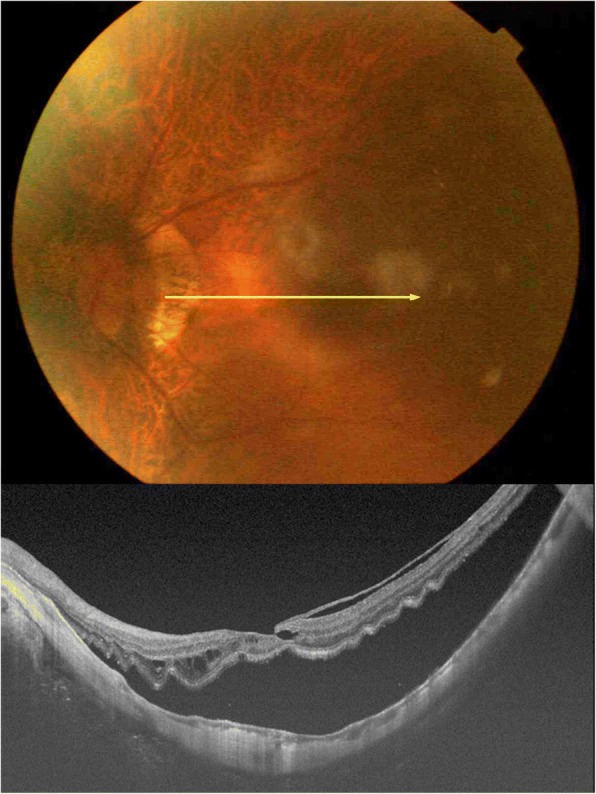
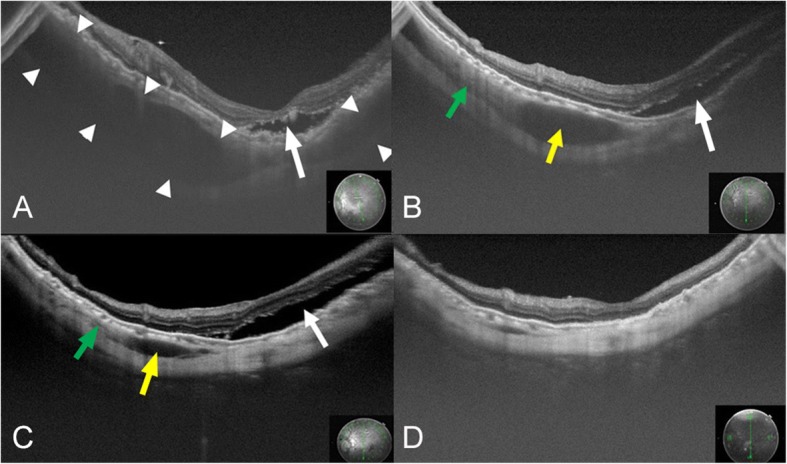
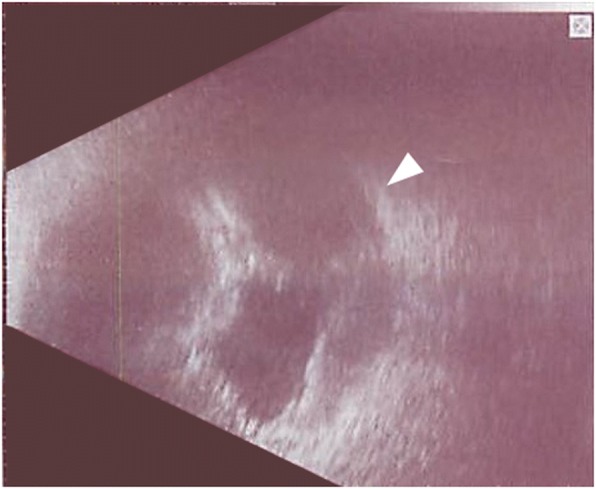
A 66-year-old woman with a rhegmatogenous retinal detachment in her left eye underwent pars plana vitrectomy. During the intraocular photocoagulation for a retinal tear after fluid-air exchange, a vitreous hemorrhage and suprachoroidal hemorrhage (SCH) developed. The surgical incisions were closed after filling the vitreous cavity with silicone oil. Two weeks later, the hemolyzed hemorrhage was removed, and new silicone oil was injected. After the surgery, a low reflective region was detected near the macula in the swept-source optical coherence tomographic (SS-OCT) images. The low reflective region was caused by the residual hemorrhage. The size of the reflective region gradually decreased and was not present at 3 months. We conclude that SS-OCT can be used to follow the resolution of a suprachoroidal hemorrhage.
SS-OCT can be used to detect and follow the natural course of a suprachoroidal hemorrhage including the absorptive processes.
报告一例脉络膜上腔出血并随后进行扫频光学相干断层扫描的病例。
一名66岁左眼孔源性视网膜脱离的女性接受了玻璃体切除术。在液气交换后对视网膜裂孔进行眼内光凝时,发生了玻璃体出血和脉络膜上腔出血(SCH)。用硅油填充玻璃体腔后关闭手术切口。两周后,清除溶血的出血,并注入新的硅油。术后,在扫频光学相干断层扫描(SS-OCT)图像中黄斑附近检测到一个低反射区域。该低反射区域是由残留出血引起的。反射区域的大小逐渐减小,3个月时消失。我们得出结论,SS-OCT可用于跟踪脉络膜上腔出血的消退情况。
SS-OCT可用于检测和跟踪脉络膜上腔出血的自然病程,包括吸收过程。