National Human Genome Research Institute, National Institutes of Health, Bethesda, MD, USA.
Laboratory of Immune System Biology, National Institute of Allergy and Infectious Diseases, National Institutes of Health, Bethesda, MD, USA.
Nat Immunol. 2018 Sep;19(9):986-1000. doi: 10.1038/s41590-018-0182-3. Epub 2018 Aug 20.
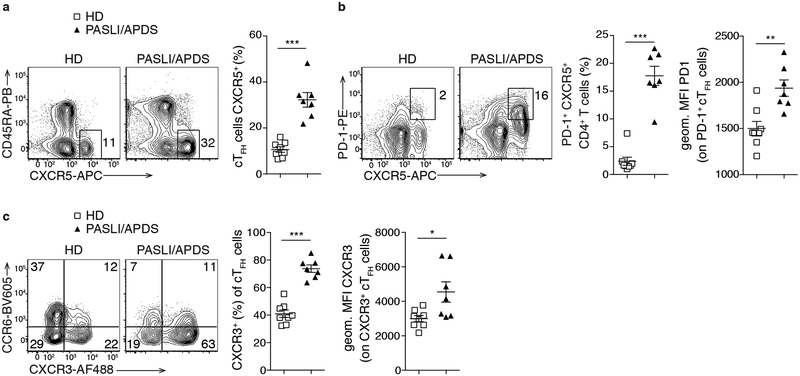
Gain-of-function mutations in the gene encoding the phosphatidylinositol-3-OH kinase catalytic subunit p110δ (PI3Kδ) result in a human primary immunodeficiency characterized by lymphoproliferation, respiratory infections and inefficient responses to vaccines. However, what promotes these immunological disturbances at the cellular and molecular level remains unknown. We generated a mouse model that recapitulated major features of this disease and used this model and patient samples to probe how hyperactive PI3Kδ fosters aberrant humoral immunity. We found that mutant PI3Kδ led to co-stimulatory receptor ICOS-independent increases in the abundance of follicular helper T cells (T cells) and germinal-center (GC) B cells, disorganized GCs and poor class-switched antigen-specific responses to immunization, associated with altered regulation of the transcription factor FOXO1 and pro-apoptotic and anti-apoptotic members of the BCL-2 family. Notably, aberrant responses were accompanied by increased reactivity to gut bacteria and a broad increase in autoantibodies that were dependent on stimulation by commensal microbes. Our findings suggest that proper regulation of PI3Kδ is critical for ensuring optimal host-protective humoral immunity despite tonic stimulation from the commensal microbiome.
PI3Kδ 基因编码的磷酸肌醇-3-OH 激酶催化亚基 p110δ 的功能获得性突变导致人类原发性免疫缺陷,其特征为淋巴组织增生、呼吸道感染和疫苗接种反应效率低下。然而,在细胞和分子水平上促进这些免疫紊乱的原因仍不清楚。我们生成了一个可重现该疾病主要特征的小鼠模型,并使用该模型和患者样本来探究过度活跃的 PI3Kδ 如何促进异常的体液免疫。我们发现,突变型 PI3Kδ 导致滤泡辅助 T 细胞(T 细胞)和生发中心(GC)B 细胞数量的非协同性受体 ICOS 独立增加,GC 紊乱和抗原特异性免疫反应不良,与转录因子 FOXO1 和 BCL-2 家族的促凋亡和抗凋亡成员的调节异常有关。值得注意的是,异常反应伴随着对肠道细菌的反应性增加和广泛的自身抗体增加,这依赖于共生微生物的刺激。我们的研究结果表明,尽管来自共生微生物组的持续刺激,PI3Kδ 的适当调节对于确保最佳的宿主保护性体液免疫至关重要。