Bao Min, Xie Jing, Huck Wilhelm T S
Institute for Molecules and Materials Radboud University Heyendaalseweg 135 6525 AJ Nijmegen The Netherlands.
Adv Sci (Weinh). 2018 Jun 13;5(8):1800448. doi: 10.1002/advs.201800448. eCollection 2018 Aug.
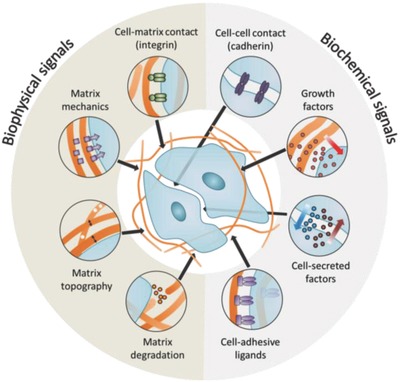
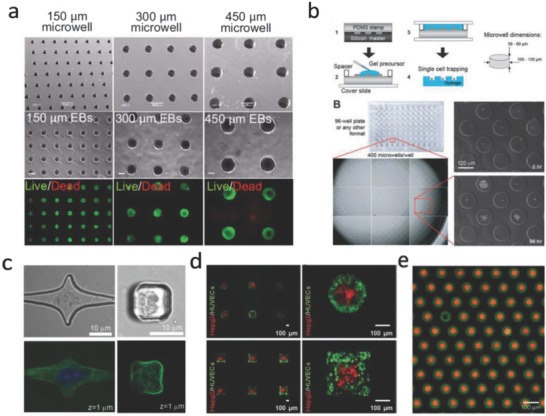
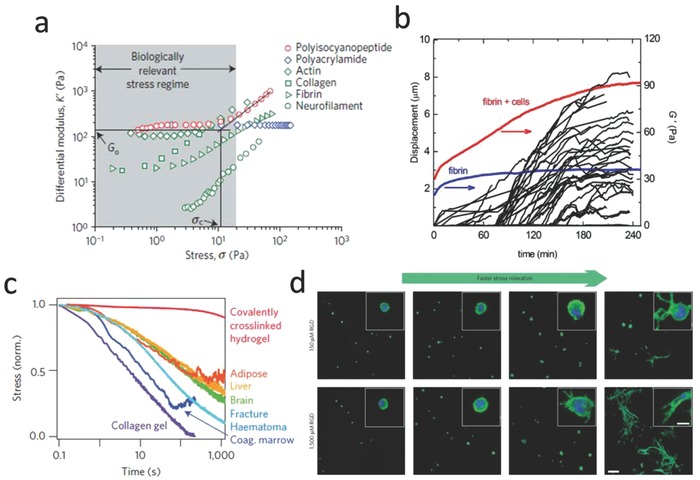
Conventional 2D cell culture techniques have provided fundamental insights into key biochemical and biophysical mechanisms responsible for various cellular behaviors, such as cell adhesion, spreading, division, proliferation, and differentiation. However, 2D culture in vitro does not fully capture the physical and chemical properties of the native microenvironment. There is a growing body of research that suggests that cells cultured on 2D substrates differ greatly from those grown in vivo. This article focuses on recent progress in using bioinspired 3D matrices that recapitulate as many aspects of the natural extracellular matrix as possible. A range of techniques for the engineering of 3D microenvironment with precisely controlled biophysical and chemical properties, and the impact of these environments on cellular behavior, is reviewed. Finally, an outlook on future challenges for engineering the 3D microenvironment and how such approaches would further our understanding of the influence of the microenvironment on cell function is provided.
传统的二维细胞培养技术为深入了解负责各种细胞行为(如细胞粘附、铺展、分裂、增殖和分化)的关键生化和生物物理机制提供了基础见解。然而,体外二维培养并不能完全捕捉天然微环境的物理和化学性质。越来越多的研究表明,在二维基质上培养的细胞与体内生长的细胞有很大差异。本文重点关注利用仿生三维基质的最新进展,这些基质尽可能多地重现天然细胞外基质的各个方面。本文综述了一系列用于构建具有精确可控生物物理和化学性质的三维微环境的技术,以及这些环境对细胞行为的影响。最后,展望了工程化三维微环境未来面临的挑战,以及此类方法将如何进一步增进我们对微环境对细胞功能影响的理解。