Departments of Ophthalmology and Anatomy and Cell Biology, Wayne State University School of Medicine, Detroit, Michigan, United States.
Eye and ENT Hospital of Fudan University, Xuhui District, Shanghai, China.
Invest Ophthalmol Vis Sci. 2018 Aug 1;59(10):4228-4237. doi: 10.1167/iovs.18-24672.
We sought to determine the role of epithelium-produced thymic stromal lymphopoietin (TSLP) and its underlying mechanisms in corneal innate immune defense against Pseudomonas (P.) aeruginosa keratitis.
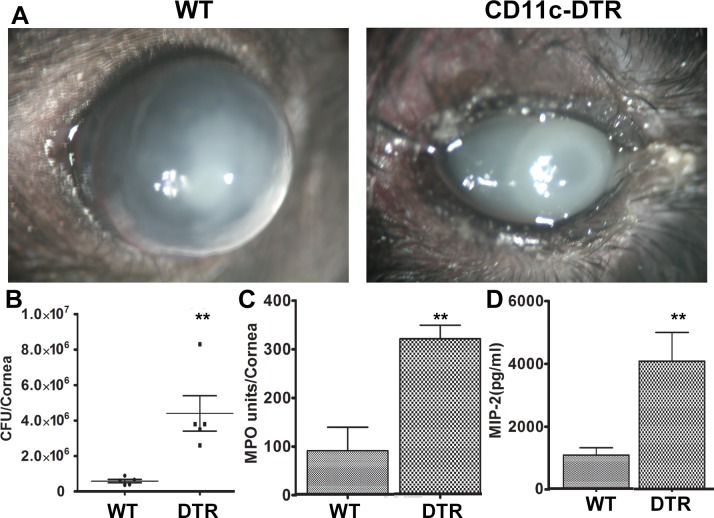
The expression of TSLP and TSLPR in cultured human corneal epithelial cells (HCECs) and mouse corneas was determined by PCR, Western, and/or ELISA. Cellular localization of TSLP receptor (TSLPR) was determined by whole mount confocal microscopy. TSLP-TSLPR signaling was downregulated by neutralizing antibodies and/or small interfering (si)RNA; their effects on the severity of P. aeruginosa-keratitis and cytokine expression were assessed using clinical scoring, bacterial counting, PMN infiltration, and real-time PCR. The role of dendritic cells (DCs) in corneal innate immunity was determined by local DC depletion using CD11c-DTR mice.
P. aeruginosa-infection induced the expression of TSLP and TSLPR in both cultured primary HCECs and in C57BL/6 mouse corneas. While TSLP was mostly expressed by epithelial cells, CD11c-positive cells were positive for TSLPR. Targeting TSLP or TSLPR with neutralizing antibodies or TSLPR with siRNA resulted in more severe keratitis, attributable to an increase in bacterial burden and PMN infiltration. TSLPR neutralization significantly suppressed infection-induced TSLP and interleukin (IL)-17C expression and augmented the expression of IL-23 and IL-17A. Local depletion of DCs markedly increased the severity of keratitis and exhibited no effects on TSLP and IL-23 expression while suppressing IL-17A and C expression in P. aeruginosa-infected corneas.
The epithelium-expressed TSLP plays a protective role in P. aeruginosa keratitis through targeting of DCs and in an IL-23/IL-17 signaling pathway-related manner.
我们旨在确定上皮细胞产生的胸腺基质淋巴细胞生成素 (TSLP) 及其在针对铜绿假单胞菌 (P.) 角膜炎的角膜固有免疫防御中的作用机制。
通过 PCR、Western blot 和/或 ELISA 测定培养的人角膜上皮细胞 (HCEC) 和小鼠角膜中 TSLP 和 TSLPR 的表达。通过全层共聚焦显微镜确定 TSLP 受体 (TSLPR) 的细胞定位。通过中和抗体和/或小干扰 (si)RNA 下调 TSLP-TSLPR 信号;通过临床评分、细菌计数、PMN 浸润和实时 PCR 评估其对铜绿假单胞菌角膜炎严重程度和细胞因子表达的影响。通过使用 CD11c-DTR 小鼠局部耗尽树突状细胞 (DC) 来确定 DC 在角膜固有免疫中的作用。
铜绿假单胞菌感染诱导培养的原代 HCEC 和 C57BL/6 小鼠角膜中 TSLP 和 TSLPR 的表达。虽然 TSLP 主要由上皮细胞表达,但 CD11c 阳性细胞对 TSLPR 呈阳性。用中和抗体或 TSLPR 的 siRNA 靶向 TSLP 或 TSLPR 导致更严重的角膜炎,归因于细菌负荷和 PMN 浸润增加。TSLPR 中和显著抑制感染诱导的 TSLP 和白细胞介素 (IL)-17C 表达,并增强 IL-23 和 IL-17A 的表达。在 P. aeruginosa 感染的角膜中,局部耗尽 DC 显着增加角膜炎的严重程度,对 TSLP 和 IL-23 表达没有影响,而对 IL-17A 和 C 的表达有抑制作用。
上皮细胞表达的 TSLP 通过靶向 DC 并通过 IL-23/IL-17 信号通路相关方式在铜绿假单胞菌角膜炎中发挥保护作用。