Loureiro Aderson, Constantinou Maria, Diamond Laura E, Beck Belinda, Barrett Rod
Menzies Health Institute Queensland, School of Allied Health Sciences, Griffith University, Gold Coast, QLD, 4222, Australia.
Pontifical Catholic University (PUCRS), Porto Alegre, Brazil.
BMC Musculoskelet Disord. 2018 Aug 21;19(1):303. doi: 10.1186/s12891-018-2230-4.
Individuals with advanced hip osteoarthritis (OA) exhibit generalized muscle weakness of the affected limb and so clinical practice guidelines recommend strength training for the management of hip OA. However, the extent and pattern of muscle weakness, including any between-limb asymmetries, in early stages of the disease are unclear. This study compared hip and knee muscle strength and volumes between individuals with mild-to-moderate symptomatic and radiographic hip OA and a healthy control group.
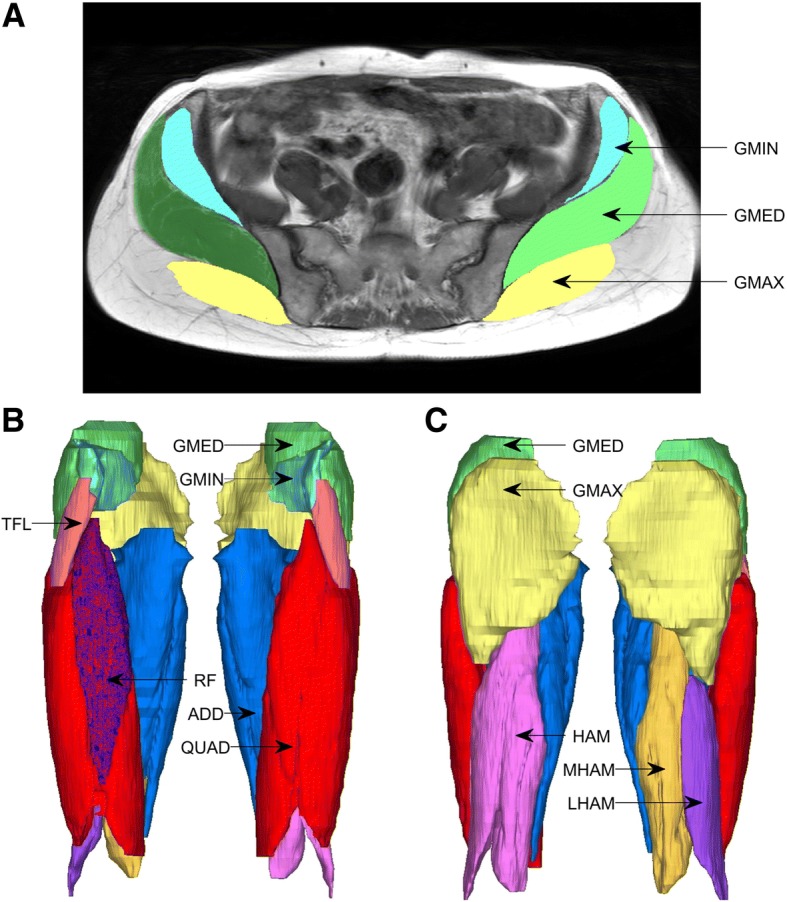
Nineteen individuals with mild-to-moderate symptomatic and radiographic hip OA (n = 12 unilateral; n = 7 bilateral) and 23 age-matched, healthy controls without radiographic hip OA or hip pain participated. Isometric strength of the hip and knee flexors and extensors, and hip abductors and adductors were measured. Hip and thigh muscle volumes were measured from lower limb magnetic resonance images. A full-factorial, two-way General Linear Model was used to assess differences between groups and between limbs.
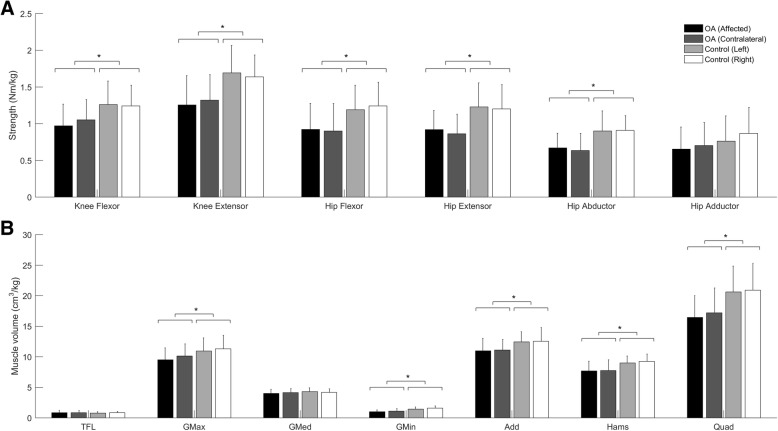
Participants in the hip OA group demonstrated significantly lower knee flexor, knee extensor, hip flexor, hip extensor and hip abductor strength compared to controls and had significantly lower volume of the adductor, hamstring and quadriceps groups, and gluteus maximus and gluteus minimus muscles, but not tensor fasciae latae or gluteus medius muscles. There were no between-limb strength differences or volume differences within either group.
Atrophic, bilateral hip and knee muscle weakness is a feature of individuals with mild-to-moderate hip OA. Early interventions to target muscle weakness and prevent the development of strength asymmetries that are characteristic of advanced hip OA appear warranted.
晚期髋骨关节炎(OA)患者患侧肢体表现出全身性肌肉无力,因此临床实践指南建议进行力量训练以管理髋OA。然而,疾病早期肌肉无力的程度和模式,包括任何肢体间的不对称情况尚不清楚。本研究比较了轻至中度有症状和影像学表现的髋OA患者与健康对照组之间的髋部和膝部肌肉力量及体积。
19例轻至中度有症状和影像学表现的髋OA患者(n = 12单侧;n = 7双侧)和23例年龄匹配、无影像学髋OA或髋部疼痛的健康对照者参与研究。测量髋部和膝部屈肌、伸肌以及髋部外展肌和内收肌的等长力量。从下肢磁共振图像测量髋部和大腿肌肉体积。采用全因素双向通用线性模型评估组间和肢体间的差异。
与对照组相比,髋OA组参与者的膝部屈肌、膝部伸肌、髋部屈肌、髋部伸肌和髋部外展肌力量明显较低,内收肌、绳肌和股四头肌组以及臀大肌和臀小肌的体积明显较小,但阔筋膜张肌或臀中肌体积无明显差异。两组内均无肢体间力量差异或体积差异。
萎缩性双侧髋部和膝部肌肉无力是轻至中度髋OA患者的一个特征。针对肌肉无力并预防晚期髋OA特征性的力量不对称发展的早期干预似乎是必要的。