Department of Developmental and Stem Cell Biology, Beckman Research Institute, City of Hope Duarte, California, USA.
Irell and Manella Graduate, School of Biological Sciences, Beckman Research Institute, City of Hope Duarte, California, USA.
Stem Cells Transl Med. 2018 Oct;7(10):740-747. doi: 10.1002/sctm.18-0003. Epub 2018 Aug 21.
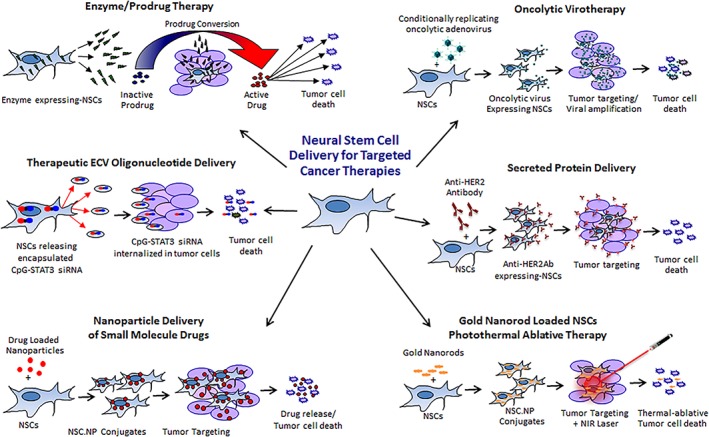
Cancer is one of the leading causes of morbidity and mortality worldwide, with 1,688,780 new cancer cases and 600,920 cancer deaths projected to occur in 2017 in the U.S. alone. Conventional cancer treatments including surgical, chemo-, and radiation therapies can be effective, but are often limited by tumor invasion, off-target toxicities, and acquired resistance. To improve clinical outcomes and decrease toxic side effects, more targeted, tumor-specific therapies are being developed. Delivering anticancer payloads using tumor-tropic cells can greatly increase therapeutic distribution to tumor sites, while sparing non-tumor tissues therefore minimizing toxic side effects. Neural stem cells (NSCs) are tumor-tropic cells that can pass through normal organs quickly, localize to invasive and metastatic tumor foci throughout the body, and cross the blood-brain barrier to reach tumors in the brain. This review focuses on the potential use of NSCs as vehicles to deliver various anticancer payloads selectively to tumor sites. The use of NSCs in cancer treatment has been studied most extensively in the brain, but the findings are applicable to other metastatic solid tumors, which will be described in this review. Strategies include NSC-mediated enzyme/prodrug gene therapy, oncolytic virotherapy, and delivery of antibodies, nanoparticles, and extracellular vesicles containing oligonucleotides. Preclinical discovery and translational studies, as well as early clinical trials, will be discussed. Stem Cells Translational Medicine 2018;7:740-747.
癌症是全球发病率和死亡率的主要原因之一,仅在美国,2017 年预计将有 168.878 例新的癌症病例和 60.092 例癌症死亡病例。包括手术、化疗和放疗在内的传统癌症治疗方法可能有效,但往往受到肿瘤侵袭、靶向毒性和获得性耐药性的限制。为了改善临床结果并减少毒性副作用,正在开发更具针对性、针对肿瘤的治疗方法。使用肿瘤趋向性细胞来输送抗癌有效载荷可以大大增加治疗剂在肿瘤部位的分布,同时避免非肿瘤组织,从而最大限度地减少毒性副作用。神经干细胞(NSC)是一种肿瘤趋向性细胞,能够快速穿过正常器官,定位于全身侵袭性和转移性肿瘤病灶,并穿过血脑屏障到达大脑中的肿瘤。本综述重点介绍了 NSC 作为载体将各种抗癌有效载荷选择性递送至肿瘤部位的潜在用途。NSC 在癌症治疗中的应用已在大脑中进行了最广泛的研究,但这些发现适用于其他转移性实体瘤,本综述将对此进行描述。策略包括 NSC 介导的酶/前药基因治疗、溶瘤病毒治疗以及抗体、载有寡核苷酸的纳米颗粒和细胞外囊泡的递送。将讨论临床前发现和转化研究以及早期临床试验。Stem Cells Translational Medicine 2018;7:740-747.