Kuroki Lindsay M, Jin Xingjian, Dmitriev Igor P, Kashentseva Elena A, Powell Matthew A, Mutch David G, Dietz Allan B, Curiel David T, Hawkins William G, Spitzer Dirk
Division of Gynecologic Oncology, Department of Obstetrics and Gynecology, Washington University School of Medicine, St. Louis, MO, United States of America.
Alvin J. Siteman Cancer Center, St. Louis, MO, United States of America.
PLoS One. 2017 Dec 21;12(12):e0190125. doi: 10.1371/journal.pone.0190125. eCollection 2017.
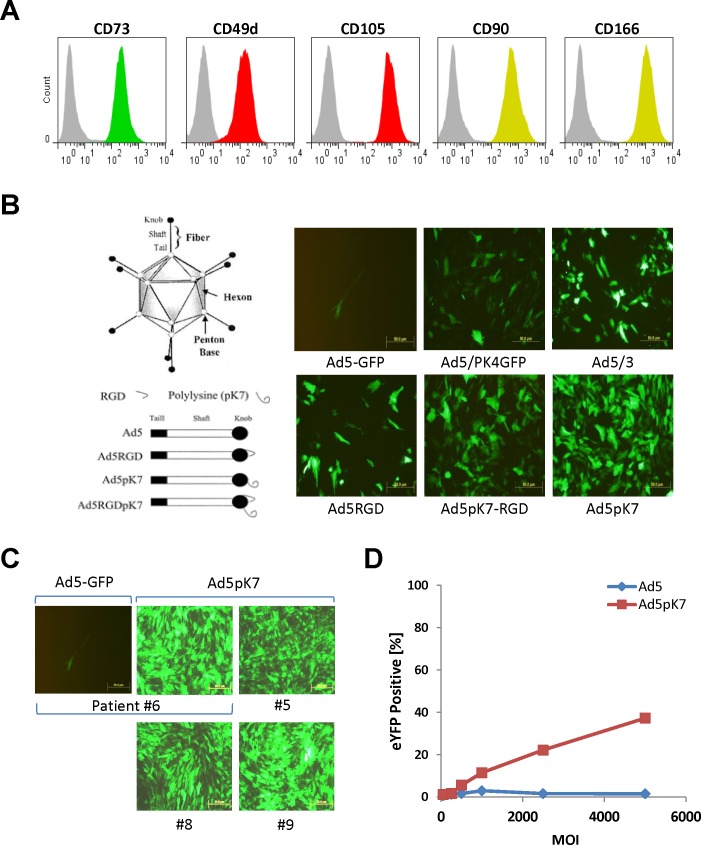
Clinical application of tumor necrosis factor-related apoptosis-inducing ligand (TRAIL)-based cancer therapeutics has not reached optimal potencies in part due to inadequate drug stability and inefficiencies in cancer-selective drug delivery. As such, innovative strategies regarding drug design and delivery are of utmost importance to achieve improved treatment results. With our current study, we aimed at exploring the groundwork for a two-stage targeting concept, which is based on the intrinsic tumor homing capacity of mesenchymal stem cells (MSCs) as cellular drug factories for the in situ production of our newly designed and biomarker-targeted TRAIL-based TR3 therapeutics. Since MSCs are primary cells, capable in vitro of only a limited number of cell divisions, identification of suitable strategies for their efficient genetic manipulation is of critical importance. We chose adenoviral (Ad) vectors as a transduction vehicle due to its ability to infect dividing and non-dividing cells and because of their limited restrictions regarding the packaging capacity of their genetic payload. In order to enhance the transduction efficacy of MSCs using Ad5 wild-type-based vectors, we tested a variety of fiber knob modifications on a panel of patient-derived MSC lines established from adipose tissue. We identified Ad5pK7, an Ad5 vector containing a polylysine fiber knob modification, exhibiting the highest transduction rates across a panel of 16 patient-derived MSC lines. We further demonstrated that MSCs could be efficiently transduced with an Ad5pK7 vector containing membrane-anchored and secreted TR3 expression units, including the MUC16 (CA125)-targeted variant Meso64-TR3. In both in vitro and in vivo experiments, MSC-derived Meso64-TR3 was far more potent on MUC16-expressing ovarian cancer compared to its non-targeted TR3 counterpart. Our findings thus provide the foundation to initiate further preclinical investigations on MSC-mediated treatment options in ovarian cancer using biomarker-targeted TR3-based biologics.
基于肿瘤坏死因子相关凋亡诱导配体(TRAIL)的癌症治疗药物的临床应用尚未达到最佳疗效,部分原因是药物稳定性不足以及癌症选择性药物递送效率低下。因此,关于药物设计和递送的创新策略对于实现更好的治疗效果至关重要。在我们当前的研究中,我们旨在探索一种两阶段靶向概念的基础,该概念基于间充质干细胞(MSC)的内在肿瘤归巢能力,将其作为细胞药物工厂用于原位生产我们新设计的、基于生物标志物靶向的TRAIL的TR3治疗药物。由于MSC是原代细胞,体外仅能进行有限次数的细胞分裂,因此确定适合其高效基因操作的策略至关重要。我们选择腺病毒(Ad)载体作为转导工具,因为它能够感染分裂和非分裂细胞,并且对其基因载荷的包装容量限制有限。为了提高使用基于Ad5野生型载体对MSC的转导效率,我们在一组从脂肪组织建立的患者来源的MSC系上测试了多种纤维结修饰。我们鉴定出Ad5pK7,一种包含聚赖氨酸纤维结修饰的Ad5载体,在一组16个患者来源的MSC系中表现出最高的转导率。我们进一步证明,含有膜锚定和分泌型TR3表达单元(包括靶向MUC16(CA125)的变体Meso64-TR3)的Ad5pK7载体能够有效地转导MSC。在体外和体内实验中,与非靶向的TR3对应物相比,MSC来源的Meso64-TR3对表达MUC16的卵巢癌的作用要强得多。因此,我们的研究结果为使用基于生物标志物靶向的TR3生物制剂对卵巢癌进行MSC介导的治疗选择开展进一步的临床前研究奠定了基础。